

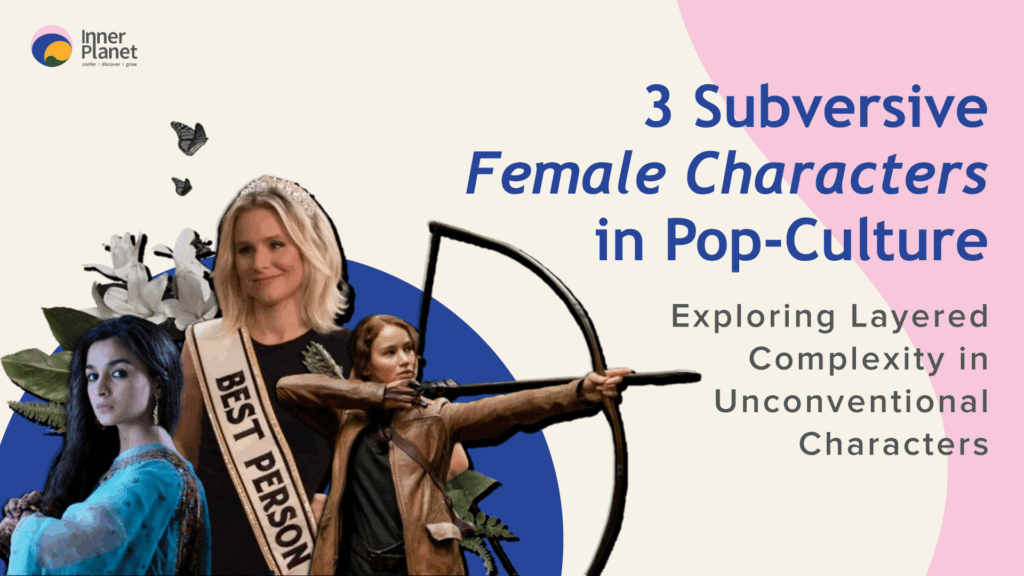
Why do subversive Female Characters on screen matter?
Pop culture often gives us strong women — but the most intriguing ones don’t just carry weapons or wisdom; they rewrite the rules. From dystopias to moral comedies to espionage thrillers, certain characters break the mould of what women are expected to be. This isn’t rebellion for rebellion’s sake. It’s something more human: the messy yet meaningful process of choosing who to be.
So why look at subversiveness?
Subversiveness means questioning or pushing against dominant norms. In pop culture, that could mean a woman rejecting a binary of good/bad, or choosing truth over loyalty, or agency over likeability. These aren’t just provocative choices; they truthfully reflect real psychological tensions around identity, resilience, and morality. For viewers, such characters can act as mirrors — not of perfection, but of realistic complexity.
Let’s explore three such women: a revolutionary, a spy, and a grifter-turned-moral-philosopher.
1. Katniss Everdeen: Revolution Without Glory
“The Hunger Games”
If you’ve watched The Hunger Games films (or read the bestselling novels), you’ll recall a bleak future where children are forced to fight to the death for entertainment. Katniss, a teenager from the impoverished District 12, volunteers to replace her younger sister in the deadly games.
Katniss doesn’t start out trying to change the world. She just wants to keep her sister alive. Thrust into a violent, voyeuristic spectacle, she becomes a reluctant symbol of rebellion. But what makes her subversive is not just defying the Capitol — it’s how she defies gendered expectations and unidimensional narrative habits.
Katniss is not sexualised or sentimentalised. Her emotional palette includes fear, anger, guilt and protectiveness — not traits traditionally glorified in female leads. She refuses to play by the Capitol’s performative rules: her alliance with Rue, the berry stunt, and her complicated relationship with Peeta all speak to defiance with layers.
Psychologically, she reflects the complexity of reluctant heroism. Her experiences of trauma and deep-rooted survival instincts influence how she navigates her world. As the symbol of the Mockingjay, she carries both personal and political weight — not as a flawless saviour, but as a young woman shaped by extraordinary demands. This makes her subversive: she shows that leadership can coexist with vulnerability, and that strength often emerges from inner conflict.
2. Sehmat Khan: Loyalty in Disguise
“Raazi” (based on Calling Sehmat)
In Raazi, based on true events, we meet Sehmat Khan, a young Kashmiri woman thrust into the world of espionage during the 1971 India-Pakistan war. She marries a Pakistani army officer to spy for India — a mission that forces her into constant danger, emotional conflict, and moral ambiguity.
Sehmat’s story is about duty at all costs — but not in any traditional sense. Sehmat moves through a world of secrecy, manipulation, and quiet resistance. Her strength lies not in confrontation, but in concealment.
Subversively, Sehmat disrupts the trope of the passive patriot or obedient daughter. Her actions are driven by familial loyalty and national duty, yet they defy the soft-spoken, sacrificial woman archetype. She deceives not out of malice, but necessity. This duality makes her morally complex.
Her psychological landscape is rich with conflict. Living undercover erodes her sense of self; her relationships become battlegrounds for loyalty versus love. Rather than glorifying espionage, her story reveals its psychological toll: trauma, identity fragmentation, and emotional numbness. Sehmat is a reminder that courage can come cloaked in silence.
3. Eleanor Shellstrop: The Ethics of Being Human
“The Good Place”
The Good Place starts with a woman waking up in the afterlife and being told she’s in heaven — but realising quickly she doesn’t belong there. That woman is Eleanor Shellstrop: rude, selfish, funny, and deeply flawed. She knows it, too — which sets her journey apart from the start.
When Eleanor realises she’s there by mistake, she doesn’t try to escape or fool the system. Instead, she makes the decision to become a better person — even if she doesn’t quite know what that means yet. It’s a choice that’s driven by self-interest at first, but gradually becomes more genuine. Along the way, she makes friends, takes philosophy lessons, faces moral dilemmas, and uncovers deeper layers of the afterlife itself.
Her subversiveness lies in rejecting the idea that personal growth must follow a neat, virtuous path. Eleanor doesn’t transform overnight, nor does she become angelic. She questions, stumbles, lies, confesses, backtracks, and tries again. She shows that goodness isn’t a fixed trait — it’s a series of decisions that accumulate through effort and self-awareness.
The show gently but powerfully pushes back against moral absolutes. Eleanor’s arc reminds us that growth often starts with self-honesty and that being a better person isn’t about being perfect — it’s about being willing. In therapy terms, her story reflects how meaningful change happens over time, in fits and starts, often spurred by connection, insight, and the courage to keep trying. Her journey is funny, painful, and deeply human — a refreshingly real take on what it means to become someone new.
Katniss, Sehmat, and Eleanor each challenge what we’re often told women in stories should be. Katniss resists being turned into a spectacle or symbol on someone else’s terms. Sehmat quietly dismantles norms from within a system that demands her silence. Eleanor learns to change not by erasing who she is, but by learning from it. These aren’t just variations of defiance; they’re reflections of how different the path to selfhood can look. None of them are easy to categorise, and that’s precisely the point — their complexity helps us rethink the stories we tell about strength, goodness, and change.
By following their stories, we begin to see how psychological growth is rarely straightforward. There are costs to resistance — exhaustion, doubt, guilt — but also clarity, connection, and courage. Each character’s journey invites us not only to empathise, but to reflect on our own internal tensions: the push and pull between roles we’re given and the selves we’re becoming. In a world still full of rigid scripts for women, these stories make space for nuance. And if you’re ever looking to explore your own path more deeply — sparked by fiction or life — we’re always just a call away!
References
- Álvarez, A. (2018). Katniss Everdeen: A new female role model in The Hunger Games film series. University of Oviedo]. https://doi.org/10.25772/QJ4T-DC64
- Ardi, V., & Hidayat, B. (2018). Katniss Everdeen’s character development in Suzanne Collins’ The Hunger Games Trilogy. Lexicon, 5. https://doi.org/10.22146/lexicon.v5i1.41265
- Jen. (2019, October 30). Eleanor Shellstrop’s character development. The Good Place Blog. Penn State University. Retrieved August 16, 2025, from https://sites.psu.edu/jenthegoodplace/2019/10/30/eleanor-shellstrops-character-development
- Kaur, A. (2020). The Good Place: Utopia or dystopia? https://www.melow.in/public/assets/uploads/article/67.pdf
- Knowledge Lost. (2017, November 13). The Good Place and ethics. Medium. Retrieved August 16, 2025, from https://medium.com/@knowledgelost/the-good-place-and-ethics-3efc64e1bcf6
- Nocturnal Mind. (n.d.). A study in character: Eleanor Shellstrop. The Streetlight. Retrieved August 16, 2025, from https://www.nocturnalmind.net/the-streetlight/a-study-in-character-eleanor-shellstrop
- Our Movie Life. (2018, January 31). The character of Eleanor Shellstrop. Retrieved August 16, 2025, from https://www.ourmovielife.com/2018/01/31/the-character-of-eleanor-shellstrop
- Sikka, H. (2008). Calling Sehmat. New Delhi, India: Penguin Books.
- Wikipedia. (n.d.). The Good Place. In Wikipedia. Retrieved August 16, 2025, from https://en.wikipedia.org/wiki/The_Good_Place