

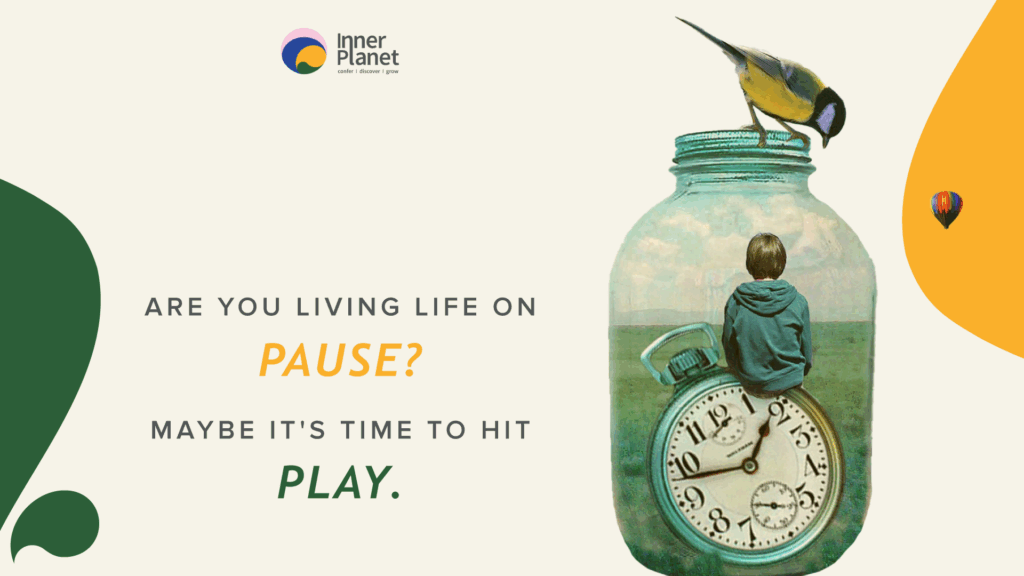
“I’ll Do It When the Time Is Right!”
Raise your hand if you’ve ever said this before delaying something important. Many of us press pause on our lives, waiting for the perfect moment to take that next step—whether it’s pursuing a dream, starting a project, or making a change in our personal lives.
On the surface, waiting can feel sensible. After all, thoughtful timing and preparation have their place. But research suggests that when waiting becomes a pattern of fear or avoidance, the “perfect moment” often proves to be an illusion. More often than not, delay born from self-doubt or perfectionism keeps us stuck, while taking even small steps forward brings progress and fulfilment (Steel, 2007).
Here we’ll explore why we sometimes wait out of fear, what it costs us, and how taking action now—even if it’s imperfect—can open doors we’ve been longing to walk through.
Why We Keep Waiting
Perfectionism and Procrastination
Not all waiting is harmful. Often, pausing allows us to prepare or reflect. But when waiting is fuelled by perfectionism, it can quietly hold us back.
Procrastination isn’t laziness—it’s often a shield against fear. For many, the fear of not doing something “well enough” leads to hesitation. Research shows that people with strong perfectionistic concerns are more likely to procrastinate, caught in the uncomfortable gap between who they are now and who they feel they “should” be (Smith et al., 2017). Another study found that when people felt pressured to live up to others’ expectations, they delayed even more, worried about letting others down (Sommantico et al., 2024).
In these moments, waiting feels like self-protection. But it also quietly costs us growth, experience, and the chance to make mistakes from which we can actually learn.
The Psychology of Inaction
Why do our minds sometimes choose hesitation over doing? Several unhelpful mental habits make inaction tempting:
- Present Bias: We value comfort now more than benefits later. For example, we may avoid a difficult task today because “tomorrow will be better,” but tomorrow rarely feels any different (O’Donoghue & Rabin, 1999).
- Status Quo Bias: We prefer what’s familiar, even if it isn’t fulfilling. Change feels risky, so we stick with what we know (Samuelson & Zeckhauser, 1988).
- Neglect of Opportunity Costs: When we delay, we focus on what we avoid but overlook what benefits we can gain. For instance, postponing a course may feel like saving money, but it also delays new skills and opportunities (Frederick et al., 2009).
These patterns make waiting feel safe in the moment. But when fear or avoidance drives them, they often leave us stuck in place, keeping us from pursuing opportunities that could bring growth and satisfaction.
Regret: The Cost of Fearful Waiting
In the moment, acting can feel riskier than waiting. But research shows that in the long run, it is inaction—especially when it stems from unwholesome patterns—that weighs most heavily. People tend to recover from mistakes they make, but the chances they never took can linger painfully in memory (Gilovich & Medvec, 1995).
This was confirmed in a large public survey, which found that short-term regrets often relate to actions, while long-term regrets are mostly about inaction (Richardson & Gilovich, 2023).
Real-life examples highlight this: in one study of people undergoing fertility treatment, many participants expressed regret about waiting too long before seeking help, and those who did so reported lower life satisfaction (Adachi et al., 2020).
The point here is not that waiting itself is bad. Sometimes pausing is wise and necessary. Rather, it illustrates how postponing important decisions—when fear, doubt, or avoidance is in the driver’s seat—can leave regrets that last longer than the fear of trying.
Action Creates Momentum
Many of us believe we need to feel motivated before we can act. Yet psychology suggests the opposite: taking action is what creates motivation.
This principle is central to behavioural activation therapy, which shows that engaging in small, simple actions—like going for a walk, tidying a corner of your room, or writing just one paragraph—can boost mood and build momentum (Dimidjian et al., 2006).
A meta-analysis confirmed this: taking even small steps reduces procrastination and helps people feel more capable and confident (van Eerde & Klingsieck, 2018).
The message is clear: thoughtful pauses are valuable, but don’t wait endlessly for motivation to appear. Taking one small step today—even if it feels imperfect—creates energy for the next.
Hitting Play
It’s natural to wait when life feels uncertain. Pausing to reflect, prepare, or rest can be healthy. But when waiting comes from fear, perfectionism, or avoidance, it often leads to missed opportunities and long-term regret. Action—even small, imperfect action—can break the cycle and build confidence.
Here are some practical strategies to “hit play” when you find yourself stuck on pause:
- Start small: Break down a big task into the smallest possible step and begin there.
- Set time limits: Give yourself just 10 minutes to start. Often, beginning is the hardest part.
- Reframe mistakes: See them as lessons rather than failures—they’re signs of progress, not proof of inadequacy. You can read our blog on dealing with mistakes for a deeper dive.
- Focus on opportunity, not fear: Instead of asking “What if I fail?”, ask “What can I learn?”
- Celebrate progress: Each small action deserves recognition. Acknowledging steps taken builds motivation for the next.
Life isn’t lived on pause—it unfolds when we press play. The first step doesn’t have to be perfect; it just has to be taken. By starting now, in small and manageable ways, you can create momentum for change that you want and open the door to the future you’ve been waiting for.
And if you need help un-pausing, remember—you don’t have to do it alone. We’re always just a call away.
References
- Adachi, T., Endo, M., & Ohashi, K. (2020). Regret over the delay in childbearing decision negatively associates with life satisfaction among Japanese women and men seeking fertility treatment: A cross-sectional study. BMC Public Health, 20, 886. https://doi.org/10.1186/s12889-020-09025-5
- Dimidjian, S., Hollon, S. D., Dobson, K. S., Schmaling, K. B., Kohlenberg, R. J., Addis, M. E., Gallop, R., McGlinchey, J. B., Markley, D. K., Gollan, J. K., Atkins, D. C., Dunner, D. L., & Jacobson, N. S. (2006). Randomized trial of behavioral activation, cognitive therapy, and antidepressant medication in the acute treatment of adults with major depression. Journal of Consulting and Clinical Psychology, 74(4), 658–670. https://doi.org/10.1037/0022-006X.74.4.658
- Frederick, S., Novemsky, N., Wang, J., Dhar, R., & Nowlis, S. (2009). Opportunity cost neglect. Journal of Consumer Research, 36(4), 553–561. https://doi.org/10.1086/599764
- Gilovich, T., & Medvec, V. H. (1995). The experience of regret: What, when, and why. Psychological Review, 102(2), 379–395. https://doi.org/10.1037/0033-295X.102.2.379
- O’Donoghue, T., & Rabin, M. (1999). Doing it now or later. American Economic Review, 89(1), 103–124. https://doi.org/10.1257/aer.89.1.103
- Richardson, J., & Gilovich, T. (2023). A very public replication of the temporal pattern to people’s regrets. Royal Society Open Science, 10(6), 221574. https://doi.org/10.1098/rsos.221574
- Samuelson, W., & Zeckhauser, R. (1988). Status quo bias in decision making. Journal of Risk and Uncertainty, 1(1), 7–59. https://doi.org/10.1007/BF00055564
- Smith, M. M., Sherry, S. B., Saklofske, D. H., & Mushquash, A. R. (2017). Clarifying the perfectionism–procrastination relationship using a 7-day, 14-occasion daily diary study. Personality and Individual Differences, 112, 117–123. https://doi.org/10.1016/j.paid.2017.02.059
- Sommantico, M., Postiglione, J., Fenizia, E., & Parrello, S. (2024). Procrastination, perfectionism, narcissistic vulnerability, and psychological well-being in young adults: An Italian study. International Journal of Environmental Research and Public Health, 21(8), 1056. https://doi.org/10.3390/ijerph21081056
- Steel, P. (2007). The nature of procrastination: A meta-analytic and theoretical review of quintessential self-regulatory failure. Psychological Bulletin, 133(1), 65–94. https://doi.org/10.1037/0033-2909.133.1.65
- van Eerde, W., & Klingsieck, K. B. (2018). Overcoming procrastination? A meta-analysis of intervention studies. Educational Research Review, 25, 73–85. https://doi.org/10.1016/j.edurev.2018.09.002