

Have you ever chased a goal like your life depended on it? Or found it impossible to relax on holiday unless you tick something off your to-do list?
In today’s world, we’re constantly reminded to “work harder,” “stand out,” and “be the best.” It’s no surprise that so many of us end up not feeling enough — as though our value depends entirely on what we achieve or how others respond to us.
This belief — that our worth must be earned — is a modern myth. It suggests that unless we’re doing something remarkable, we don’t deserve happiness, respect, or even self-acceptance. Psychologists call this conditional self-worth — the belief that we are only as good as our last success (Neff, 2011; Crocker & Wolfe, 2001).
Let’s explore where this belief comes from, how it quietly shapes our thoughts and relationships, what it costs us emotionally, and how embracing inherent worth — the idea that one is “enough” simply because they exist — can free us from the exhausting cycle of proving ourselves.
The Cultural Blueprint: How Society Shapes Our Self-Worth
The idea of “earning” worth is deeply woven into modern life. In most societies, especially those built on competition and individualism, worth is treated as something that can be measured. In India, we often measure it through All India Ranks, salaries, luxury goods, the size of one’s home, or even the grandeur of a wedding — the list is endless, and increasingly alarming.
Hard work and success are framed as moral virtues, while those who achieve them are seen as more deserving. The message isn’t always spoken aloud, but it’s everywhere: in slogans like “Just Do It” or “Impossible Is Nothing”, in hashtags such as #HustleCulture and #NoDaysOff, and in the way we treat exhaustion as proof of dedication. We’re taught that pushing harder is strength and that slowing down means we’re falling behind.
This belief doesn’t just shape motivation — it shapes admiration. We instinctively defer to people who earn more or hold higher titles, as though status automatically equals worth. That quiet hierarchy — the unspoken ranking of human value — reveals how deeply this mindset runs.
But research suggests all that chasing and acquiring isn’t enough. Psychologists Tim Kasser and Richard Ryan (1996) found that the more people chase external goals like money, image, and status, the less fulfilled they feel. It’s not that ambition is wrong; it’s that when self-worth is tied to external rewards, contentment always seems one achievement away. Many people live in that space — almost happy, almost enough. And perhaps what makes this mindset so hard to shake is that we learned it long before we even realised we were being taught.
Early Conditioning: When Love Becomes Conditional
Most of us don’t start out believing our worth is conditional — we learn it. In childhood, approval and affection are powerful currencies. When parents, teachers, or caregivers reward us for “good” behaviour or success but withdraw warmth when we fail, we absorb the message that love must be earned.
Think about moments when you were praised for excelling — the gold star at school, the smile from a proud parent — or scolded for underperforming. These experiences shape behaviour & identity. They teach us to associate achievement with acceptance and mistakes with rejection. Be good to be loved, be bad to be trashed.
Carl Rogers (1959) called these conditions of worth — invisible rules we internalise, such as “I’m only lovable when I succeed,” or “I matter only if I please others.” Over time, they become part of our inner voice. Even as adults, we may hear echoes of them in our self-talk after failure or conflict.
Crocker and Wolfe (2001) described how people base their self-esteem on particular “domains” — like appearance, approval, or success. When things go well in these areas, confidence rises. When they don’t, it collapses. This is why a single negative comment, a missed promotion, or even a friend’s silence can sting disproportionately — it doesn’t just challenge our abilities; it threatens our sense of being “enough”.
The Psychological Trap: Why We Chase Worth
The cycle of chasing worth is hard to break because it gives temporary relief. Every small win — a compliment, a good grade, a new follower — quiets the self-doubt for a moment. But the remedy doesn’t last. Before long, the inner critic returns, whispering: “What have you done lately?”
Psychologists call this introjected motivation — when we act not because we truly want to, but because we fear the guilt or shame of not meeting expectations (Assor et al., 2004). It’s why we might say yes to extra work we don’t enjoy, push through exhaustion to prove reliability, or feel guilty for resting. We’re not chasing success anymore; we’re avoiding disapproval.
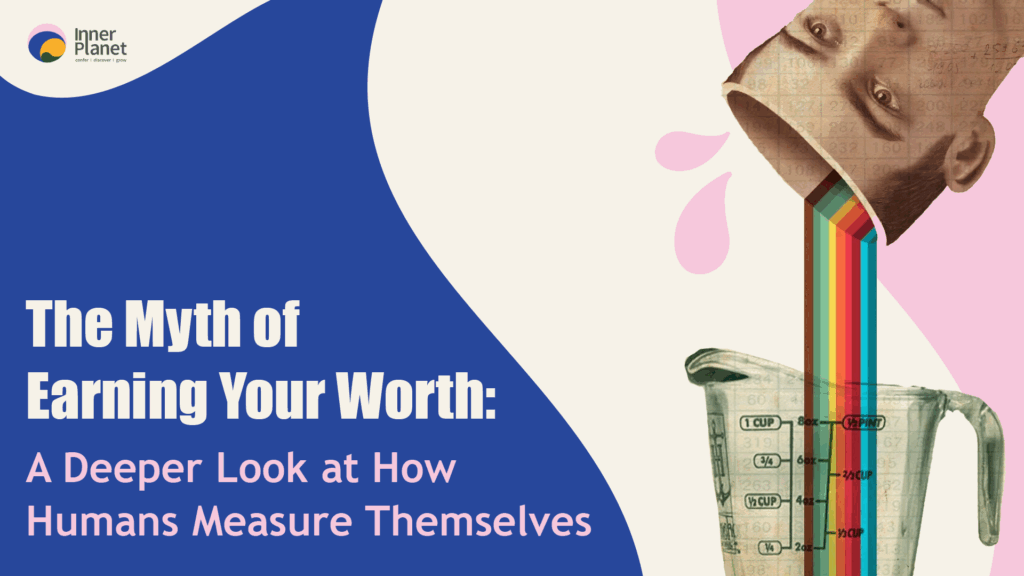
Crocker and Park (2004) noted that people driven by contingent self-worth— the belief that one’s value depends on achievements, appearance, or approval— tend to mistake validation for fulfilment. Each success soothes insecurity but doesn’t heal it. It’s like refilling a leaking cup — no matter how much we pour in, it never stays full.
We often rationalise this cycle as “being ambitious” or “wanting to improve.” But there’s a crucial difference between growth and self-punishment. One comes from curiosity; the other from fear.
The Price of Conditional Worth: Emotional and Mental Strain
When self-worth depends on performance, life becomes a constant test. A good day at work, a kind comment, or a social achievement can lift our mood — but one setback can send us spiralling. We start living on emotional rollercoasters powered by approval.
Blom (2012) found that this kind of performance-based self-esteem was one of the strongest predictors of burnout in working adults — more than long hours or workload itself. The emotional exhaustion doesn’t come from effort alone but from the constant fear of not being enough.
Children raised under conditional approval often carry that fragility into adulthood. Assor et al. (2004) found that such individuals experience higher shame and emotional instability. They may feel loved when they succeed but rejected when they fail. As adults, this translates into perfectionism, overthinking, and a suppressed panic that any mistake might expose their flaws.
Perfectionists often describe living with a double edge: the drive to excel fuels success but also erodes joy. Achievements feel hollow because they’re motivated by anxiety, not passion. Even praise can feel uncomfortable — not because it isn’t deserved, but because it raises the stakes.
This emotional pattern often leads to impostor syndrome: the sense of being a fraud despite evidence of competence (Mees, 2020). When worth is conditional, no achievement feels safe enough to rest on. The goalpost always moves.
Relationships Under Pressure: When Worth Depends on Validation
Conditional self-worth doesn’t stay confined to our inner world — it leaks into how we relate to others. When we believe love must be earned, connection becomes performance. We may try to “deserve” affection by being overly helpful, agreeable, or successful, fearing that showing imperfection might cost us our love.
Park and Crocker (2004) observed that students who tied their worth to grades became less empathetic when they failed, focusing on self-criticism rather than connection. It’s a telling pattern: when self-worth feels fragile, compassion shrinks. We become too preoccupied with self-doubt to truly see others.
The same dynamic can strain romantic relationships. Ward et al. (2020) found that people who equated their worth with financial success had more arguments and less satisfaction in their relationships. It wasn’t about money — it was about insecurity. When love feels conditional, partners can feel pressured to constantly “prove” their value, creating cycles of resentment and emotional distance.
Over time, conditional worth can make relationships feel unsafe — we hide our flaws, suppress our needs, and overextend ourselves just to be accepted. Ironically, these defences keep us from the very intimacy we crave.
Reclaiming Inherent Worth: Acceptance Without Conditions
Imagine living with the quiet confidence that nothing we do or fail to do could make us less worthy. This is what Carl Rogers (1959) called unconditional positive regard — the belief that everyone deserves acceptance and empathy, not because they’re perfect, but because they’re human.
When people experience this kind of acceptance— from a therapist, friend, or partner— something shifts. They begin to extend that same kindness inward. The inner critic softens, and the self becomes less divided between who we are and who we think we should be.
Kristin Neff’s (2011) work on self-compassion builds on this. She found that people who treat themselves kindly during failure are more resilient, less anxious, and more motivated to grow. Self-compassion isn’t undeserved indulgence— it’s psychological grounding. It says, “I’m allowed to be human. I am human”
Inherent worth doesn’t remove ambition; it restores balance. When we’re not terrified of failure, we can take risks. When we’re not trying to prove our value, we can focus on what genuinely matters. We start striving from wholeness, not for it.
The Shift in Motivation: From Proving to Becoming
When we stop running to prove ourselves, our energy transforms. Motivation shifts from avoidance to aspiration. Psychologists call this autonomous motivation — pursuing goals because they align with our values and interests, not because we fear judgment (Assor et al., 2004).
Kasser and Ryan (1996) found that people who prioritise intrinsic goals like learning, connection, and contribution report higher life satisfaction and lower anxiety. The difference lies in intention: doing something “for ourselves” instead of “to validate ourselves”.
This doesn’t mean giving up ambition — it means changing from fossil fuel to sustainable & renewable energy. We can still work hard, dream big, and set goals. But we’re doing it from a place of security, not scarcity. Success becomes an expression of our growth, not a measure of our worth.
Redefining Success: Lessons from Culture
Not every culture ties self-worth to personal achievement. Heine et al. (1999) found that in many East Asian societies, people place less emphasis on individual self-esteem and more on collective harmony. In such environments, worth is rooted in belonging and contribution rather than competition.
While this approach has its own complexities, it shows something vital: the way we define worth is learned, not fixed. Western cultures often glorify independence and comparison; others value connection and cooperation. Both perspectives reveal that self-worth isn’t a universal formula — it’s also a cultural story.
And that’s good news — because stories can be rewritten. We can choose to measure worth not by productivity or praise, but by presence, empathy, and authenticity.
A Note on Balance
None of this means children shouldn’t be taught the difference between right and wrong, or that success and ambition are somehow harmful. Goals, discipline, and achievement give life structure and meaning. What we’re questioning isn’t the pursuit itself — it’s the rigidity behind it. When motivation turns into self-punishment, or when our worth rises and falls on outcomes, we lose sight of the person beneath the performance.
Even the tallest buildings are designed with a degree of flexibility so they can withstand strong winds without breaking apart. Human beings are no different. We need a little give in our beliefs — room for rest, failure, and imperfection — so that growth doesn’t cost us our peace.
There is a better way to strive: one that blends compassion with ambition, and achievement with acceptance. When we learn to move with that balance, we don’t become less driven — we simply stop staking our self-worth on the result. It’s a shift from proving to being — a reminder that we can still aim high without treating self-worth as collateral.
The belief that worth must be earned keeps many of us running in circles — always chasing, never arriving. But the truth is quieter, and far more powerful: we don’t need to earn our worth. We already have it. We were born with it.
When we stop tying our value to success, we don’t lose ambition — we gain freedom. We can fail without falling apart, succeed without arrogance, and love without fear. Research shows that unconditional self-acceptance builds stronger mental health, deeper relationships, and a more stable sense of self (Neff, 2011; Rogers, 1959).
We don’t need to prove that we’re enough— we already are. And remembering that may be the most meaningful success of all.
And if you need help via self-esteem therapy, we’re always just a call away!
References
- Assor, A., Roth, G., & Deci, E. L. (2004). The emotional costs of parents’ conditional regard: A self-determination theory analysis. Journal of Personality, 72(1), 47–88. https://doi.org/10.1111/j.0022-3506.2004.00256.x
- Blom, V. (2012). Contingent self-esteem, stressors and burnout in working women and men. Work, 43(2), 123–131. https://doi.org/10.3233/WOR-2012-1366
- Bravata, D. M., Watts, S. A., Keefer, A. L., Madhusudhan, D. K., Taylor, K. T., Clark, D. M., Nelson, R. S., Cokley, K. O., & Hagg, H. K. (2020). Prevalence, predictors, and treatment of impostor syndrome: A systematic review. Journal of General Internal Medicine, 35(4), 1252–1275. https://doi.org/10.1007/s11606-019-05364-1
- Crocker, J., & Park, L. E. (2004). The costly pursuit of self-esteem. Psychological Bulletin, 130(3), 392–414. https://doi.org/10.1037/0033-2909.130.3.392
- Crocker, J., & Wolfe, C. T. (2001). Contingencies of self-worth. Psychological Review, 108(3), 593–623. https://doi.org/10.1037/0033-295X.108.3.593
- Heine, S. J., Lehman, D. R., Markus, H. R., & Kitayama, S. (1999). Is there a universal need for positive self-regard? Psychological Review, 106(4), 766–794. https://doi.org/10.1037/0033-295X.106.4.766
- Kasser, T., & Ryan, R. M. (1996). Further examining the American Dream: Differential correlates of intrinsic and extrinsic goals. Personality and Social Psychology Bulletin, 22(3), 280–287. https://doi.org/10.1177/0146167296223006
- Kernis, M. H., & Goldman, B. M. (2006). A multicomponent conceptualization of authenticity: Theory and research. In M. P. Zanna (Ed.), Advances in Experimental Social Psychology (Vol. 38, pp. 283–357). Elsevier Academic Press. https://doi.org/10.1016/S0065-2601(06)38006-9
- Mees, L. (2020). Performance-based self-esteem can lead to anxiety and burnout. Medium. https://medium.com/invisible-illness/performance-based-self-esteem-can-lead-to-anxiety-and-burnout-e317f8588d70
- Neff, K. D. (2011). Self-compassion, self-esteem, and well-being. Social and Personality Psychology Compass, 5(1), 1–12. https://doi.org/10.1111/j.1751-9004.2010.00330.x
- Rogers, C. R. (1959). A theory of therapy, personality, and interpersonal relationships as developed in the client-centred framework. In S. Koch (Ed.), Psychology: A Study of a Science (Vol. 3, pp. 184–256). McGraw-Hill. https://www.beeleaf.com/wp-content/uploads/2017/09/rogers_chapter_in_koch-1.pdf
- Ward, D. E., Park, L. E., Walsh, C. M., Naragon-Gainey, K., Paravati, E., & Whillans, A. V. (2021). For the love of money: The role of financially contingent self-worth in romantic relationships. Journal of Social and Personal Relationships, 38(4), 1303–1328. https://doi.org/10.1177/0265407521991663