

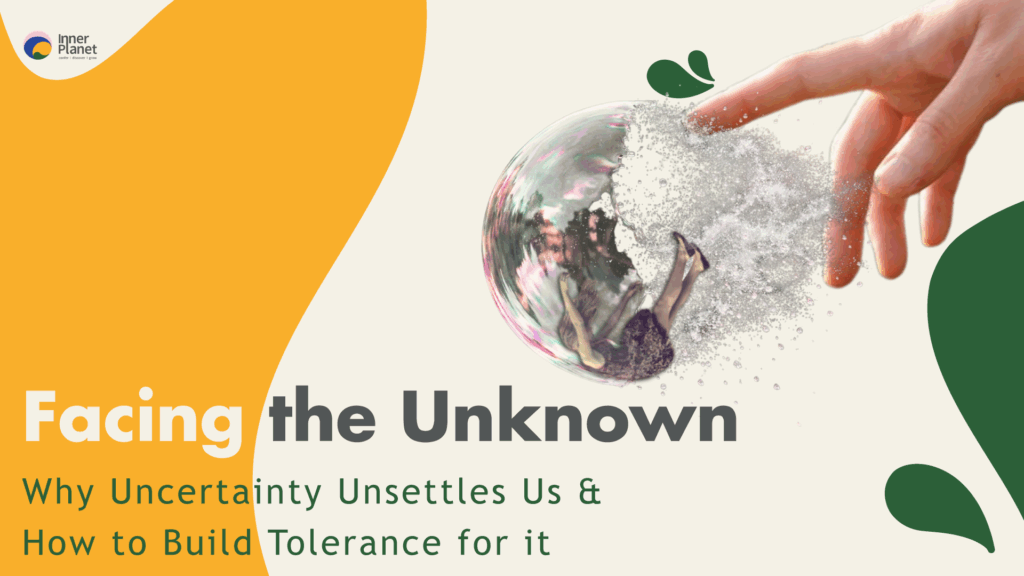
Uncertainty has a way of creeping into our lives quietly and then refusing to leave. It shows up while waiting for medical results, when a relationship begins to feel unclear, or when you find yourself stuck in a job without knowing what comes next. The mind begins its familiar pattern — endless “what if” questions, restless thoughts, difficulty sleeping, checking messages more often than usual.
If anything can happen at any moment, and we can only influence events to a limited extent, it is hardly surprising that unpredictability feels intimidating and unpleasant.
So let’s explore why uncertainty feels so intimidating from a psychological perspective. We will look at what happens in the mind when we struggle with the unknown, and consider more grounded ways to interpret uncertainty — so we can gradually make peace with it rather than constantly battle it.
Why Uncertainty Feels Intimidating
Uncertainty unsettles us because it removes stability. Even if our current situation is imperfect, it is at least familiar. The unknown, however, has no clear shape. It could improve, worsen, or stay the same — and that ambiguity is what feels threatening.
For example, when a career path becomes uncertain, it can shake not just financial security but also identity. Who am I if this plan does not work out?
Uncertainty keeps the mind on high alert. It encourages catastrophic thinking. We imagine worst-case scenarios because the brain would rather prepare for danger than be caught off guard. This constant anticipation is exhausting.
These reactions, although unpleasant, are deeply human.
The Psychology Behind The Fear
To understand why uncertainty feels so daunting, we need to understand how the brain responds to ambiguity.
Our nervous system is wired to detect threats. Predictability allows the brain to conserve energy. When outcomes are unclear, the brain struggles to assess risk. In many cases, it treats uncertainty itself as a potential danger. That is why waiting for results or clarity can feel physically uncomfortable — tight chest, racing thoughts, irritability.
There is also something known as intolerance of uncertainty. Some individuals find ambiguity particularly distressing and feel a strong urge to eliminate it quickly. This can lead to overthinking, reassurance-seeking, or compulsively analysing conversations.
The goal is deceptively simple: reduce the discomfort of not knowing.
Another factor is the illusion of control. Planning gives us psychological safety. When plans collapse or outcomes remain undefined, it exposes how little control we truly have. That realisation can feel threatening to our safety.
Uncertainty threatens both our sense of safety and our sense of control — two pillars of psychological stability.
When We Try To Escape It
Because uncertainty feels uncomfortable, we often try to escape it.
We may overplan every detail of the future. We may rush into decisions simply to end the waiting. We might remain in unhealthy dynamics because at least they are predictable. Some people constantly seek reassurance from friends, partners, or family members.
These strategies provide short-term relief. They create the illusion that something is being done. But in the long term, they reinforce the belief that ambiguity is intolerable. The more we try to eliminate it completely, the more anxious we become when it inevitably returns.
Avoidance does not remove uncertainty. It strengthens our fear of it.
A More Wholesome Interpretation
What if uncertainty is not purely a threat? What if it is also evidence that life is still unfolding?
Periods of certainty often feel comfortable, but they rarely stretch us. Uncertainty, while intimidating, is often present during transitions — new careers, evolving relationships, personal growth. It signals that something is changing.
Reframing it does not mean romanticising it. It still feels uncomfortable. However, instead of asking, “How do I control the outcome?”, we might ask, “How do I strengthen my capacity to handle the outcome?”
This shift moves us from external control to internal resilience. From prediction to presence. From fearing the unknown to trusting our ability to respond to it.
Uncertainty then becomes less about certain danger and more about open possibilities.
Building Tolerance For The Unknown
Making peace with uncertainty will not happen overnight. It requires developing tolerance for discomfort.
Emotional regulation plays a key role. Learning to sit with incomplete answers without immediately reacting builds psychological flexibility. Not every anxious thought requires action. Not every doubt needs immediate resolution.
Therapy, reflective journalling, and honest conversations can help expand our capacity to hold ambiguity. Over time, we begin to realise that uncertainty is survivable. We have endured it before. We will endure it again.
The goal is not to remove uncertainty from life. That would be impossible. The goal is to strengthen ourselves so that uncertainty no longer feels like an emergency.
You Are Not Behind
One of the most painful aspects of uncertainty is comparison. It can appear as though everyone else has clarity — stable careers, defined relationships, mapped-out futures. Social comparison can intensify feelings of insecurity and inadequacy.
Life is rarely linear. Most people are navigating their own private uncertainties. We only see the polished version.
Feeling uncertain does not mean you are failing. It means you are human and in transition. Growth rarely announces itself clearly. It often arrives disguised as confusion.
Uncertainty can feel daunting because it activates our deepest survival instincts. It challenges our need for control and stability. Yet it is also where transformations can unfold.
Making peace with uncertainty does not mean enjoying it. It means building the emotional capacity to live alongside it. When we stop fighting the unknown, we begin strengthening ourselves instead.
And if you need help building resilience in the face of uncertainty, we’re always just a call away!