

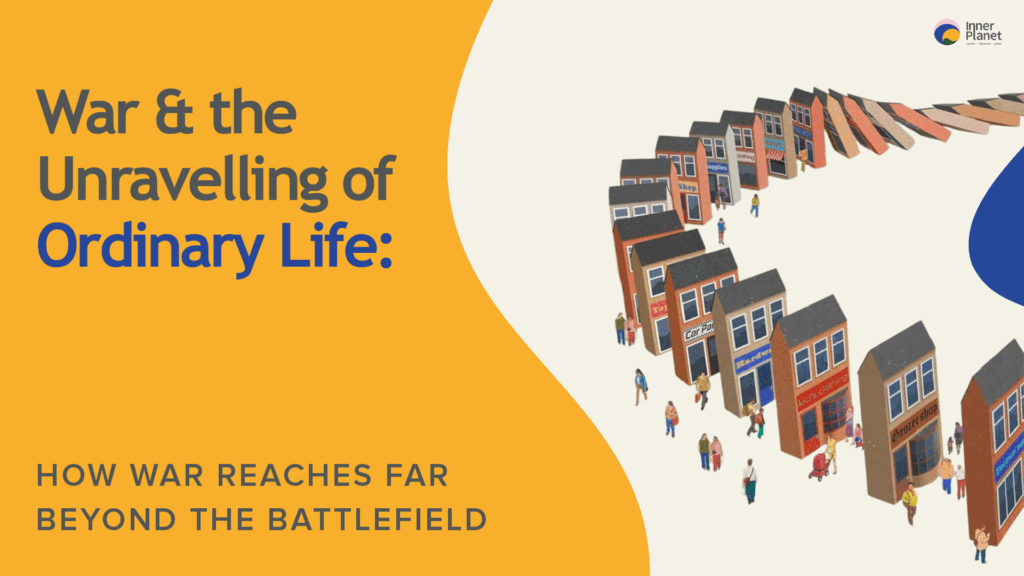
When people talk about war, they usually talk about the obvious things: missiles, borders, retaliation, military power.
Those things matter. But they can also distract us from another truth.
War does not only destroy lives in the direct sense. It also disturbs the ordinary world people rely on without thinking.
It reaches into kitchens, electricity bills, travel plans, school routines, grocery budgets, workdays, and the belief that tomorrow will be more or less manageable.
That is part of what makes war an existential threat.
It does not stop at the senseless ending of countless lives. It also damages the conditions that make life feel steady, recognisable, and worth building.
This is why even people who do not follow the news can still feel war suffocating their lives. They may not know every headline, but they certainly feel the aftershocks.
So, let’s look at how war travels beyond the battlefield, how it turns stability into strain, and how it slowly makes the future feel harder to trust.
War Does Not Remain on the Battlefield
War begins as something distant. It belongs to another country, another government, another set of people making decisions far away.
But modern life is tied together by shipping routes, fuel supplies, digital systems, trade networks, and prices that move across borders in ways most of us barely notice until something goes wrong.
That is why the effects of war rarely stays where it starts.
The current U.S.–Iran war is one example of this.
A conflict centred far from many of us can still disrupt the flow of energy and goods that on which daily life depends.
Once major routes become unstable, the effects travel outward. Fuel becomes more expensive. Supply becomes less predictable. Costs rise. Services strain.
Life does not collapse all at once, but it becomes harder to hold together.
This is one of the most disturbing things about war. It does not need to arrive as visible violence in your street to alter the terms of your life. It can do so indirectly, through systems.
And because those systems are so basic to how we live, the impact is felt not only in economies or governments, but in the mood of everyday life.
Scarcity Makes Life Smaller
One of the first ways war enters civilian life is through scarcity. Not always dramatic scarcity, not always panic, not always empty shelves.
Often it begins more quietly than that. Cooking gas becomes costlier. Fuel prices rise. Deliveries slow. Travel becomes more uncertain. Power feels less secure. What was once routine begins to require more thought, more planning, more caution.
This matters because most people do not live in geopolitical language.
They live through habits. They live through monthly budgets, domestic routines, commutes, work schedules, internet access, and the simple expectation that essential things will be there when needed.
When those essentials begin to feel less secure, something changes inside people.
Scarcity is not only a practical problem. It is also a mental burden. It makes people more watchful. More calculating. More easily worn down.
A rise in the cost of gas is never only about numbers on a bill. It can mean rethinking household expenses, adjusting plans, worrying about the next month, postponing purchases, feeling less room to breathe.
Even systems that seem distant from ordinary life matter more than they first appear to. When fuel supply is disrupted, the effects can spread into transport, delivery networks, digital services, and basic reliability.
A person does not need to understand the full mechanics of global supply chains to feel what happens when the systems around them become less dependable.
And that is where war begins to settle into the psyche.
Not always as panic. Often as pressure. A low, steady pressure.
A feeling that life requires more vigilance than it should. A sense that the margin for error has become thinner. A faint but persistent awareness that what feels normal is, in fact, more fragile than it seemed.
From Living to Enduring
There is a difference between living and enduring.
Living has openness in it. It allows room for rest, curiosity, pleasure, long-term plans, and the small freedoms people need in order to feel fully human.
Enduring is narrower. It is about coping, adjusting, and getting through. It is about making things work under strain.
War pushes life in that direction. Even for people who are not directly in combat zones, prolonged instability can make existence feel tighter and more defensive.
People begin to think in shorter timeframes. They become more preoccupied with what might go wrong. Their attention shifts from possibility to maintenance. Instead of asking what kind of future they want, they spend more energy trying to keep the present from slipping.
This narrowing has a psychological cost.
It can make people more irritable, more tired, less patient, less able to settle. It can produce a background feeling of unease that is hard to explain and easy to dismiss, especially when one is technically “safe”.
But safety is not only the absence of immediate harm. It is also the presence of enough stability to live without bracing all the time.
That is why war is so damaging even when its effects seem indirect. It teaches people to live defensively. It introduces the logic of crisis into ordinary life. Slowly, daily existence begins to revolve less around meaning and more around management.
And there is an important dignity lost in that. A dignified life is not simply a comfortable life.
It is a life in which a person can do more than react. A life in which one can trust routines, make plans, and feel that the world will hold still long enough for those plans to matter.
War weakens that trust.
The Future Starts to Feel Conditional
This is perhaps the deepest injury war causes. It does not only damage the present. It weakens faith in the future.
A future is not made only of grand ambitions.
It is made of ordinary expectations: that work will continue, that bills can be managed, that children can grow in some peace, that homes can remain homes, that tomorrow is not always at the mercy of some fresh shock.
When war disturbs the systems beneath daily life, those expectations begin to fray.
People start planning more cautiously. Institutions behave more defensively. Societies become more used to emergency language, emergency pricing, emergency thinking.
Even when there is no immediate disaster, there is a growing sense that the ground is less firm than it used to be.
This is why ceasefires, however necessary, do not instantly restore normal life. The formal pause in violence does not immediately repair the damage done to confidence, supply, or public feeling.
The material systems may still be strained. The prices may still be high. The uncertainty may still linger. And people carry that forward, often quietly, into how they think about the days ahead.
War steals from the future long before it destroys it outright. It does so by making tomorrow feel less promised and more provisional.
Why This Bleakness Matters
This is a bleak argument, and it should be. War deserves seriousness. But there is a reason to look at it this way.
If we speak about war only through military language or diplomatic language, we risk missing what it really threatens.
We risk treating it as a matter of strategy alone, when it is also a matter of ordinary human life.
We risk becoming numb to the slower forms of damage simply because they are less visible than fire and rubble.
To think carefully about war is not to surrender to despair. It is to refuse simplification. It is to remember that peace is not just the absence of active violence.
Peace is also the presence of reliability, continuity, trust, and enough stability for people to live as more than survivors.
That is worth saying plainly, because we tend to underestimate the ordinary, until it disappears.
War is an existential threat not only because it kills, but because it presses upon the basic structures that make life liveable.
It disrupts supplies, unsettles routines, narrows the mind, and makes the future harder to trust. Long before it reaches everyone as direct violence, it can reach them as strain, uncertainty, war anxiety, and a quieter kind of fear.
That is why war must be understood not only as a political or military event, but as an assault on ordinary life itself.
And ordinary life — the ability to cook a meal, make a plan, trust the week ahead, and imagine tomorrow with some measure of peace — is far more precious than we tend to notice until it is under threat.
If you need help coming to terms with these unprecedented times, we’re always just a call away!