

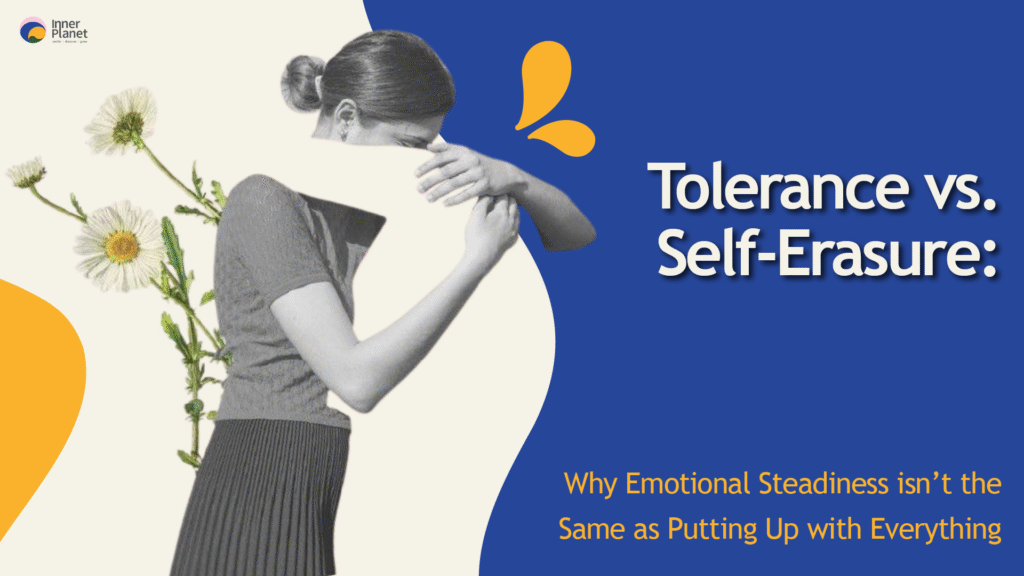
It’s good to have tolerance, but why?
Many of us grow up thinking it means staying quiet, adjusting endlessly, or proving our strength by not reacting. We are told to be patient, be mature, be understanding, be the bigger person.
Sometimes, these are helpful reminders.
At other times, they become polite ways of asking someone to ignore their own discomfort.
But tolerance is not the same as swallowing hurt.
At its healthiest, tolerance is the ability to bear discomfort without being pushed around by it. It helps us pause before we react, think before we decide, and recognise the difference between a difficult feeling and a damaging situation.
So, let’s look at what tolerance really means, why discomfort can feel so urgent, when tolerance becomes unhealthy, and how to build steadiness without losing your boundaries.
We Misunderstand Tolerance
Tolerance is often treated as a virtue only when someone is easy to deal with.
The quiet child is called mature. The partner who never asks for much is called understanding. The employee who never complains is called professional.
Sometimes this is true. A person may genuinely be calm, flexible, and thoughtful.
But sometimes, what looks like tolerance from the outside is self-suppression on the inside.
In many families and relationships, tolerance is treated less like an emotional skill and more like a social duty. Adjust. Keep the peace. Do not make things worse. Do not be difficult.
So, a person may stay quiet during a tense conversation and later tell themselves, “I was being tolerant.” But if that silence came from fear, helplessness, or the belief that their feelings do not matter, that is not tolerance. That is self-silencing.
Healthy tolerance does not mean becoming easier for others at your own expense. It does not mean slowly treating your own limits as if they do not matter.
Ideally, tolerance does not ask, “How much can I take?”
It asks, “Can I stay steady enough to choose well?”
That question changes the meaning of tolerance. It moves it away from silent endurance and towards emotional clarity.
The Space Before Reaction
Tolerance is the space between feeling something uncomfortable and immediately acting on it.
It is what allows a feeling to arrive without instantly turning into a message sent, a door slammed, a conversation avoided, or a conclusion made.
This does not mean we stop feeling hurt, angry, anxious, rejected, or impatient. It means the feeling does not immediately become the decision-maker.
That space may be small at first. Sometimes it is only a few seconds. But even a few seconds can matter.
Imagine sending an important message and not receiving a reply. Discomfort appears quickly. You may feel ignored, embarrassed, worried, or angry. One part of you may want to send another message immediately. Another may want to withdraw completely. Another may start writing a whole story: “They do not care. I should not have said anything. I have made a fool of myself.”
Low tolerance makes the discomfort feel like something that must be solved immediately.
Healthier tolerance allows you to notice the discomfort without obeying it straight away. You may still feel anxious. You may still care about the reply. But the feeling does not get to drag you into the next action without your consent.
Tolerance is not the absence of discomfort. It is the presence of a little more room inside it.
When Discomfort Feels Urgent
When tolerance is low, discomfort feels like an emergency.
The aim becomes simple: make the feeling stop as quickly as possible.
This can show up in ordinary ways. Needing immediate reassurance. Re-reading messages again and again. Avoiding difficult conversations. Snapping when plans change. Taking feedback as rejection. Distracting constantly to avoid boredom, sadness, anxiety, or uncertainty.
Low tolerance turns discomfort into instruction.
Reply now. Leave now. Prove yourself now. Shut down now. Fix this now.
It can also turn discomfort into certainty.
We feel anxious, so we decide something is wrong. We feel rejected, so we decide we are unwanted. We feel impatient, so we decide the other person is careless. We feel ashamed, so we decide we are a failure.
The emotion may be real. But the conclusion may not be.
This is one of the quiet gifts of tolerance: it gives us enough room to understand the story our discomfort is telling us.
A person may say, “I cannot handle conflict,” when what they mean is, “The anxiety that comes up during conflict feels too intense for me to stay present.”
Someone else may say, “I hate waiting,” when what they mean is, “Waiting makes me feel powerless.”
Another may say, “I do not care,” when the truth is, “I care so much that not knowing what will happen feels unbearable.”
Low tolerance is not a character flaw. It can come from stress, burnout, anxiety, criticism, past hurt, emotional neglect, or simply never being taught how to stay with difficult feelings safely.
Many people are not reacting quickly because they are dramatic. They are reacting quickly because discomfort has become linked with danger, shame, rejection, or loss of control.
But low tolerance does not always look loud. Sometimes it looks like disappearing.
Exploding Or Disappearing
Some people react loudly when discomfort appears. Others disappear.
The loud reaction is easier to notice. It may look like anger, blame, urgency, defensiveness, repeated texting, interrupting, or needing the other person to understand everything right now.
The quieter reaction can be harder to name. It may look like shutting down, saying “it is fine”, avoiding the issue, becoming cold, feeling numb, or acting polite while emotionally leaving the room.
One is not automatically worse than the other.
Both can damage trust if they become repeated patterns.
One person raises their voice the moment they feel misunderstood. Another says, “It does not matter,” but becomes distant for days. Both may be struggling with the discomfort of feeling hurt, unseen, exposed, or vulnerable.
This matters because we often mistake silence for maturity.
Calmness is not always regulation. A person can look composed and still be absent. Another can look emotional and still be trying, however clumsily, to stay connected.
The goal is not to become someone who never reacts, never needs, never gets upset, and never shows discomfort.
That is not tolerance.
The goal is to not lose track of what you feel and need while you choose your response.
This is where tolerance becomes more complicated. Not every discomfort deserves the same response.
What To Stay With
Some discomfort is worth staying with.
This is not always easy to accept. We often want unpleasant feelings to disappear as quickly as possible. But discomfort is not always a sign that something is wrong. Sometimes it is simply the feeling of stretching beyond an old pattern.
There is the discomfort of learning.
It can be uncomfortable to receive feedback without instantly defending yourself. It can be uncomfortable to be new at something and not be good at it yet. It can be uncomfortable to make a mistake, apologise, and try again.
But this kind of discomfort often helps us grow.
A comment at work may sting even when it is fair. If we cannot tolerate that sting, we may become defensive and miss the part that could help us improve.
There is also the discomfort of relating.
It can be uncomfortable to let someone finish speaking before we correct them. It can be uncomfortable to wait for a reply without assuming the worst. It can be uncomfortable to hear that we hurt someone, even when we did not mean to.
But these moments can make honesty possible.
And then there is the discomfort of restraint.
Not checking the phone immediately. Not filling every bored moment with scrolling. Not replying from anger. Not forcing a conversation to resolve before the other person is ready.
These may seem like small moments, but they matter.
Some discomfort asks us to stay long enough to understand ourselves. Some asks us to listen. Some asks us to practise. Some asks us to come back to the conversation more honestly.
Before rushing to escape discomfort, it is helpful to ask: Is this harming me, or is this asking me to grow? Is this painful because something is wrong, or because something is unfamiliar? Is this a boundary being crossed, or a muscle being used?
These questions are not always easy.
But they are useful.
Because not all discomfort is growth. Some discomfort is a warning.
What Not To Tolerate
Healthy tolerance does not mean accepting behaviour that repeatedly damages your dignity, safety, or sense of self.
This is where the word tolerance can become dangerous if we use it carelessly.
People may be told to tolerate cruelty because “no one is perfect”. They may be asked to tolerate manipulation because “relationships require compromise”. They may be encouraged to tolerate disrespect because “family is family”.
But there is a difference between discomfort and harm.
Discomfort may challenge you. Harm diminishes you.
It may be uncomfortable to tell someone, “I need time before I can continue this conversation.” That discomfort may be worth tolerating.
But being repeatedly mocked, threatened, or shamed for asking for basic respect is not something tolerance should be used to justify.
It may be uncomfortable to hear that you hurt someone. That discomfort may be worth staying with.
But being constantly humiliated, controlled, or emotionally intimidated is not a lesson in patience.
It may be uncomfortable when a loved one disagrees with you. That can be part of healthy difference.
But contempt, manipulation, repeated humiliation, punishment for boundaries, or promises of change without any real change are not simply “difficult moments”.
They are signs that something more serious may be happening.
Tolerance without boundaries becomes self-erasure.
Boundaries without tolerance can become rigidity.
We need both.
Tolerance helps us bear the discomfort of a hard conversation. Boundaries help us recognise when the conversation is no longer safe, respectful, or honest.
Tolerance helps us stay open to difference. Boundaries help us avoid making excuses for repeated harm.
Difference is not always danger. Discomfort is not always harm. But harm should not be renamed as growth.
Relationships Test Tolerance
Relationships require tolerance because no two people think, feel, apologise, communicate, or grow at the same pace.
One person may need time to process. Another may want to talk immediately. One may express love through practical help. Another may need verbal reassurance.
None of this automatically means the relationship is unhealthy.
It may simply mean two people are different.
Tolerance helps us make room for those differences without turning every mismatch into a verdict.
It helps us ask, “What else could be true here?” before deciding the other person does not care. It helps us listen when we would rather defend ourselves. It helps us say, “This hurt me,” without immediately turning pain into accusation.
But tolerance in relationships has limits.
In a healthy relationship, tolerance may mean giving your partner time to explain themselves before deciding what they meant.
In an unhealthy relationship, “tolerance” may become the word used to excuse repeated hurt.
The difference often lies in pattern and repair.
Does the person take responsibility? Do they try to understand? Do they make some effort to change? Can both people speak? Are boundaries allowed? Is there space for honesty without punishment?
Relationships do not require us to tolerate every flaw endlessly. But they do ask us to tolerate the discomfort of being close to another imperfect human being.
Tolerance in relationships is not, “How much can I endure?”
It is, “Can I stay connected to myself while I respond to this honestly?”
And sometimes, the person we struggle to tolerate most is not someone else. It is ourselves.
Tolerance Towards Yourself
Many people can tolerate others’ moods, mistakes, and delays, but become harsh with themselves for being ordinary, imperfect, emotional, or slow.
They can understand why someone else needs time, but shame themselves for not healing quickly.
They can support a friend through confusion, but attack themselves for not having clarity.
They can forgive someone else’s mistake, but call themselves useless after one misstep.
They may spend an hour comforting a friend who feels lost, then call themselves pathetic for feeling the same way.
This is where self-tolerance matters.
Self-tolerance is not self-excusing. It is not pretending our actions do not have consequences. It is not saying, “This is just how I am,” and refusing to grow.
It is the ability to face yourself honestly without cruelty.
After making a mistake at work, one person may reflect, apologise if needed, and learn. Another may spiral into, “I always ruin things.” The difference is not that one cares more. It is that one has more tolerance for the discomfort of being imperfect.
Without self-tolerance, every mistake becomes an identity statement.
“I made an error” becomes “I am incompetent.”
“I felt jealous” becomes “I am a terrible person.”
“I am struggling” becomes “I am weak.”
“I need time” becomes “I am behind.”
This kind of inner harshness does not usually make us wiser. It often makes us more afraid. And fear does not create lasting growth; it creates performance, hiding, and exhaustion.
Self-tolerance allows us to remain on our own side while still telling ourselves the truth.
It says: Yes, this is uncomfortable. Yes, I may need to apologise. Yes, I may need to change something. But I do not need to abandon myself in order to improve.
Self-tolerance is not letting yourself off the hook.
It is staying with yourself long enough to learn.
Building Tolerance
Tolerance does not grow because we bully ourselves into becoming stronger.
It grows when we practise staying with manageable discomfort, one moment at a time.
A useful place to begin is by noticing the first impulse.
When discomfort appears, what do you want to do immediately? Defend? Withdraw? Text again? Explain? Please? Escape? Prove your point? Shut down?
The impulse is not the enemy. It is information. It tells you what your discomfort is trying to make you do quickly.
Then try naming what is happening inside you.
A simple sentence can help: “I am feeling anxious.” “I am feeling dismissed.” “I am feeling impatient.” “I am feeling ashamed.” “I am afraid of being misunderstood.”
Naming the feeling does not make it vanish. But it can make it less blurry. And what becomes clearer often becomes more workable.
After that, create a little space before acting.
This does not mean doing nothing forever. It means giving yourself a moment before choosing. Sometimes that space is a deep breath. Sometimes it is saying, “I need a few minutes.” Sometimes it is waiting before replying. Sometimes it is writing down what you want to say before you say it.
Then ask the important question: is this discomfort, or is this harm?
Is this asking me to grow, wait, listen, speak, apologise, practise, or protect myself?
The next step depends on the answer.
You may stay. You may speak. You may pause. You may apologise. You may set a boundary. You may leave.
The point is not that you always remain calm. The point is that your decision comes from clarity, not panic.
If someone gives you feedback and you feel defensive, tolerance may mean waiting before replying. If someone repeatedly insults you and calls it feedback, tolerance may mean ending the conversation.
If you are learning something new and feel embarrassed, tolerance may mean continuing gently. If you are in an environment where mistakes are constantly used to shame you, tolerance may mean recognising that the environment is not healthy.
If a loved one needs a little time before responding, tolerance may mean not assuming the worst. If someone repeatedly disappears and refuses accountability, tolerance may mean naming the pattern and deciding what you need.
The aim is not to become endlessly patient.
The aim is to become less easily pushed around by discomfort.
Tolerance is not weakness, silence, or endless adjustment.
It is the ability to face discomfort without immediately surrendering to it.
Sometimes discomfort asks us to listen, wait, apologise, practise, or have the hard conversation. Sometimes it tells us a boundary has been crossed.
The aim is not to tolerate everything. It is to know the difference, and to respond without losing yourself.
And if you need help building tolerance, we’re always just a call away!