

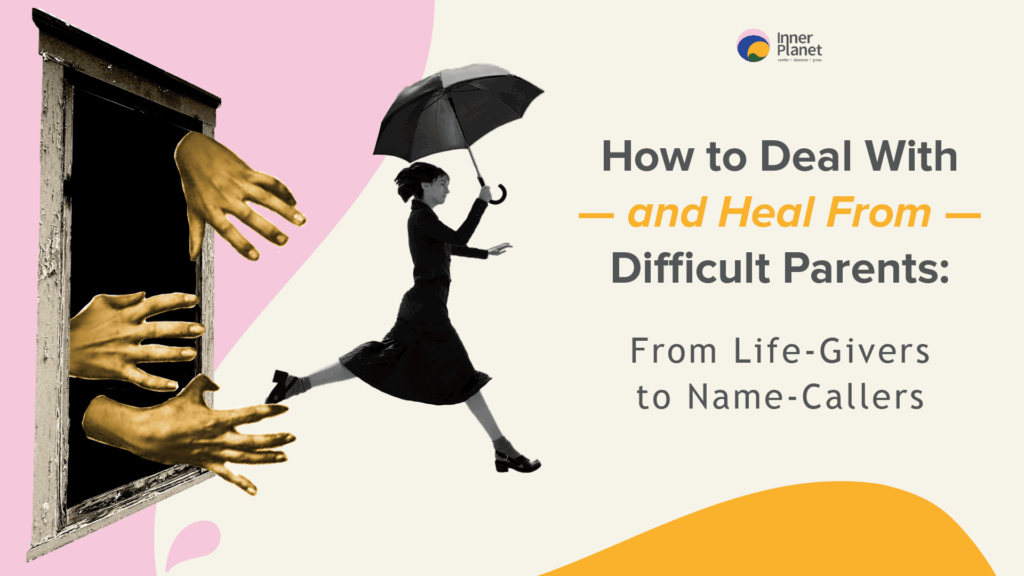
Most of us grow up believing our parents will be our safe place — people who love and protect us unconditionally. But for many, the reality is more painful. Some parents criticise, control, or hurt us emotionally well into adulthood. And the idea of stepping back from difficult parents, even for our own peace, can feel impossible — especially in cultures where honouring one’s parents is seen as non-negotiable.
Yet, you are not alone. A YouGov survey of over 11,000 participants show that more than one in four people are estranged from a family member, often after years of conflict or emotional damage (Brody, 2024). We’ll walk you through thoughtful, research-backed ways to cope — whether that means setting firm boundaries, trying to repair what’s broken, or simply learning to protect your peace. If you’ve been wondering where to even begin with a parent who hurts more than helps, you’re in the right place.
1. Why It’s Hard to Deal with Difficult Parents as an Adult
As adults, we have the ability — and the right — to choose how we engage with our parents. But emotionally, many of us still feel like children around them. We may long for their approval, or feel guilt for wanting distance, even when they continue to cause harm.
That pull is deeply human. We’re wired to seek affection from our parents, even when it’s not given in healthy ways, since our survival depends on it.
It’s important to recognise the difference between normal parent–child conflict and toxic patterns. All families argue now and then. But when a parent constantly manipulates, belittles, or makes you feel unsafe to be yourself, it crosses into harmful territory (Chung, 2024).
Studies show that long-term stress from toxic parenting can lead to anxiety, depression, and even physical health issues like high blood pressure and weakened immunity (Ben-Noun, 1998; Birditt et al., 2009). Knowing the damage is real can be a powerful motivator to take your emotional well-being seriously.
2. How to Have a Relationship With a Difficult Parent
Once you’ve recognised the need for change, the next question is: What kind of relationship is realistic — and healthy — for me to have with this parent now?
Not every difficult parent is abusive. Some may simply lack self-awareness or struggle with emotional expression. Others may repeat harmful behaviours without ever acknowledging them. The kind of relationship you can maintain depends on both their behaviour and your boundaries.
For some, that might mean keeping contact to specific times — like holidays or birthdays. For others, it may involve avoiding certain topics, or keeping conversations brief and polite. This approach is sometimes called “low contact.”
It’s okay to choose distance. It’s okay to change the shape of the relationship. You’re not rejecting them — you’re choosing to protect yourself.
For those who still live at home or depend on their parents, redefining the relationship may not be easy or immediate. But even small shifts — like choosing what you will and won’t talk about, or emotionally distancing in subtle ways — can help you feel more in control.
3. How to Respond to Difficult Parents (and Communicate With Them)
When faced with criticism, guilt-trips, or emotional manipulation, it’s tempting to lash out or shut down. But research shows that constructive conflict — calm, respectful communication — leads to better outcomes (Birditt et al., 2009).
Here are a few techniques that can help:
- Use “I” statements: When you’re hurt or angry, it’s easy to say things like “You always make me feel worthless.” But starting with “you” often puts the other person on the defensive, especially a parent who may already struggle with accountability. Instead, try saying, “I feel hurt when I’m spoken to that way.” It keeps the focus on your experience, which is harder to argue with — and easier to hear.
- Stick to the issue at hand: Difficult conversations often spiral because we try to address everything at once — past arguments, old wounds, every slight. But that can overwhelm the other person and derail the moment. Instead, focus on one issue. If your parent tries to change the subject or deflect — for example, shifting blame or bringing up your past mistakes — don’t follow them there. Staying with the original point helps you see when they’re trying to avoid accountability, and gives you the best chance of being heard.
- Avoid shouting or insults: This one’s tough — especially if you feel provoked or constantly misunderstood. But raising your voice or lashing out, however justified it may feel, usually gives a difficult parent the excuse to shut down or flip the blame. Staying calm doesn’t mean you’re okay with their behaviour; it means you’re protecting your message — and your peace.
- Try the “broken record” method: Some parents dismiss, deflect, or wear you down with repetition. If you’ve clearly stated a need or a boundary, you don’t need to keep re-explaining or justifying it. You can simply repeat it, calmly, like a broken record: “I’m not comfortable discussing this right now.” “We’ll have to talk another time.” This helps you hold your ground without escalating the conflict.
- Set limits that work for you: If certain topics always lead to conflict, it’s okay to set limits: “I’d rather not talk about that.” And if things get too heated, step away: “I need a break. We can continue later.”
- Write what you’re feeling instead of saying it: Sometimes, writing a letter or email gives you more control over what you say — and how. It allows space for reflection, rather than reactive arguments.
- Try internal detachment: If you’re unable to walk away from a fight — say, if you live with your parents — you can still practice internal detachment. You don’t have to absorb every word. Remind yourself: “This isn’t about me. I can stay calm. I will leave the room when I can.”
You can’t force your parents to change, but you can choose how you respond — even if it’s silently, strategically, and for your own peace.
4. How to Fix a Broken Relationship With My Parents, and Should I?
If things have already fallen apart, you might wonder: Is there hope to repair this?
Surprisingly, yes. Research shows that most estrangements between parents and adult children eventually end—about 81% of children reconcile with mothers, and 69% with fathers (Reczek et al., 2023).
But reconciliation takes work — and willingness on both sides.
Start by asking yourself: What do I really want? Do you need an apology? Do you want to rebuild trust slowly? Being clear about your needs helps you avoid jumping back into the same painful patterns.
Real healing requires both parties to take responsibility. That means open conversations where both people feel heard—ideally in a calm setting or with a therapist.
It also means noticing if your parents are making an effort. Do they apologise? Are they respecting your boundaries now? That’s how trust begins to rebuild.
Even if the relationship never becomes what you hoped for, partial repair — being back on speaking terms, for instance — can still bring relief.
5. How to Heal From a Toxic Parent in Adulthood
Whether or not your parent is still in your life, your healing is in your hands. This doesn’t happen overnight — but small, consistent steps can help you move forward. Here are a few such steps that research and therapy often recommend:
- Therapy or Counselling: A trained therapist can help you unpack complex feelings like guilt, anger, or self-blame. They may use approaches like inner-child work or CBT (Cognitive Behavioural Therapy) to help reshape the negative beliefs your parent instilled. Even if reconciliation is not possible, therapy gives you the tools to heal — for your own sake.
- Build a Support System: A painful truth of toxic parenting is that it often leaves you feeling emotionally unsupported. But that support can be rebuilt — through close friends, partners, mentors, or even online communities who offer kindness and affirmation.
- Protect Your Energy with Self-Care: Self-care isn’t indulgence — it’s maintenance. Sleep, nutrition, and movement are proven to reduce the impact of long-term stress. Even small acts like a walk, reading a book, or just stepping away from tension can slowly restore a sense of safety and control.
- Practice Self-Compassion: That critical inner voice? It often sounds just like the parent who hurt you. Replace it gradually with your own, kinder voice. Research shows that self-compassion — treating yourself with the patience and care you’d offer a loved one — leads to stronger emotional recovery (Schonbrun, 2024). Start small: when that voice says, “You’re so ungrateful for distancing yourself” try instead, “I’m allowed to protect myself, that’s a basic human right.”.
- Journal or Reflect: Writing helps. Whether it’s a private journal or an unsent letter to your parent, expressing what you couldn’t say out loud can bring deep relief. You don’t need to share it with anyone — sometimes, it’s enough that you know your truth.
- Reframe the Narrative: Forgiveness doesn’t mean pretending everything’s fine. It means loosening the grip their behaviour has on how you see yourself. Try writing your story from your own point of view — not as someone who was “too sensitive,” but as someone who survived what they weren’t given. Even saying, “That was never my fault — and I get to choose what comes next,” can be a powerful start.
Healing doesn’t always require changing the world around you — just the way you speak to yourself, protect your space, and choose what comes next.
Loving a difficult parent is never simple. Sometimes it means staying — with clear boundaries. Sometimes it means stepping back. And sometimes, it means letting go entirely. Whatever path you choose, know this: protecting your well-being is not a betrayal. It’s a form of strength.
You can choose to love your parents in a way that also honours yourself. That might mean loving them from a distance. Or it might mean rebuilding something new, slowly and carefully. You are not wrong for needing peace.
You are fully capable of creating a life that isn’t ruled by pain from the past — but led by healing, hope, and your own sense of worth. And if you need help on this journey of healing, we’re always just a call away!
References
- Ben-Noun, L. (1998). Generalized anxiety disorder in dysfunctional families. Journal of Behavior Therapy and Experimental Psychiatry, 29(2), 115–122. https://doi.org/10.1016/s0005-7916(98)00003-2
- Birditt, K. S., Rott, L. M., & Fingerman, K. L. (2009). “If you can’t say something nice, don’t say anything at all”: Coping with interpersonal tensions in the parent–child relationship during adulthood. Journal of Family Psychology, 23(6), 769–778. https://pmc.ncbi.nlm.nih.gov/articles/PMC2805116/
- Brody, B. (2024, November 26). I was estranged from my family. I returned one Thanksgiving. The Washington Post. https://www.washingtonpost.com/wellness/2024/11/26/family-estrangement-health-reconciliation-thanksgiving/
- Burnett, J. (2023, August 30). You’re allowed to cut ties with a toxic parent. Oprah Daily. https://www.oprahdaily.com/life/relationships-love/a44677129/owning-our-struggles-with-a-toxic-parent/
- Bursack, C. B. (2011). Detaching with love: Setting boundaries with difficult elderly parents. AgingCare. https://www.agingcare.com/Articles/setting-boundaries-with-parents-who-are-abusive-142804.htm
- Chung, M. (2024, December 16). Toxic parents: Signs & how to deal with them. Talkspace. https://www.talkspace.com/blog/toxic-parents/
- Coleman, J. (2024, April 15). How parents can heal rifts with their adult children. Scientific American. https://www.scientificamerican.com/article/how-parents-can-heal-rifts-with-their-adult-children/
- Hussain, S. (2021, October 22). “I didn’t talk to my mother for six years”: Dealing with a toxic parent to preserve your sanity. Tweak India. https://tweakindia.com/wellness/health/i-didnt-talk-to-my-mother-for-six-years-dealing-with-a-toxic-parent-to-preserve-your-sanity/
- Meyers, S. (2021, September 14). How to cope with the stress of caring for aging parents. Psychology Today. https://www.psychologytoday.com/us/blog/insight-is-2020/202109/how-cope-the-stress-caring-aging-parents
- Neff, K. D. (2011). Self-compassion, self-esteem, and well-being. Social and Personality Psychology Compass, 5(1), 1–12. https://doi.org/10.1111/j.1751-9004.2010.00330.x
- Newport Institute. (2023). Parental estrangement: Can the family heal after adult children divorce their parents? Newport Healthcare. https://www.newportinstitute.com/resources/mental-health/parental-estrangement/
- Reczek, R., Stacey, L., & Thomeer, M. B. (2023). Parent–adult child estrangement in the United States by gender, race/ethnicity, and sexuality. Journal of Marriage and Family, 85(2), 494–517. https://doi.org/10.1111/jomf.12898
- Schonbrun, Y. (2024, November 26). How to set boundaries with other grown-ups. Parent Data. https://parentdata.org/set-boundary-family/
- Streep, P. (2023, May 5). No, parent–child estrangement isn’t just a fad. Psychology Today. https://www.psychologytoday.com/us/blog/tech-support/202305/no-adult-childparent-estrangement-isnt-a-fad
- Streep, P. (2024, January 18). Why parents and adult children must maintain boundaries. Psychology Today. https://www.psychologytoday.com/us/blog/tech-support/202401/adult-children-parents-and-the-issue-of-boundaries