

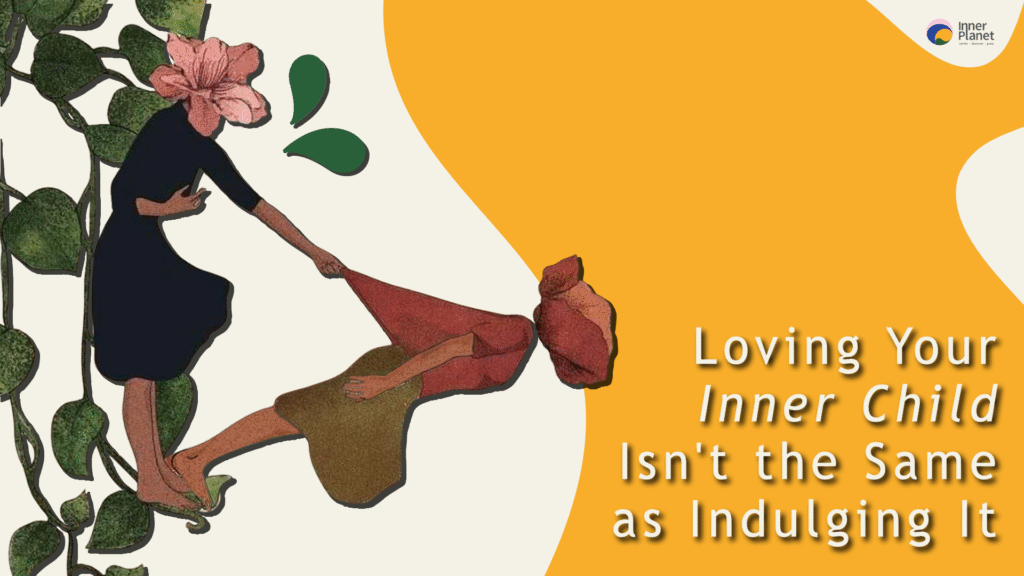
“Reconnect with your inner child” can become one of those phrases that gets stretched to cover almost anything.
Buying something you don’t need. Skipping a conversation you’ve been avoiding. Numbing out for the evening instead of dealing with what actually happened.
It can become about something else entirely — the id, a part of us that demands immediate gratification disregarding consequences — quietly borrowing the inner child’s name.
What follows is really about learning to tell the difference between your Inner Child and your Id. Because confusing them doesn’t just miss the point. It’s how old wounds stay open long after they could have healed.
What the Inner Child Is Carrying
The inner child isn’t a demanding toddler stamping its feet. It’s the part of us that still holds our earliest emotional imprints — the wish to be chosen, to be safe, to matter to someone without having to earn it first.
When that part of us speaks, it’s usually asking to be seen. Not soothed into silence. Seen.
The id works differently. It wants relief, and it wants it now — no sense of timing, no concept of consequence, just an urgent pull towards whatever will satisfy an urge or stop discomfort.
The id isn’t a villain in this. Impulse exists for a reason — it keeps us informed of our needs/wants, and it’s still registering something real.
The trouble isn’t that id exists. It’s that its response can often be aimed at resolving superficial concerns.
When the Two Get Mistaken
Picture the moment right after something hard happens. A difficult call ends. An argument goes unresolved. And almost without thinking, a hand reaches for a drink, a phone, a shopping app.
In that second, it’s helpful to ask this:
Which part of me is driving this? Is it the inner child, quietly needing to feel less alone with what just happened? Or is it the id, simply wanting the feeling to stop?
They can look identical from the outside. The reach is the same. But one is trying to meet a need, and the other is trying to escape one — and only one of those actually sustainably works.
Why It’s Easy to Call This Self-Care
“Treat yourself.” “You deserve this.”
Phrases built for a Tuesday-evening impulse buy get borrowed to describe something much deeper — an old ache that’s never actually been addressed.
Once the language of self-compassion gets attached to instant relief, it becomes hard to tell the two apart. Comfort that soothes a wound and comfort that simply mutes it can look, on the surface, exactly the same.
A string of messages sent to be reassured you’re still liked. Scrolling through someone else’s life until your own starts to feel smaller. Jealousy or insecurity standing in for the deeper, harder-to-name feeling of wanting to be truly seen by someone.
Most of us, at some point, have reached for something instant when what we actually needed was to be heard or known. That’s a phenomenon worth noticing, because noticing is the only way the pattern can ever change.
What Guiding the Inner Child Looks Like
Guiding the inner child isn’t about restraint for its own sake. It’s about accuracy — working out what’s actually needed, and then meeting that, rather than whatever’s most convenient.
Sometimes the right response is immediate. Real comfort. Real rest. A firm “no” to something that’s asking too much. Guiding the child was never about slowing everything down.
The shift is less about timing and more about the question underneath the reaction. Not “what will make this feeling go away”, but “what does this part of me actually need right now”. Sometimes the honest answer is a nap. Sometimes it’s a conversation you’ve been putting off.
That said, the id’s urgency is still telling you something true, even when it is misguided. It’s rarely worth ignoring outright — the more useful move is to hear it out, then check its answer against what’s actually needed.
A Few Ways to Tell Them Apart
A short pause before reacting is often enough — long enough to ask which part is actually speaking.
Naming it helps too. Saying, even briefly, “this feels like wanting relief” versus “this feels like wanting to be understood” gives the moment somewhere to land, rather than sliding straight into autopilot.
Writing it down afterwards can also make the pattern visible over time — not the urge itself, but the need that seemed to sit underneath it. Patterns are far easier to spot on a page than in the middle of a reaction.
None of this needs to become another self-improvement routine. It works best as a habit of noticing, practised with baby steps over time.
This is rarely as clean in the moment as it sounds on a page. The inner child and the id often arrive tangled together, not one after the other, and telling them apart takes patient practice rather than a single flash of clarity.
That same moment — the hard call, the difficult evening, the hand reaching for something within reach — will keep happening. That’s not a flaw to fix. It’s simply how the mind tries to cope.
What changes is what happens in the second before the reach. A brief pause, a clearer question, and the chance to meet the actual need instead of just quieting it.
If this is a pattern that feels bigger than a pause can hold and you need help, we’re always just a call away!