

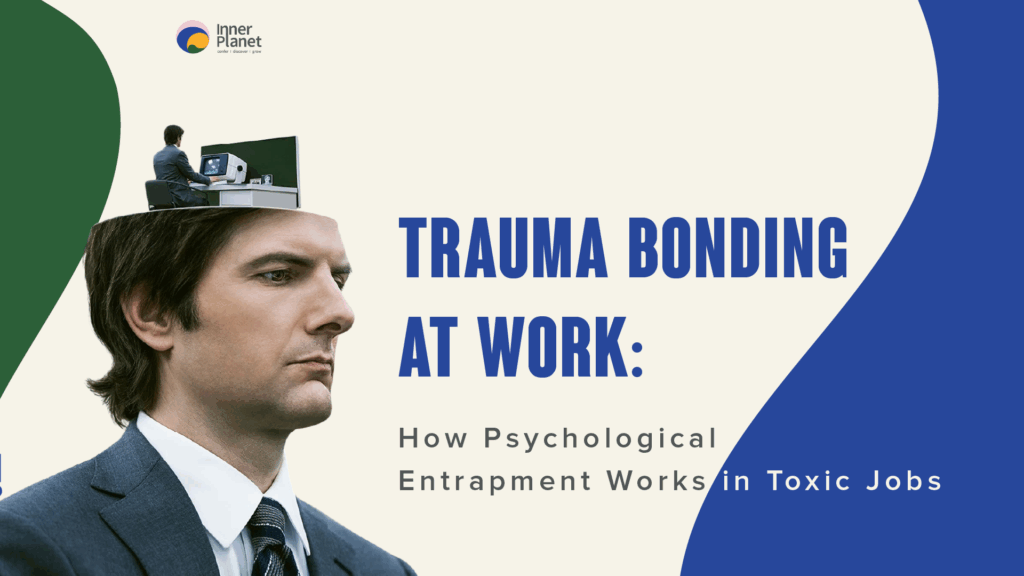
Most of us have had difficult jobs or demanding bosses. But sometimes, it goes beyond stress—it becomes a strange loyalty to something that’s hurting us. This is something deeper: trauma bonding.
Originally studied in the context of abuse and hostage situations, trauma bonding describes a confusing attachment that can form between someone being mistreated and the person mistreating them. While this concept isn’t yet fully researched in workplace settings, parallels can be drawn from similar patterns being researched.
In this blog, we explore how trauma bonding may show up at work, what to look out for, and why recognising it matters for your mental health and workplace wellbeing.
What is Trauma Bonding?
Trauma bonding is when a person forms an unhealthy emotional connection to someone who’s hurting them. This happens through repeated cycles of harsh treatment followed by moments of kindness. After all, our brains have evolved longer for survival than for recognising emotional harm in complex social structures.
Trauma bonding was first described by psychologists Donald Dutton and Susan Painter in the 1980s, based on patterns they saw in abusive relationships. For trauma bonding to happen, two things are usually present: a strong power imbalance, and inconsistent treatment that flips between cruelty and care (Reid et al., 2013).
Over time, the person being mistreated may start to confuse fear with affection, especially if the brief moments of kindness bring relief. This relief becomes a reason to stay, even when the overall situation is damaging. Think of it like a rollercoaster: the lows are terrible and voluntarily forgotten, but the highs are perceived as being so good that they make the lows worth tolerating.
Why It Matters at Work
Trauma bonding isn’t a term used much in workplace research—yet. But parallel behaviour patterns are observed. Studies on toxic workplaces talk about abusive bosses, bullying, and manipulation. These situations often involve power imbalances, fear, and emotional exhaustion. Researchers have found that employees stuck in such environments may feel trapped, anxious, and deeply loyal to a harmful boss or company (Tepper et al., 2017; Mackey et al., 2015).
This doesn’t mean that every difficult job or demanding manager falls under the pattern of trauma bonding. It’s when fear, confusion, and misplaced loyalty all come together—and keep someone stuck—that we might be looking at something more serious.
Signs You Might Be Caught in a Trauma Bond at Work
How can you tell if you or someone else is in this kind of dynamic? Here are some common red flags (El-Dekmak et al., 2024):
- Extreme highs and lows: One day your boss tears you down. The next day, they praise you or offer support. You start craving those rare good moments.
- Downplaying the bad stuff: You find yourself making excuses for mistreatment. “They’re under pressure” or “They only yelled because they care.”
- Blaming yourself: You feel like you’re the problem. “If only I worked harder, maybe they’d treat me better.”
- Feeling isolated: You’ve stopped reaching out for help. Maybe you’ve been discouraged from talking to HR or your colleagues.
- Physical or emotional stress: Constant anxiety, trouble sleeping, or even panic when you get a message from your boss.
- Feeling unable to leave: You know the job is harming you, but the thought of leaving fills you with intense fear or guilt.
Experiencing one or two of these doesn’t always mean trauma bonding—but if several are true, it’s worth pausing to reflect.
Common Misconceptions: What Trauma Bonding Is Not
As awareness of trauma bonding grows, so does the risk of it being misunderstood or overused—particularly in online spaces. So, let’s clarify what trauma bonding is not, to preserve the integrity of the term and ensure we support those genuinely affected.
- Trauma bonding is not the same as bonding through shared hardship. Working late nights on a tight deadline or going through a stressful company restructure with your team can create deep camaraderie—but that’s not a trauma bond. The key difference is the absence of power imbalance & abuse.
- It’s not just staying in a tough job. People might remain in unpleasant roles for financial reasons, career strategy, or visa dependency. These are practical decisions, not psychological attachments rooted in abuse.
- It is not loyalty to a strict or demanding boss. A manager can be firm and challenging while still being fair and respectful. High expectations alone don’t constitute emotional harm.
Unfortunately, on social media, terms like “trauma bond” can be used casually to describe any intense work relationship or even codependent dynamics. This misuse risks trivialising the real, damaging experience of trauma bonding, where psychological manipulation and emotional entrapment are at play.
Using the term too loosely can also lead to pathologising healthy behaviours, like resilience or team cohesion. It’s vital that we reserve “trauma bonding” for situations that truly involve cycles of abuse, coercion, and distorted emotional attachment.
How Trauma Bonds Form: Psychological Traps and Conditioning
To understand how trauma bonding takes hold, we need to look at the subtle psychological forces at play—ones that gradually condition a person to stay loyal in situations where they are being harmed.
- One powerful mechanism is intermittent reinforcement. This means that praise, approval, or kindness is given unpredictably, and only occasionally. In workplaces, this might look like an abusive manager who berates their team for weeks, only to then offer a bonus, a compliment, or a motivational speech. The inconsistency keeps employees emotionally hooked. That rare reward becomes a glimmer of hope—and people begin to chase it, believing that if they just work harder, it will come more often.
- Another factor is dependency conditioning. In many toxic workplaces, the abusive figure also controls key resources: performance reviews, promotions, visa support, or even basic approval. The more dependent an employee is on that figure, the more likely they are to suppress their own instincts and rationalise mistreatment as necessary. This isn’t weakness—it’s human nature in a power-skewed relationship.
- Betrayal trauma, a concept from psychologist Jennifer Freyd, helps explain why people often fail to recognise the harm being done. When someone depends on another person (or institution) for safety, support, or survival, acknowledging abuse can feel psychologically dangerous. To protect themselves, people may unconsciously minimise, deny, or forget mistreatment. This is known as betrayal blindness—and in a job, it can look like someone defending a toxic boss while privately falling apart.
- Gaslighting is another key dynamic. This is when a person makes you question your perception of reality. For example, a boss might deny saying something they clearly said, accuse you of being too sensitive, or suggest that others see you as a problem. Over time, this can erode your confidence and make you more reliant on the very person distorting your truth.
Together, these mechanisms create what feels like a psychological trap. You’re isolated, unsure of your own judgment, craving approval, and financially dependent. It’s not just difficult to leave—it becomes hard to even imagine leaving.
Trauma bonding at work is real—even if the term is new to many and under-researched. It’s not just about bad bosses or tough jobs. It’s about the emotional traps that keep people stuck in places that harm them.
If you’re feeling confused, loyal to someone who’s hurting you, or unable to leave a toxic job—you’re not alone. These patterns are more common than they seem, and they don’t mean you’re weak. They mean something needs to change. And change starts with awareness.
If you need help on this journey we’re always just a call away!
References
- Dutton, D. G., & Painter, S. L. (1981). Traumatic bonding: The development of emotional attachments in battered women and other relationships of intermittent abuse. Victimology, 6(1–4), 139–155.
- El-Dekmak, N., Zomignani Barboza, J., & De Hert, P. (Eds.). (2024). HEROES Deliverable 7.1 Findings on trauma bonding impact in THB and CSA/CSE victims. Universidad Complutense de Madrid. https://researchportal.vub.be/en/publications/heroes-deliverable-71-findings-on-trauma-bonding-impact-in-thb-an
- Freyd, J. J. (2020). What is a betrayal trauma? What is betrayal trauma theory? Retrieved October 13, 2025, from http://pages.uoregon.edu/dynamic/jjf/defineBT.html
- Gallegos, I., Guàrdia-Olmos, J., & Berger, R. (2022). Abusive supervision: A systematic review and new research approaches. Frontiers in Communication, 6, 640908. https://doi.org/10.3389/fcomm.2021.640908
- Houghtaling, M. B., Buchanan, R., & Clark, K. (2025). Trauma bonding in nursing: A reflection. International Journal of Nursing & Clinical Practices, 12, 416. https://doi.org/10.15344/2394-4978/2025/416
- Mackey, J. D., Frieder, R. E., Brees, J. R., & Martinko, M. J. (2015). Abusive supervision: A meta-analysis and empirical review. Journal of Management, 43(6), 1940–1965. https://doi.org/10.1177/0149206315573997 (Original work published 2017)
- Paul, M. (2021, June 23). Umbrella summary: Abusive supervision. Quality Improvement Center for Workforce Development. https://www.qic-wd.org/umbrella/abusive-supervision
- Reid, J. A., Haskell, R. A., Dillahunt-Aspillaga, C., & Thor, J. A. (2013). Contemporary review of empirical and clinical studies of trauma bonding in violent or exploitative relationships. International Journal of Psychology Research, 8(1), 37–73. https://law.syracuse.edu/wp-content/uploads/ARTICLE_1_Attached_to_Pander_Report.pdf?_ga=2.140437235.1100982440.1672826098-12924726.1672826098
- Tepper, B. J., Simon, L., & Park, H. M. (2017). Abusive supervision. Annual Review of Organizational Psychology and Organizational Behavior, 4(1), 123–152. https://doi.org/10.1146/annurev-orgpsych-041015-062539
- Verkuil, B., Atasayi, S., & Molendijk, M. L. (2015). Workplace bullying and mental health: A meta-analysis on cross-sectional and longitudinal data. PLOS ONE, 10(8), e0135225. https://doi.org/10.1371/journal.pone.0135225