

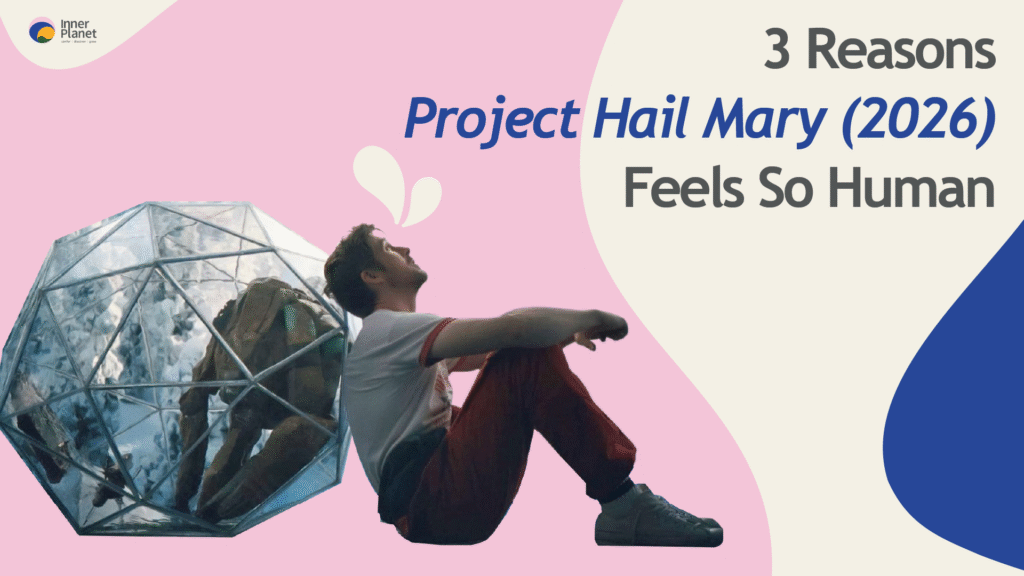
Contains major spoilers
One of the most interesting things about Grace in Project Hail Mary is that when asked to go on the impossible space mission, he runs.
That detail changes the emotional weight of the story. Grace is not introduced to us as a flawless hero, already prepared for sacrifice. He wakes up alone, confused, and far from Earth, carrying a responsibility he did not calmly choose. His journey is not about fear disappearing. It is about what happens when fear, loneliness, friendship and responsibility collide.
So let’s look at three psychological themes in Project Hail Mary: the loneliness of being truly alone, the regulating power of friendship, and the complicated courage of a person who first runs away, but eventually rises up to the occasion.
1. Alone in Space
Grace’s loneliness begins before we fully understand the mission.
He wakes up on a spaceship with no memory of how he got there. His crewmates didn’t make it. Earth is unimaginably far away. Even his own mind cannot yet offer him the comfort of a clear story.
That kind of loneliness is more than just the absence of people. It is also about having no one to confirm your reality. No one to say, “Yes, this happened.” No one to help you place yourself inside your own life.
Project Hail Mary’s space setting makes this loneliness visible, but the feeling is not limited to space. Many people know quieter versions of it. You can be surrounded by duties, deadlines and decisions, while still feeling privately unreachable. You may be functioning, solving problems, responding to what needs to be done — and still feel that no one is really with you inside the experience.
Grace’s isolation is frightening because it is relatable. He cannot simply fall apart. He has to observe, repair, calculate and survive before he has fully caught up with himself.
That is often how loneliness works. It does not always announce itself dramatically. Sometimes it grows beside competence. And this is what Project Hail Mary succeeds in capturing.
2. Friendship; Rope to the Drowning
When Rocky enters the story, Grace does not merely get company. He gets someone to relate to.
That difference matters.
Company can reduce silence. Relationships change the meaning of silence. With Rocky, Grace has someone to misunderstand and then understand. Someone to worry about. Someone to learn from. Someone whose survival becomes personal, not abstract.
Their friendship is not instant or easy. They do not share a language, a biology, an atmosphere, or a species. Their bond is built slowly through curiosity, trial, error and repair. That makes it feel earned, not just a plot point. It is a living breathing friendship.
Psychologically, this is where the film becomes tender without becoming sentimental. Rocky does not remove the danger. He does not make the mission simple. But his presence changes Grace’s nervous system, in the ordinary way a real bond can. A terrifying situation can remain terrifying and still become more bearable when someone is facing it with you.
Rocky also gives Grace’s purpose a direction. Amaze, amaze, amaze.
Before Rocky, the mission is enormous: Earth, survival, extinction, science, responsibility. These are too large for a mere mortal to emotionally hold all at once, all alone. But friendship reduces that distance. Grace is no longer acting alone for a planet, a species, or a mission brief. He is also collaborating with someone he truly cares about.
That is often how courage becomes possible.
Not because fear disappears, but because care and support give fear somewhere to sit.
3. Complex Courage
Grace’s initial running away does not weaken the story of courage. It makes it more honest.
When he is first asked to join Project Hail Mary, he does not rise nobly to the occasion. He runs. He cannot bring himself to accept a responsibility that is too final, too frightening and too much for one person to absorb. So he is drugged and wakes up confused on the ship.
This is morally uncomfortable. It should be.
The film is not asking us to pretend that running away is heroic. But it does allow us to see that avoidance is not always simple selfishness. Sometimes it is panic. Sometimes it is disbelief. Sometimes the mind understands the stakes, but the body still says, “I cannot do this.”
That is what makes Grace’s character human.
Many stories treat courage as a fixed trait. Brave people volunteer. Good people step forward. Heroes know what must be done and do it immediately.
Grace’s arc is more psychologically realistic than that. He does not arrive at courage cleanly. His fear is not a fake obstacle placed before inevitable bravery. It is real. He does not want the mission. He does not choose it with calm dignity. He resists it. He wants the cup to pass from him.
And still, once he is inside the situation, something begins to change.
He solves what he can solve. He remembers what he can remember. He builds a bond with Rocky. He becomes responsible not only because the mission requires it, but also because the relationship draws responsibility out of him.
His final choice lands because of this. Grace chooses to save Rocky and the Eridians rather than return home, while still sending Earth what it needs. This is not abstract heroism. It is not a grand speech about sacrifice. It is a specific choice shaped by friendship, danger and love.
Grace’s courage comes after fear.
After refusal.
After shame.
After connection.
That is a quieter kind of courage, and all the more real for it.
The psychological power of Project Hail Mary lies in the fact that Grace’s humanity is not polished away.
He is lonely. He is frightened. He runs from the responsibility placed before him. He wakes up inside a mission he did not willingly accept. And yet, through connection, care and responsibility, he becomes capable of acting.
That depicts how fear is not always the end of the story, merely a starting point.
Perhaps that is why Grace stays with us. Not because he begins as the person the mission needs, but because he becomes someone who can respond to love, danger and responsibility, growing in the process.
Grace could’ve definitely used some online therapy to save the world, but he was too far away from earth.
But you’re not. And if you need help on your odyssey, we’re always just a call away!