

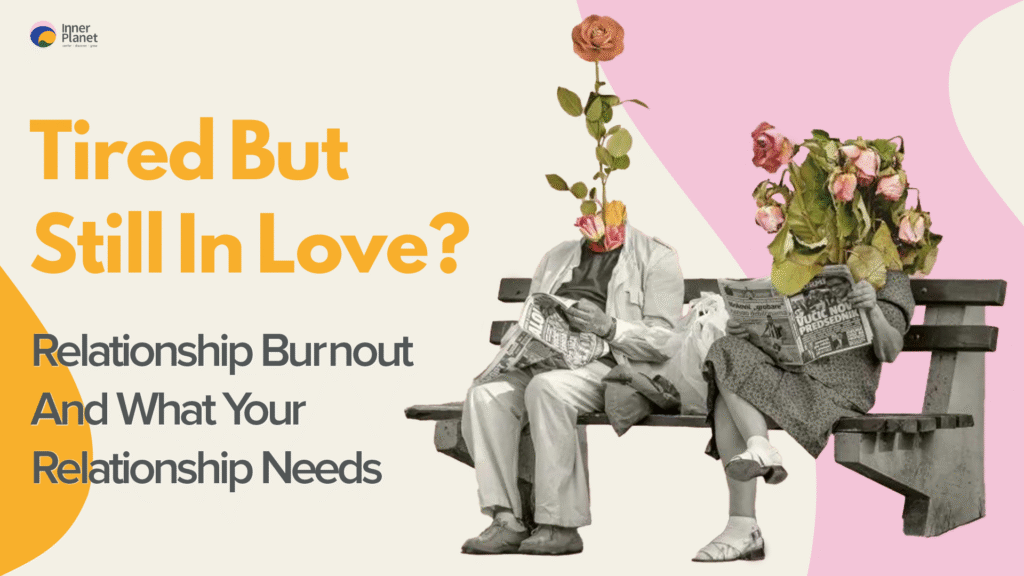
Relationship burnout can feel deeply confusing because it does not always come with obvious indicators of loss of love.
Sometimes, you still care. You still miss them. You still remember the good days. You may still want the relationship to work.
And yet, something in you feels tired.
You may feel close to them one day and completely defeated the next. You may wonder how you can miss someone who is still technically right there.
So let’s talk about that painful in-between place: when you do not know whether your relationship needs repair, distance, or an ending. We will look at what relationship burnout can mean, what you may actually be tired of, when repair is possible, when promises are not enough, and when leaving may be an act of honesty rather than failure.
Before we begin, one important distinction: this piece is about relationships where there is safety to reflect. If there is violence, coercion, serious control, threats, or fear, the priority is safety and support — not another attempt to talk things through.
Love Is Not Enough
One of the hardest parts of romantic relationship burnout is that love may still be present.
That can make everything feel more complicated.
If you did not care, leaving might feel simple. If there was no tenderness, history, attraction, or warmth, the decision might feel clearer. But often, people feel relationship burnout precisely because they still care and have been trying for a long time.
You may love someone and still feel lonely with them.
You may be attached to them and still not feel able to speak honestly without being punished for it.
You may want the relationship to work and still know that the current version of it is costing you too much.
This is why “Do I love them?” is not always the most useful question. Love matters, of course. But love alone cannot carry a relationship that has stopped feeling like a place where both people can coexist.
A better question may be: “Is this way of loving each other still possible to live inside?”
Sometimes, the issue is not the absence of love. Sometimes, the issue is that love has become too heavy to carry in the same way.
What Relationship Burnout Looks Like
Relationship burnout is usually not obviously dramatic.
It may not look like shouting, breaking up, or declaring that everything is over. Sometimes, it is disguised.
It can look like avoiding a difficult conversation because you already know the route. After some time, even starting the conversation begins to feel exhausting.
It may show up as irritation over small things. Their tone, their delay, their forgetfulness, their way of responding — things you once brushed aside may begin to feel unbearable.
It may show up as emotional distance. You may still eat together, sleep next to each other, share updates, meet families, or discuss ordinary plans, but feel strangely alone inside the relationship.
It may show up in the body too. You may feel less playful, less open to intimacy, less able to reach for them naturally. Sometimes the body starts withdrawing before the mind has found the words.
And often, relationship burnout carries guilt.
You may think, “They are not a bad person, so why am I so tired?”
Or, “They do love me, so why does this still hurt?”
Or, “Maybe I am asking for too much.”
But relationship burnout is not always proof that you are ungrateful or impatient. Sometimes it is information. It is a sign that something in the relationship, as it currently exists, has become unsustainable.
What Are You Tired Of?
Before deciding whether to stay or leave, it helps to ask a more precise question: what exactly are you tired of?
You may not be tired of loving them. You may be tired of what loving them has started asking from you.
Sometimes, you are tired of the lack of basic relationship hygiene.
This can be difficult to admit, especially when there are still good moments. But it may be true if their basic way of treating you feels consistently dismissive, cruel, contemptuous, dishonest, unsafe, or deeply incompatible with who you are.
You may notice that you feel more like yourself when they are absent. You may no longer want closeness, even when things are calm. You may feel that the relationship repeatedly asks you to accept a version of love that makes you smaller.
Sometimes, you are tired of the pattern.
In this case, both people may care, but the relationship keeps getting trapped in the same cycle. One partner keeps asking for reassurance. The other feels criticised and withdraws. The more one person asks, the more the other shuts down. The more one shuts down, the more desperate the other feels.
Soon, both people feel alone. Both feel misunderstood. Both may feel like they are the only one trying.
And sometimes, you are tired of your role.
You may have become the fixer, the emotional translator, the one who brings up every serious conversation, the one who adjusts first, the one who remembers what needs attention. You may be the person keeping the relationship functioning, while also wondering why you feel so resentful.
Sometimes it’s a mix of all three and more.
A pattern may be repaired. A role may be renegotiated. But a relationship that repeatedly harms your dignity may need distance.
The History Trap
Romantic relationships come with stories.
You remember how it began. The early conversations. The first time you felt chosen. The private jokes. The intimacy. The version of them that made you feel safe, desired, understood, or hopeful.
You may also remember everything you have survived together. The difficult seasons, the family complications, the fights you came back from, the plans you made, the future you imagined.
That history is alive within us.
But history can also make it harder to see the present clearly.
A beautiful beginning does not cancel out a painful present pattern. Chemistry does not erase inconsistency. Shared memories do not automatically mean the relationship is still good for you now.
This becomes even harder when families are involved, when marriage has been discussed, when children are part of the picture, when years have been invested, or when your daily life has become built around the relationship.
Leaving may not feel like losing only a person. It may feel like losing a whole imagined life.
So, it is natural to hesitate. It is natural to keep looking for proof that the good version of the relationship is still the real one.
But the beginning of the relationship cannot be the only evidence for staying. The more honest question is: what is the relationship like now, not only when things are warm and easy, but when something difficult needs to be faced?
When Repair Is Possible
Relationship burnout does not always mean the relationship should end.
Some relationships are tired because they have avoided honest repair for too long. Some are not broken beyond hope; they are stuck in patterns neither person fully understands. Some need a serious reset, not an immediate ending.
Repair may be possible when there is still basic respect. When both people can admit some responsibility. When the relationship is not emotionally or physically unsafe. When both partners are willing to have uncomfortable conversations without making one person carry all the blame.
It may be possible when apologies are followed by changed behaviour. Not dramatic declarations, but ordinary evidence.
They remember what was discussed without being chased. They bring up the issue themselves later. They ask what would help instead of only defending themselves. They change a repeated habit. They tolerate discomfort without shutting the conversation down. They make room for your hurt without demanding immediate reassurance from you.
A relationship does not need to be painless to be worth repairing. But it does need to be responsive.
Repair is not just talking more. Many couples talk a lot and still remain stuck. Real repair may involve rebuilding trust, changing routines, learning how to argue differently, making space for intimacy again, renegotiating expectations, or seeking relationship counselling.
Repair does not require both people to be perfect. But it does require both people to be willing.
When Love Becomes Labour
Sometimes, what we call love has slowly become labour.
You may start every serious conversation. You may calm them down before you can express your own hurt. You may explain the same need again and again, carefully changing your tone each time so they do not feel attacked.
You may manage their moods to avoid conflict. You may forgive quickly because fighting feels too tiring. You may lower your expectations and call it maturity. You may know their wounds in detail, while they barely understand yours.
At some point, love can begin to feel like a job.
Care is part of any sustainable relationship. But care becomes exhausting when it is not mutual. When one person is always noticing, naming, explaining, forgiving, adjusting, and hoping, the relationship begins to rest on one person’s effort.
This is why the answer to relationship burnout is not always “communicate better”. Sometimes you have communicated. Many times. In many tones. With patience, anger, tears, calmness, distance, and hope.
Promises Are Not Repair
In romantic relationships, promises can be powerful.
After a painful fight, an apology can feel like relief. A tearful conversation can bring back closeness. A partner saying, “I understand now,” or “I will change,” can make you feel hopeful again.
Sometimes, those promises are sincere.
But sincerity is not the same as repair.
An apology may comfort you for one night. Repair changes what happens next week.
Relationship burnout often returns when the apology is emotional, but the behaviour remains the same. The words may be different. The tone may be softer. The fear of losing you may be real. But if the pattern does not change, your exhaustion will return.
This is where many people get stuck. They do not want to be unfair. They can see that their partner is trying in the moment. They may even feel guilty for not feeling better after an apology.
But trust is not rebuilt by intensity alone. It is rebuilt through consistency.
Do not only listen to what they promise when they are afraid of losing you. Watch what they practise when the fear settles.
Pause Before Deciding
When you are exhausted and experiencing relationship burnout, the urge to decide quickly can feel strong.
Stay or leave. Forgive or end it. Try again or stop trying.
But big relationship decisions made from the part of you that is completely worn down can become reactive. At the same time, avoiding the decision forever can also keep you trapped.
So the pause is not about pretending everything is fine. It is about creating enough steadiness to hear yourself clearly.
Notice what you feel after rest, not only after conflict. Notice what you feel after some distance. Ask whether you miss them, or whether you miss feeling chosen. Ask whether anything has changed beyond words.
And most importantly: what would need to change for you to stay without resenting yourself?
That question matters because staying should not require you to keep betraying your own needs.
Once you have more clarity, the next step may not be another vague emotional fight. It may be one honest, specific conversation.
Have The Real Conversation
If the relationship still has enough safety and respect, the conversation does not need to become a courtroom.
You do not have to prove that your partner is a bad person. You are trying to find out whether the relationship has enough honesty, care, and willingness to change.
You might say:
“I love you, and I do not want to make a decision from exhaustion. But I need to be honest that I am burning out in this relationship. I feel like we keep returning to the same pattern, and I cannot continue like this. I need us to be honest about whether we can both do something different, because I cannot keep surviving the same pattern.”
The point is to name what keeps happening, what it is costing you, and what needs to change.
Try not to turn the conversation into “you always” and “you never”. These phrases may be understandable when you are hurt, but they often push the other person into defence.
Instead, stay close to what is true.
“This is what keeps happening.”
“This is how it affects me.”
“This is what I need to change.”
“This is what I cannot keep doing.”
A real conversation does not guarantee repair. But it gives you information. It shows you whether the relationship can hold truth without immediately punishing it.
Watch What Changes
The conversation matters.
But the response matters equally if not more.
Watch whether your partner becomes curious or only defensive. Watch whether they can make room for your hurt without making you comfort them immediately. Watch whether they take responsibility without turning the whole conversation into their shame.
Watch whether they show change without needing constant reminders. Whether they respect boundaries. Whether they care about the relationship when you are not at the edge of leaving.
Fear of losing you is not the same as willingness to love you differently.
Someone can be scared to lose you and still not be ready to change how they treat you. Someone can cry, apologise, and mean it deeply, but still return to the same pattern once the panic passes.
This does not make them evil. It just tells you something important.
For repair to be real, change has to become visible in ordinary days, not only in emotional moments.
When Support Helps
Sometimes, both people care, but the relationship has become too tangled to understand alone.
This is where support can help.
Individual therapy can be useful when you feel confused, guilty, resentful, attached, or unsure what you need. Sometimes therapy helps you separate love from fear, guilt from responsibility, and hope from evidence.
Couples therapy can help when both partners care but keep hurting each other. It can slow the pattern down, make conversations safer, and help both people understand what keeps going wrong.
Therapy is not there to force a relationship to survive. It is not there to make one person tolerate more than they should. It is a space to become more honest about what is happening and what may be possible.
Support is most useful when there is enough safety and willingness for both people to look at the relationship honestly.
But not every relationship should be repaired.
When Leaving Is Valid
Some relationships are not simply tired. They are harmful.
Leaving may be necessary when the relationship repeatedly damages your sense of self. When there is contempt, cruelty, manipulation, coercion, gaslighting, or control. When your needs are mocked, punished, or dismissed. When honesty leads to retaliation. When promises keep replacing change.
It may be time to step away if you feel smaller, quieter, lonelier, or less alive in the relationship. If the relationship only works when you stop asking for what you need. If you are staying mostly for potential, not reality.
Not every painful relationship is toxic.
But not every relationship with love is healthy enough to continue.
People often judge themselves for not leaving sooner. But attachment is not a switch. Shared history, tenderness, guilt, fear, hope, family pressure, practical realities, and the memory of better days can all make leaving complicated.
Taking time to become clear does not make you weak.
And if you do leave, it may not feel clean. You may miss them. You may doubt yourself. You may grieve the version of the relationship you wanted. You may still remember the good parts.
But grief is not always proof that the decision was wrong. Sometimes grief is simply the cost of telling the truth.
Leaving is not always a failure of love. Sometimes it is the point where you stop shrinking yourself to keep the relationship intact.
Relationship burnout does not always mean you should leave. It also does not mean you should keep trying endlessly.
The real question is not only, “Do I love them?” It is, “Can this relationship become a place where I can breathe, speak honestly, and still feel like myself?”
Some relationships need repair. Some need support. Some need distance. Some need an ending.
If the difference feels difficult to understand alone, we’re always just a call away!
You do not have to decide everything right now. But your relationship burnout deserves to be taken seriously.