

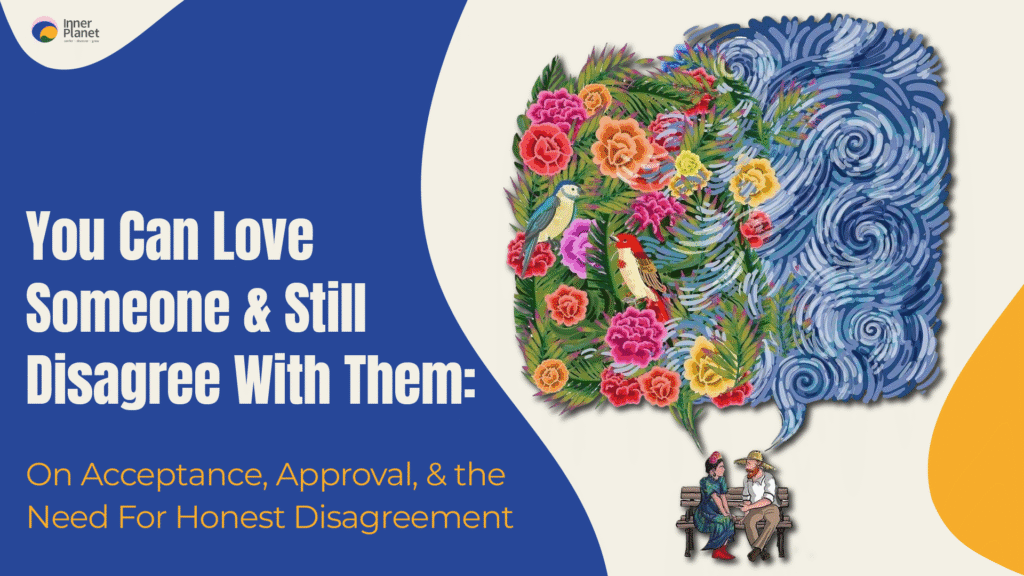
It can be surprisingly painful to hear someone you love say, “I don’t agree with this.”
Even when they are gentle, something within may tighten. For a moment, it may stop feeling like they are questioning a choice, belief, or behaviour. It starts feeling like they are questioning you.
This is where a conversation can turn into a test of love.
Do you still accept me? Are you judging me? Am I safe with you? Do I have to agree with you to stay close to you?
All of the above questions speed through our minds so fast that we only ever catch the feeling and miss the process.
This is why the difference between approval vs acceptance matters.
So, let’s look at why disagreement can hurt, how acceptance and approval are different, why disapproval does not always mean rejection, and why healthy relationships need both honesty and boundaries.
When Disagreement Feels Personal
Disagreement feels heavier in close relationships because it is rarely just about the topic.
When a colleague disagrees with us, we may feel irritated or defensive. When a parent, partner, sibling, or close friend disagrees with us, it can feel far more personal. Their opinion carries emotional weight because their acceptance matters to us.
This becomes even more painful when someone has grown up around conditional love. If love was offered only when they behaved correctly, achieved enough, obeyed enough, or stayed agreeable, then disapproval can feel threatening.
It may not sound like, “I disagree with this choice.”
It may sound like, “You are no longer lovable.”
Sometimes, we are not responding only to the disagreement in front of us. We are responding to an older fear: that love disappears the moment we disappoint someone.
That is why a simple disagreement can quickly become about loyalty, respect, freedom, or love.
Acceptance Is Not Approval
Acceptance means recognising someone’s reality without denying their humanity.
It says, “I see you as a whole person.”
Approval means endorsement. It says, “I support this choice, belief, or behaviour.”
These two things are related, but they are not the same.
You can accept your inner child without approving of every belief they hold. You can accept a friend without approving of the relationship they keep returning to. You can accept your partner’s emotional pain without approving of the way they speak when they are angry.
Acceptance says, “You still matter.”
Approval says, “I support this.”
That difference is small in language, but huge in its impact on relationships.
When we confuse the two, we begin to expect agreement as proof of love. That is too heavy a burden for any relationship to carry.
Disapproval Is Not Rejection
Disapproval can hurt. Even respectful disapproval can sting.
The point is not that it should feel painless. The point is that pain is not always proof of rejection.
There is a difference between saying, “I cannot support this choice,” and saying, “You are no longer worthy because of this choice.”
Healthy disapproval does not humiliate. It does not threaten. It does not use silence, shame, or emotional withdrawal as punishment. It does not try to control the other person into becoming more comfortable for us.
It simply tells the truth.
It may sound like:
“I love you, but I do not think lying to your partner is okay.”
“I care about you, but I cannot support the way you speak to me when you are angry.”
“I respect your right to decide, but I do not agree with this decision.”
This kind of disapproval can protect relationships from false peace. It allows people to be honest without pretending. It makes room for difference without turning difference into cruelty.
Of course, not all disapproval is healthy. Some people use “I disagree” as a softer way of judging, controlling, or shaming. That kind of disapproval does damage.
But respectful disapproval is different. It does not remove someone’s dignity. It does not make love conditional on obedience. It simply allows honesty to exist inside the relationship.
Acceptance Is Not Permission
There is another side to this.
Acceptance should not become a polite word for tolerating everything.
Accepting someone does not mean allowing repeated disrespect. Accepting someone’s pain does not mean accepting abusive behaviour. Accepting someone’s beliefs does not mean giving those beliefs unlimited space in your life.
You can accept that a friend is not ready to leave a painful relationship without being available for the same midnight conversation every night.
You can accept that a family member has different views without allowing insulting comments at the dinner table.
You can accept that a partner is overwhelmed without accepting shouting, blame, or stonewalling.
This is the difference between acceptance and self-abandonment.
Acceptance says, “I can see you clearly.”
A boundary says, “And I also have to take care of myself.”
Both can exist together.
In fact, boundaries often make acceptance more honest. Without boundaries, acceptance can become resentment. Without acceptance, boundaries can become cold and punitive.
The healthier middle is not, “I approve of everything,” or “I reject you completely.”
It is, “I can care about you without participating in everything.”
The Middle Is Difficult
Most of us find the middle path uncomfortable.
Full approval feels safe because nobody is disappointed. Full rejection feels clean because nobody has to tolerate discomfort.
The middle is harder because it asks us to stay honest without becoming cold.
It asks us to care without agreeing. To disagree without becoming cruel. To stay connected without becoming over-responsible. To see people as complicated, not simply good or bad.
Sometimes, when we ask someone to approve of our choice, what we really want is reassurance.
We may be asking, “Can you still stay close to me while I figure this out?”
That is a very human need. But when we demand approval as the only proof of love, we put the other person in a difficult position. We ask them to silence their own values, discomfort, or judgement so that we can feel safer.
At other times, we withhold acceptance because we fear that accepting someone will look like approving them. We think, “If I am kind, they will think I am okay with it.”
So we become harsher than we need to be.
This is why the distinction matters. It gives us more emotional range. We do not have to choose between total agreement and total rejection.
Why Relationships Need Both
Relationships become safer when people do not have to choose between honesty and belonging.
If every disagreement feels like abandonment, people stop being honest. They agree on the surface and build resentment underneath.
If every act of disapproval becomes a rejection of the person, then love becomes fragile. It can only survive when everyone behaves, believes, and chooses in ways that feel comfortable.
Over time, that kind of relationship becomes less honest. People may stay close on the surface, but they stop bringing their real thoughts into the room.
Healthy relationships need enough safety for acceptance and enough honesty for disagreement.
A friendship can survive difference when both people know that disagreement is not betrayal.
A family can mature when members stop demanding total approval as proof of loyalty.
A romantic relationship can become more honest when partners can say, “I hear you. I care about you. And I still see this differently.”
This does not mean every difference is easy to live with. Some differences ache. Some change the relationship. Some affect trust, safety, or respect.
But even then, clarity helps.
Acceptance gives the person dignity. The space for respectful disapproval gives the relationship honesty. Boundaries help both survive.
When Distance Is Necessary
There are situations where acceptance is not enough to keep someone close.
You can accept who someone is and still decide that close access to you is no longer healthy.
This matters especially in relationships where there is repeated cruelty, manipulation, abuse, chronic disrespect, or refusal to take responsibility. In these relationships, the issue is no longer simply difference. It is the cost of staying available to someone who keeps harming you.
Acceptance does not require ongoing closeness.
It does not require you to keep explaining your pain to someone who keeps dismissing it. It does not require you to remain available to someone who uses your empathy against you. It does not require you to call harm “difference”.
Sometimes, the most honest form of acceptance is distance.
Not hatred. Not revenge. Not punishment.
Just distance.
How To Say It Better
Many difficult conversations soften when people stop arguing for total approval and start asking for respectful honesty.
Instead of saying, “How can you say you love me if you don’t agree with me?” we may say, “I am finding it hard not to experience your disagreement as rejection.”
Instead of saying, “I accept you, but…” in a way that sounds cold or superior, we may say, “I care about you. I am not rejecting you. But I need to be honest that I do not agree with this.”
A few useful sentences are:
“I am not rejecting you. I am disagreeing with this choice.”
“I care about you, and I still need to say that this does not feel okay to me.”
“I respect your right to decide, but I also have to decide what I can participate in.”
“I am finding it hard not to experience your disagreement as rejection.”
These sentences do not remove discomfort. The discomfort may remain, but the confusion softens.
They help people understand what is being questioned: the choice, not the whole person.
The Larger Point
Mature relationships are not built on constant approval.
They are built on the ability to remain respectful when approval is absent.
This does not mean agreement is unimportant. Shared values, mutual respect, and emotional safety matter deeply. Some differences are small. Some are not. Some can be lived with. Some cannot.
But we damage relationships when we make approval the price of acceptance.
The goal is not to agree with everyone we love. The goal is to stop using disagreement as proof that love has disappeared.
We can love someone and still have limits.
We can accept someone and still have different values.
We can disagree and still remain humane.
Approval vs acceptance matters because relationships cannot survive on agreement alone.
We need room to say, “I care about you,” and “I do not agree with this,” without treating one sentence as a betrayal of the other. When we learn to hold both, relationships become more honest, less reactive, and safer for real conversation.
And if you need help building more tools to improve your relationships we’re always just a call away!