

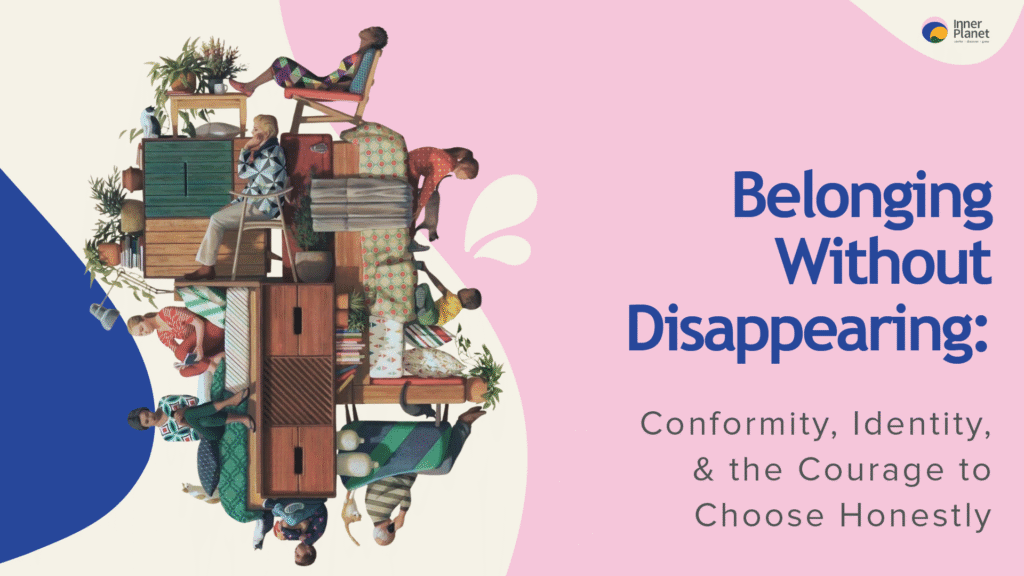
There is a particular kind of silence that follows an answer people do not expect.
“I don’t think I want that life.”
“I’m not sure this path is for me.”
Sometimes the silence is brief. Sometimes it fills the room. A parent looks confused. A friend tries to be supportive but does not quite know what to say. Someone gives a practical warning. Someone else smiles as if the whole thing is temporary, as if you will eventually come back to the person they know how to understand.
And suddenly, what began as a quiet truth inside you has become something you have to explain.
Long before we know what we want, we learn what will be applauded.
Study this. Become that. Marry by then. Earn enough. Keep the family proud. Do not make life harder than it needs to be. Become someone others can point to and say, “They turned out well.” That is conformity.
There is nothing inherently wrong with that kind of life. For many people, it is not a performance. It is not surrender. It is where love, duty, ambition, and peace take root.
But sometimes the life that looks right from the outside feels strangely airless from within. Sometimes the thing everyone calls practical feels, to the person living it, like a slow departure from themselves.
This is where non-conformity begins. Not always in rebellion. Often, it begins with a private discomfort. A small but persistent question: Is this truly what I want?
This piece is not about becoming different for display, or treating the expected path as shallow. It is about the courage to live with enough honesty that belonging does not require self-erasure.
The Comfort Of Conformity And Being Approved
The world tends to be gentler with choices it can name.
A familiar life is easier to praise, easier to explain to relatives, easier to place inside a story where everyone knows their role.
“She’s doing well.”
“He’s settled now.”
“They’re on the right track.”
Social approval is not a small thing. It can sound like a proud parent on the phone, or a beaming room full of relatives. It can look like trust, admiration, family pride, professional confidence, or the simple relief of not having to translate yourself every few months.
A socially recognisable life often comes with fewer questions. It asks less of other people’s imagination. It does not disturb the room in the same way.
That matters because most of us are not indifferent to belonging. We want our choices to make sense to those who raised us, trusted us, or imagined a future for us. We want, in some tender part of ourselves, to be easy to bless.
So when someone chooses the familiar road, they may not simply be choosing conformity. They may be choosing peace. They may be choosing continuity. They may be choosing a language of love they know how to speak.
Familiar Is Not False, And Different Is Not Deeper
A life is not less real because others recognise its shape.
There can be freedom in a stable job, an arranged marriage, a big family, religious traditions, a hometown, a routine, or a role that has been lived by many before. The fact that something is familiar does not make it empty.
For some people, the conventional path of conformity is not a cage. It is a home. It fits their values, temperament, hopes, and sense of responsibility. They are not sleepwalking through it. They have chosen it mindfully.
At the same time, leaving the familiar path does not automatically make a life deeper.
Not every unusual choice is brave. Not every act of defiance is wise. Sometimes the desire to be different can become its own kind of performance. A person may stop following the crowd only to begin following an image of rebellion.
Reacting against society is still letting society set the terms.
The more meaningful departures aren’t always visible. They are the ones that come from self-knowledge rather than display. They ask, “What is true for me?”
That truth may lead someone away from the expected path, towards non-conformity. It may also lead them back to parts of tradition they once dismissed. It may lead them towards a life that looks unusual to others, or one that looks surprisingly ordinary.
What matters is not how unusual the life looks, but whether the person living it can breathe.
The Courage To Question What You Have Inherited
We inherit more than names, languages, recipes, and rituals.
We inherit ideas about what makes a life respectable. We inherit timelines. We inherit fears. We inherit dreams that may have belonged first to our parents, our communities, our schools, our faiths, our class, or the generation before us.
Some of these inheritances are precious. They ground us. They teach us how to care, endure, belong, and remember where we come from.
Others may suffocate the person we are becoming.
The difficult part is that inherited expectations often arrive wrapped in love. A parent may push a certain career because they know the terror of financial instability. A community may insist on respectability because it has learnt that being accepted can be a form of protection. A family may hold tightly to tradition because it is the thread that survived migration, loss, or change.
Not everyone who questions us is trying to control us. Some people are frightened on our behalf. Some are grieving the future they imagined for us. Some simply do not yet have a language for the life we are trying to build.
That is why questioning conformity — what we have inherited — can feel disloyal, even when it is necessary. It can feel as if we are rejecting not only an expectation, but the people attached to it.
The work, then, is not to throw everything away. It is to sort through what we have been given and ask ourselves — what helps us live authentically?
Which values help us become more whole?
Which ones ask us to shrink?
Which dreams are truly ours?
Which ones were placed in our hands before we were old enough to refuse them?
Sometimes the first act of courage is admitting how your life actually feels.
Maybe the job everyone admires leaves you numb. Maybe the relationship everyone approves of requires too much pretending. Maybe the version of success you chased for years no longer has your heart in it.
These are not easy admissions. They disturb the peace. They ask for attention.
But maturity is not accepting every inheritance. It is learning which ones can be carried without abandoning yourself.
Why Different Roads Feel Heavier
Non-conformity — taking a different road — is challenging for almost everyone.
Even people who seem independent can ache for reassurance. Even people who appear confident may lie awake wondering whether they have made their lives unnecessarily hard. Even those who speak boldly can feel the sting of being misunderstood by someone they love.
It is easier to feel certain when the world keeps agreeing with you.
There is a particular exhaustion in having to become the interpreter of your own life. You are not only making the choice; you are explaining it, defending it, softening it for others, and sometimes comforting them through their discomfort with it.
The questions may not always be cruel. Sometimes they come wrapped in concern.
“Are you sure?”
“What will people say?”
“But what if you regret it?”
“Is this really practical?”
Those questions can come from love. They can also wear you down.
Choosing differently can mean repeating yourself at dinner tables, disappointing people who genuinely care for you, watching a conversation tighten when you say what you really want, or carrying the quiet grief of no longer being easily understood.
Some people do not reject your choice outright. They simply keep waiting for you to return to the version of yourself they understood.
And there can be practical costs too. Not everyone pays the same price for difference.
Some people can experiment knowing there is a family home to return to, money in the bank, or a community that will forgive the detour. Others know that one honest choice could cost them work, housing, safety, inheritance, protection, or the relationships they depend on.
This is why “just be yourself” can sound simple and feel impossible.
Living honestly matters, but it is not always safe, simple, or rewarded quickly. Courage does not magically erase the consequences of non-conformity. It helps us see them clearly and still ask what kind of life we can live without losing ourselves completely.
The different road can feel heavier not because the person walking it is weak, but because they may be walking without adequate support.
We Shape And Are Shaped
No man is an island.
We are shaped by the homes we grew up in, the languages we speak, the stories we were told, the rules we learnt to follow, the warnings we absorbed, and the possibilities we were encouraged to imagine.
The world around us does not sit outside us like a distant authority. It enters us early. It gives us words for who we are, and sometimes withholds them.
So the aim isn’t to escape every influence. That is impossible. The better task is to become more conscious of the conversation we are having with those influences.
Which parts of my world have helped me become more generous, more rooted, more alive? Which parts have made me smaller? Which expectations protect something valuable, and which ones only preserve someone else’s comfort?
But this shaping does not go in only one direction.
What we call normal is often just what has been repeated long enough. And what feels unusual now may, through enough honest lives, become easier for someone else to choose later.
Most change does not look dramatic while it is happening. Sometimes it looks like one person in a family choosing tenderness where there used to be silence. One person in a workplace refusing to treat burnout as a badge of honour. One person in a community naming a truth that others were afraid to say aloud.
Sometimes the first person to live differently is called difficult. Years later, they are called the reason someone else felt less afraid.
Non-conformity, at its best, is not an escape from society. It is a more truthful way of participating in it.
Belonging Without Disappearing
Underneath both conformity and non-conformity, there is often the same longing.
We want to belong.
Some people choose conformity because approval feels like safety. Others choose non-conformity because self-erasure eventually becomes its own kind of loneliness. These may look like opposite movements, but they often begin from the same human place: the desire to be loved without being exiled from oneself.
The deeper hope is not to stand apart forever. It is not to be admired for being unusual. It is not to build an identity out of opposition.
The hope is to belong without pretending.
A healthier society would have room for more than one version of a meaningful life. It would recognise dignity in paths that do not all look alike. It would not ask people to flatten themselves in order to be considered respectable.
And a healthy individual remains open to conformity, too. None of us becomes whole simply because we have rejected an expectation. We still need to be challenged, softened, corrected, loved, and shaped by others. There is no freedom in becoming unreachable.
We do not need to live untouched by society. We need enough room within it to remain recognisable to ourselves.
Perhaps that is the deeper courage: not standing alone for the sake of standing alone, but standing honestly among others.
Maybe, over time, the silence after an unexpected answer becomes less frightening.
Maybe it becomes a space where a truer conversation can begin.
Not every life needs to surprise the world. Not every life needs to soothe it either. Some people will find themselves on the familiar road that conformity brings. Others will need to step away from it. Most of us, at different points, will have to ask which parts of our lives were chosen freely and which parts were built to keep us acceptable.
The question is not simply whether we have followed the expected path or left it. The better question may be whether we are awake inside the life we are building.
A society becomes more humane when it has room for many honest lives, or in other words, room for non-conformity. And a person becomes freer when they no longer have to disappear in order to belong.
And if you need help on this journey we’re always just a call away!