

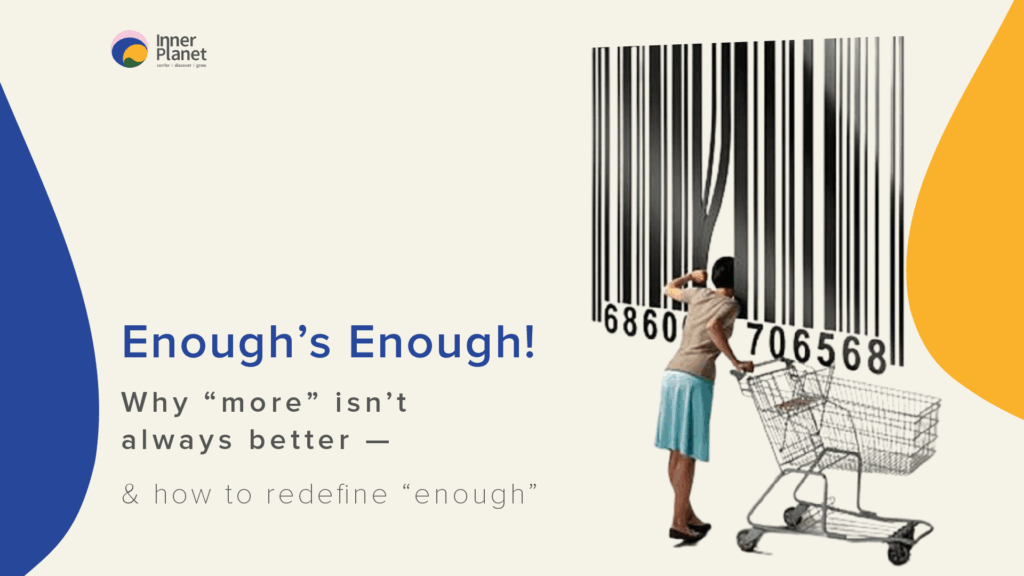
We live in an age where the horizon always seems to move just a few steps ahead of us. Each new purchase, promotion, or project promises satisfaction, only to rush to the next goal. Consumerism today isn’t just about what we buy — it’s about how we think, plan, and measure our worth. It has quietly turned “more” into a moral compass, guiding our sense of success and even self-worth.
But what happens when the pursuit of more leaves us drained? When the thrill of achievement fades faster than we expected, and the next milestone already looms large? Perhaps it’s time to ask the question we rarely pause to consider — when is enough truly enough?
The Culture of “Next”
Modern consumerism thrives on restlessness. The world around us — from adverts to algorithms — is designed to keep us chasing. There’s always a “next”: the next phone, next hustle, next life upgrade. Even ambition, once a healthy motivator, has been repackaged into the perpetual urgency of grasping for more.
The system runs on our natural drive for progress and improvement. Humans are wired to seek novelty and reward — to explore beyond the cave, to build, to improve. The problem begins when the search for growth becomes a race with no finish line. We start to equate constant motion with meaning, mistaking acceleration for advancement.
It’s like being on a treadmill that speeds up each time you adjust your pace. You’re not lazy for feeling tired — you’re simply human, trying to keep up with a culture that never pauses.
The Half-Empty Glass Syndrome
We’ve learnt to measure life by its missing pieces. If we’re not reaching, we feel we’re falling behind. A raise isn’t enough once we know someone else earns more. A quiet weekend feels unproductive if the world is posting “grindset” highlights online.
Consumerism feeds this “glass-half-empty” view because that is beneficial for it. It keeps us comparing, upgrading, refreshing. Yet, in that constant appraisal, we forget to appreciate. Fulfilment slips through our fingers because we’re already grasping for the next thing.
The truth is, contentment doesn’t mean a lack of ambition. It means learning to stand still without feeling left behind. To look at what we have — career, home, relationships — and recognise that sufficiency isn’t the enemy of growth. It’s the ground from which meaningful growth begins, fertilized by contentment and gratitude.
Redefining “Enough” in a World of More
“Enough” isn’t a number; it’s a feeling — and a personal one at that. For some, it’s financial security; for others, it’s time, peace, or creative freedom. The challenge is that in a consumerist world, our inner compass for “enough” gets scrambled by the noise of collective aspiration.
To redefine it, we must first silence the noise and look inward. Ask: What actually adds value to my life? What do I pursue because I find it meaningful, and what do I chase because I’m conditioned to?
“Enough” doesn’t mean settling or lowering standards. Think of it like tuning a radio — clarity doesn’t come from simply turning the volume up, but from adjusting the frequency. When we decide what’s truly ours to pursue, the static of comparison begins to fade.
The Power of Pause and Celebration
Consumerism teaches us to incessantly climb — but rarely to rest. We rush past our own victories like travellers sprinting full speed through scenic routes. We often leave for places, yet rarely, if ever, arrive. Celebration and self-awareness, then, are not self-indulgence; they’re acts of acknowledgment. It tells our mind, you’ve arrived, you’re truly here.
Pausing isn’t giving up momentum; it’s recalibrating direction. Like a runner who stops to tie their laces, you move forward more steadily when you take a moment to reflect.
And in that pause — gratitude grows. Ambition, now tempered with self-awareness, gratitude, and contentment, becomes sustainable.
The solution doesn’t have to be complicated. Life isn’t a spreadsheet of goals; sometimes “enough” is simply a hot cup of tea, a good laugh, and the realisation that peace of mind was never something we could buy in the first place.
Consumerism isn’t the villain of our story — it’s the backdrop. The real story is how we choose to live within it. To want more isn’t wrong; to never feel complete because of it is exhausting.
Maybe the quiet rebellion of our times is not to reject progress, but to redefine it. To see “enough” not as the end of aspiration, but as its anchor. Because in a world that constantly tells us to seek more, perhaps the most radical act is to pause, breathe, and say — this will do.
And perhaps that’s the quiet reminder we all need — enough is enough. Not in surrender, but in self-recognition. Enough as in, I have done, I have tried, I have lived — and for now, this is sufficient.
And if you need help cultivating this mindset we’re always just a call away!