

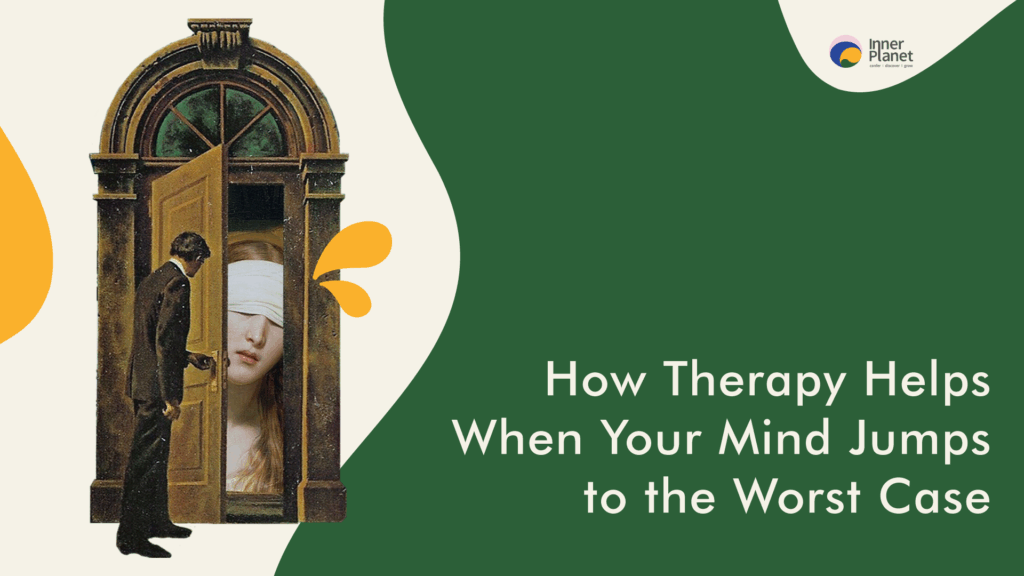
It often starts quietly. A message goes unanswered. A physical sensation feels unfamiliar. A conversation doesn’t go the way we expected. Before we know it, the body tightens, thoughts race, and a single moment begins to feel like the beginning of something unendingly and permanently terrible; something utterly unbearable.
If you recognise this negative thinking pattern, you are not alone. Many people experience moments where the mind keeps jumping to the worst outcomes; from “this is hard” to “this is an absolute hecking disaster.” REBT theory in psychology has a name for this process: catastrophizing.
Let’s explore what catastrophizing actually means from a psychological perspective, why the mind does this—especially under stress or uncertainty—how it affects emotions and daily life, and how therapy helps people soften these extreme inner alarms without denying reality or pain.
What Do We Mean by “Catastrophizing”?
Catastrophizing refers to a specific way of evaluating events. It is not simply noticing that something has gone wrong. It is the belief that what has happened is awful, unbearable, or the worst thing that could ever happen.
In Rational Emotive Behavior Therapy (REBT), catastrophizing is understood as an evaluative belief—a judgment about the meaning and severity of an event, rather than a description of the event itself (Dryden, 2012; DiLorenzo et al., 2011). Two people can face the same situation—failure, rejection, loss—and experience very different emotional reactions depending on how they evaluate or perceive it.
When psychologists describe catastrophizing as “irrational fear thoughts,” they are not saying it is silly or dramatic emotional overreaction. They are pointing to its extreme and absolute nature. Catastrophizing leaves no room for coping, adaptation, or perspective. The situation is not just bad—it is framed as intolerable and devastating, which escalates emotional distress far beyond the situation itself.
Catastrophizing Is Not the Same as Worry
Many people assume catastrophizing is just intense worry, but there is an important difference.
Worry often sounds like: “What if something goes wrong?”
Catastrophizing sounds like: “If this goes wrong, I won’t be able to handle it.”
Psychologically, this distinction matters. REBT differentiates between inferential errors (mistaken predictions about what might happen) and evaluative errors (judgments about how bad it would be if it did happen). A person may accurately predict a negative outcome and still remain emotionally steady—unless catastrophic evaluation takes over (Dryden, 2012).
In other words, distress does not come only from uncertainty or risk. It comes from the belief that certain outcomes would be unbearable or disastrous.
Why the Mind Escalates So Quickly
Once catastrophizing is activated, it rarely stays contained. Research shows that catastrophic thinking tends to unfold as a chain of “what if” questions, each adding another layer of threat (Davey & Levy, 1998). The mind moves rapidly from one imagined consequence to the next, escalating emotional arousal along the way.
This process is supported by threat appraisal—the subjective interpretation of situations, sensations, or outcomes as signals of serious danger. Attention narrows. The mind scans for confirming evidence. Bodily sensations such as anxiety or tension are then interpreted as further proof that something is terribly wrong (Clark, 1986). Like a mother’s unexplainable anxiety regarding her child’s safety in her absence.
REBT describes this as a feedback loop: catastrophic evaluations intensify emotions, and intense emotions are then read as signs of impending breakdown or loss of control (Dryden, 2012). The problem is not that the mind reacts—reactivity is human—but that the reaction becomes self-reinforcing, snowballing.
When Emotions Become Overwhelming
REBT makes a helpful distinction between healthy and unhealthy negative emotions. Sadness, concern, disappointment, and grief are painful, but they tend to remain proportionate and allow for reflection and problem-solving. Catastrophizing, however, is strongly linked to unhealthy emotional states such as panic, debilitating anxiety, rage, and despair (Cramer & Kupshik, 1993).
When an event is evaluated as unbearable or disastrous, emotional intensity rises sharply. Thinking becomes rigid and can turn into overthinking spirals. The nervous system shifts into survival mode. This is why people often say, “I knew I was overreacting, but I couldn’t stop.” Catastrophizing does not just create distress—it hijacks emotional regulation.
What the Research Shows About Its Impact
A substantial body of research links catastrophizing with higher levels of psychological distress across conditions. A large meta-analysis of 83 studies found that irrational beliefs—including catastrophizing—were moderately associated with emotional distress, including anxiety, depression, anger, and guilt (Vîslă et al., 2016).
Importantly, these associations remain even when accounting for situational severity. People who catastrophize more strongly tend to experience greater emotional intensity than others facing similar circumstances (DiLorenzo et al., 2011). This supports the idea that catastrophizing is not simply a reaction to difficult lives—it is a cognitive–emotional process that amplifies suffering.
How Catastrophizing Shows Up in Daily Life
Catastrophizing is not something that only shows up in severe cases. It also appears in everyday experiences:
- An unexplainable physical symptom becomes a sign of serious illness
- A conflict in a relationship feels like irreversible damage that destroys the bond
- An exam or work mistake is seen as a permanent failure
- Chronic pain is interpreted as evidence of permanent incapacity
Research in academic settings shows that students with higher catastrophic beliefs experience significantly greater exam-related distress, regardless of actual performance demands (DiLorenzo et al., 2011). Similarly, in pain research, catastrophizing is associated with greater pain intensity, disability, and functional impairment, even when medical factors are controlled (Wertli et al., 2014).
Across contexts, the pattern is the same: catastrophic evaluation magnifies threat, narrows perceived options and leads to thinking traps.
Why Avoidance Feels Helpful—and Isn’t
When something feels unbearable, avoidance makes sense. People cancel plans, seek reassurance, suppress anxious thoughts, or over-monitor symptoms in an effort to feel safe. These behaviours often reduce distress temporarily.
However, research on fear-avoidance models shows that avoidance prevents corrective learning. When catastrophic beliefs are never tested, they remain intact and even grow stronger over time (Vlaeyen & Linton, 2000 as cited in Quartana et al., 2009). Life gradually becomes organised around preventing imagined disasters, which reinforces the belief that those disasters truly are intolerable.
Avoidance is not a failure of willpower. It is a natural response to perceived threat. But it comes at a cost.
Can Catastrophizing Actually Change?
Yes. Across therapeutic approaches, catastrophizing is consistently identified as a modifiable process.
REBT directly targets catastrophic evaluations through structured disputation—examining whether an outcome is truly unbearable and developing more flexible, preference-based alternatives (Dryden, 2012). Experimental studies show that replacing catastrophic self-statements with non-extreme appraisals leads to meaningful reductions in emotional distress, even when situations do not change (Cramer & Kupshik, 1993).
Other approaches, including exposure-based CBT and acceptance-oriented therapies, also reduce catastrophizing through different pathways—by disconfirming feared outcomes, increasing tolerance for discomfort, or reducing the dominance of catastrophic thoughts (Foa & Kozak, 1986; Martínez-Calderón et al., 2024).
What Therapy Does Differently
Therapy does not try to convince people that nothing bad will happen. Instead, it works to loosen the belief that bad outcomes are unmanageable.
Research suggests several overlapping mechanisms through which catastrophizing reduces:
- Evaluative reappraisal
This involves learning to loosen extreme judgments such as “this is unbearable” and replace them with more flexible, preference-based evaluations. The situation may still be difficult or painful, but it is no longer framed as disastrous or intolerable. Experimental REBT research shows that changing these evaluative beliefs is associated with meaningful reductions in emotional distress, even when circumstances remain unchanged (Cramer & Kupshik, 1993; DiLorenzo et al., 2011; Dryden, 2012). - Corrective experiences through approach
Catastrophizing is often maintained by avoidance. When feared situations are gradually approached rather than avoided, catastrophic expectations can be tested and weakened through lived experience. Exposure- and learning-based models show that approaching feared stimuli allows new, non-catastrophic information to be integrated, reducing the emotional power of worst-case appraisals (Foa & Kozak, 1986; Vlaeyen & Linton, 2000 as cited in Quartana et al., 2009). - Increased self-efficacy
Research highlights the importance of perceived coping capacity. When individuals experience themselves as more capable of handling distress, uncertainty, or discomfort, catastrophic evaluations lose some of their emotional impact. Self-efficacy acts as a buffer, shaping how strongly catastrophizing translates into anxiety and distress (Bandura, 1977; Kardash et al., 2024). - Greater psychological flexibility
Process-based approaches emphasise changing one’s relationship with catastrophic thoughts rather than eliminating them. From this perspective, catastrophic ideas may still arise, but they no longer dominate behaviour or decision-making. Studies show that increased psychological flexibility is associated with reductions in catastrophizing and improvements in functioning, even without direct cognitive disputation (de Boer et al., 2014; Martínez-Calderón et al., 2024; Sanabria-Mazo et al., 2023).
Across models, change occurs when catastrophic meaning loses its power to govern attention, emotion, and action (Smeets et al., 2006; Ranjbar et al., 2020). The goal is not emotional numbness, but emotional proportionality followed by emotional regulation
Life will always include uncertainty, loss, and pain. Therapy does not remove these realities. What it can change is the inner narration that turns difficulty into disaster.
Catastrophizing tells us that suffering is unbearable and that collapse is inevitable. Therapy helps restore a quieter, sturdier truth: this is hard, but it is survivable. And in that shift—from disaster to difficulty—people often find room to breathe again, to choose more freely, and to live with greater steadiness.
If you find yourself caught in catastrophic spirals, seeking support is not a sign that something is wrong with you. It is a recognition that no one is meant to navigate these inner storms alone. And if you need help braving the storms we’re always just a call away!
References
- Bandura, A. (1977). Self-efficacy: Toward a unifying theory of behavioral change. Psychological Review, 84(2), 191–215. https://doi.org/10.1037/0033-295X.84.2.191
- Carleton, R. N., Norton, M. A., & Asmundson, G. J. (2007). Fearing the unknown: A short version of the Intolerance of Uncertainty Scale. Journal of Anxiety Disorders, 21(1), 105–117. https://doi.org/10.1016/j.janxdis.2006.03.014
- Clark, D. M. (1986). A cognitive approach to panic. Behaviour Research and Therapy, 24(4), 461–470. https://doi.org/10.1016/0005-7967(86)90011-2
- Cooke, M. E., Edwards, R. R., Wheeler, G. L., Schmitt, W. A., Nielsen, L. V., Streck, J. M., Schuster, R. M., Potter, K., Evins, A. E., & Gilman, J. M. (2023). Pain catastrophizing is associated with reduced neural response to monetary reward. Frontiers in Pain Research, 4, 1129353. doi: 10.3389/fpain.2023.1129353 https://www.frontiersin.org/journals/pain-research/articles/10.3389/fpain.2023.1129353/full#cite
- Cramer, D., & Kupshik, G. (1993). Effect of rational and irrational statements on intensity and “inappropriateness” of emotional distress and irrational beliefs in psychotherapy patients. British Journal of Clinical Psychology, 32(3), 319–329. https://doi.org/10.1111/j.2044-8260.1993.tb01062.x
- Davey, G. C. L., & Levy, S. (1998). Catastrophic worrying: Personal inadequacy and a perseverative iterative style as features of the catastrophizing process. Journal of Abnormal Psychology, 107(4), 576–586. https://doi.org/10.1037/0021-843X.107.4.576
- David, D., Szentagotai, A., Lupu, V., & Cosman, D. (2008). Rational emotive behavior therapy, cognitive therapy, and medication in the treatment of major depressive disorder: A randomized clinical trial, posttreatment outcomes, and six-month follow-up. Journal of Clinical Psychology, 64(6), 728–746. https://doi.org/10.1002/jclp.20487
- De Boer, M. J., Steinhagen, H. E., Versteegen, G. J., Struys, M. M., & Sanderman, R. (2014). Mindfulness, acceptance and catastrophizing in chronic pain. PLOS ONE, 9(1), e87445. https://doi.org/10.1371/journal.pone.0087445
- DiLorenzo, T., David, D., & Montgomery, G. (2011). The impact of general and specific rational and irrational beliefs on exam distress: A further investigation of the binary model of distress as an emotional regulation model. Journal of Cognitive and Behavioral Psychotherapies, 11(2), 121–142. https://jebp.psychotherapy.ro/vol-xi-no-2-2011/the-impact-of-general-and-specific-rational-and-irrational-beliefs-on-exam-distress-a-further-investigation-of-the-binary-model-of-distress-as-an-emotional-regulation-model/
- Dryden, W. (2012). The “ABCs” of REBT I: A preliminary study of errors and confusions in counselling and psychotherapy textbooks. Journal of Rational-Emotive & Cognitive-Behavior Therapy, 30, 133–172. https://doi.org/10.1007/s10942-011-0137-1
- Foa, E. B., & Kozak, M. J. (1986). Emotional processing of fear: Exposure to corrective information. Psychological Bulletin, 99(1), 20–35. https://doi.org/10.1037/0033-2909.99.1.20
- Foa, E. B., Rothbaum, B. O., Riggs, D. S., & Murdock, T. (1991). Treatment of posttraumatic stress disorder in rape victims: A comparison between cognitive-behavioral procedures and counseling. Journal of Consulting and Clinical Psychology, 59(5), 715–723. https://doi.org/10.1037//0022-006X.59.5.715
- Kardash, L., Wall, C. L., Flack, M., & Searle, A. (2024). The role of pain self-efficacy and pain catastrophising in the relationship between chronic pain and depression: A moderated mediation model. PLOS ONE, 19(5), e0303775. https://doi.org/10.1371/journal.pone.0303775
- Ladouceur, R., Dugas, M. J., Freeston, M., Léger, E., Gagnon, F., & Thibodeau, N. (2000). Efficacy of a cognitive–behavioral treatment for generalized anxiety disorder: Evaluation in a controlled clinical trial. Journal of Consulting and Clinical Psychology, 68(6), 957–964. https://doi.org/10.1037/0022-006X.68.6.957
- MacLaren, C., Doyle, K. A., & DiGiuseppe, R. (2016). Rational emotive behavior therapy (REBT) theory and practice. In H. E. A. Tinsley, S. H. Lease, & N. S. Giffin Wiersma (Eds.), Contemporary theory and practice in counseling and psychotherapy (pp. 233–263). SAGE Publications, Inc.
- Martínez-Calderon, J., García-Muñoz, C., Rufo-Barbero, C., Matias-Soto, J., & Cano-García, F. J. (2024). Acceptance and commitment therapy for chronic pain: An overview of systematic reviews with meta-analysis of randomized clinical trials. The Journal of Pain, 25(3), 595–617. https://doi.org/10.1016/j.jpain.2023.09.013
- Quartana, P. J., Campbell, C. M., & Edwards, R. R. (2009). Pain catastrophizing: A critical review. Expert Review of Neurotherapeutics, 9(5), 745–758. https://doi.org/10.1586/ern.09.34
- Ranjbar, S., Mazidi, M., Sharpe, L., Dehghani, M., & Khatibi, A. (2020). Attentional control moderates the relationship between pain catastrophizing and selective attention to pain faces on the antisaccade task. Scientific Reports, 10, 12885. https://doi.org/10.1038/s41598-020-69910-2
- Rosin, L., & Nelson, W. M. (1983). The effects of rational and irrational self-verbalizations on performance efficiency and levels of anxiety. Journal of Clinical Psychology, 39(2), 208–213. https://psycnet.apa.org/doi/10.1002/1097-4679(198303)39:2%3C208::AID-JCLP2270390210%3E3.0.CO;2-S
- Smeets, R. J., Vlaeyen, J. W., Kester, A. D., & Knottnerus, J. A. (2006). Reduction of pain catastrophizing mediates the outcome of both physical and cognitive-behavioral treatment in chronic low back pain. The Journal of Pain, 7(4), 261–271. https://doi.org/10.1016/j.jpain.2005.10.011
- Turner, M. J. (2016). Rational emotive behavior therapy (REBT), irrational and rational beliefs, and the mental health of athletes. Frontiers in Psychology, 7, 1423. https://doi.org/10.3389/fpsyg.2016.01423
- Vîslă, A., Flückiger, C., Holtforth, M. G., & David, D. (2016). Irrational beliefs and psychological distress: A meta-analysis. Psychotherapy and Psychosomatics, 85(1), 8–15. https://doi.org/10.1159/000441231
- Vlaeyen, J. W., & Linton, S. J. (2000). Fear-avoidance and its consequences in chronic musculoskeletal pain: A state of the art. Pain, 85(3), 317–332. https://doi.org/10.1016/S0304-3959(99)00242-0
- Wertli, M. M., Eugster, R., Held, U., Steurer, J., Kofmehl, R., & Weiser, S. (2014). Catastrophizing-a prognostic factor for outcome in patients with low back pain: A systematic review. The Spine Journal: Official Journal of the North American Spine Society, 14(11), 2639–2657. https://doi.org/10.1016/j.spinee.2014.03.003