

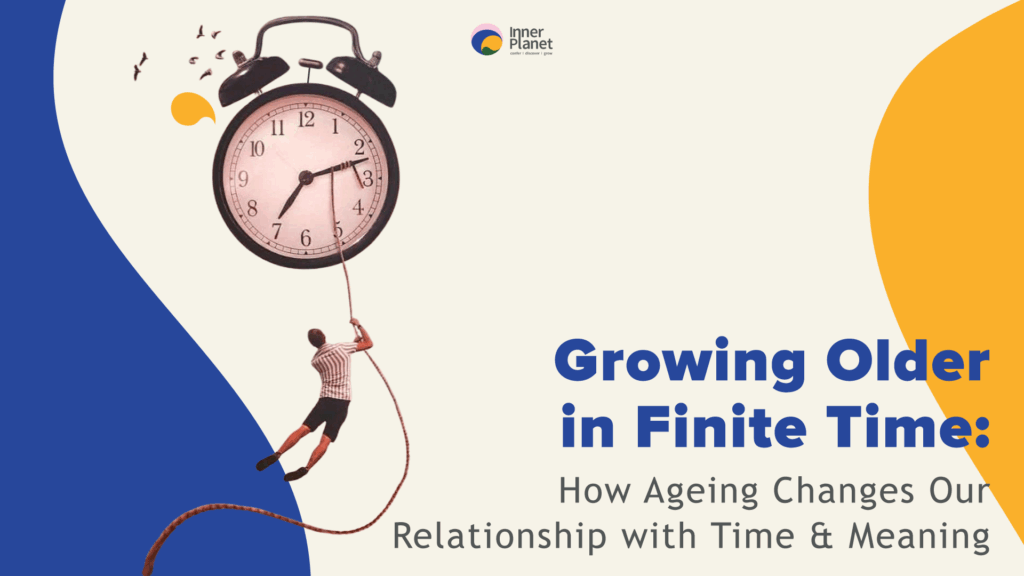
In life there comes a moment when time starts to feel different.
A birthday passes faster than expected. A year seems to disappear between two calendar notifications. The body takes a little longer to recover after an ordinary day. Nothing is “wrong,” exactly—but something has shifted.
For many people, this is the beginning of what we call growing old. Not in the sense of decline or defeat, but in the sense of becoming aware. Aware of time. Aware of limits. Aware of age. Aware that life is not endlessly editable. And while this awareness can feel unsettling, it is also deeply human.
Finite Time
Earlier in life, time feels generous; perhaps it’s not even a consideration for decades. There is room to make mistakes, change directions, postpone decisions. “Someday” feels comfortably vague. Choices don’t yet carry much weight because there seems to be plenty of future left to accommodate them.
As we grow older, that relationship changes. The future still exists, but it feels more defined. Certain paths close. Decisions feel heavier, not because we are pessimistic, but because we understand their cost more clearly. Time begins to feel personal.
This shift is rarely announced. It arrives in everyday moments—realising a plan has been postponed for years, noticing how quickly months pass, or sensing that energy needs to be spent more carefully than before.
The Body Notices First
Often, the body is the first to register this change.
Unexplainable back pain that crops up. Fatigue that lingers. Recovery that takes longer than an overnight rest.
These experiences can be confusing, even frustrating. We are taught to see the body as something to optimise or fix, so when it slows down, it can feel like betrayal. But the body is not failing—it is communicating.
Through aches, stiffness, and altered rhythms, the body introduces us to time in a more immediate way. It reminds us that life is finite. This can feel uncomfortable, but it is also grounding. We are no longer abstract beings planning a future; we are embodied people living one.
Why This Awareness Feels Uncomfortable
This new awareness of time often brings a quiet unease. Not exactly panic, but a restlessness. A sense that something needs attention, even if we cannot yet name it.
People sometimes feel guilty about this discomfort, especially if their life feels stable. But discomfort here is not ingratitude. It is not a sign of failure. It is what happens when we realise that time is limited and that our lives matter more because of it.
This is a natural human confrontation; not a weed to be removed, but a moment to understand.
The Grief That Comes With Living
As awareness deepens, so can grief. The quiet grief of recognising that some versions of life will never be lived. Paths not taken. Selves imagined, never realised.
This grief often goes unspoken because it feels disloyal to the life we do have. But gratitude and grief are not opposites. They frequently coexist. Feeling both does not mean we have lived poorly—it means we have lived attentively.
Grief, in this sense, is not about regret alone. It is about recognising the weight of choice and the reality that every life is shaped as much by what was let go as by what was chosen.
Oldness
There is a tendency to equate getting older with becoming “old” in spirit. But these are not the same.
The body may slow down. Energy may need to be conserved. These are real changes. But what truly drains vitality is not age itself—it is disengagement from meaning. When curiosity fades, when life begins to feel empty or repetitive, when connection thins, people often describe feeling old regardless of their actual age.
Oldness, in this sense, is not about years lived. It is when we feel disconnected with the joy of living. And this can happen at 30 or 70.
Importantly, this is not a moral failing. It is often a response to exhaustion, disappointment, or prolonged stress. The task is not to judge it, but to notice it and reengage with life in meaningful ways.
Age: The Giver and Taker
Ageing is often framed as loss—and there is loss. But there is also a quiet deepening that comes with time.
Many people develop a greater tolerance for complexity, a clearer sense of what matters, and a reduced appetite for what does not. The urgency to accumulate gives way, slowly, to a desire for meaning. Life shifts from expansion to essence.
This may not make life easier, but it sure makes it more authentic.
Living With Time
The existential task of growing older is not to outrun time or to master it. It is to learn how to live with it.
This might mean allowing the body to set new rhythms. Letting go of unnecessary rushing. Not postponing joy indefinitely. Meeting limitations with curiosity rather than resentment.
Time does not ask us to do more with it. It asks us to be more present within it.
Growing older is not a problem to solve. It is a relationship to understand. One’s relationship with time.
We do not need fear of aging, nor do we need to romanticise it. What matters is how we stay connected to meaning, curiosity, and life—even as time makes itself known.
Perhaps growing old is less about losing time, and more about finally learning how to live within it.
And if you need help on this journey we’re always just a call away!