

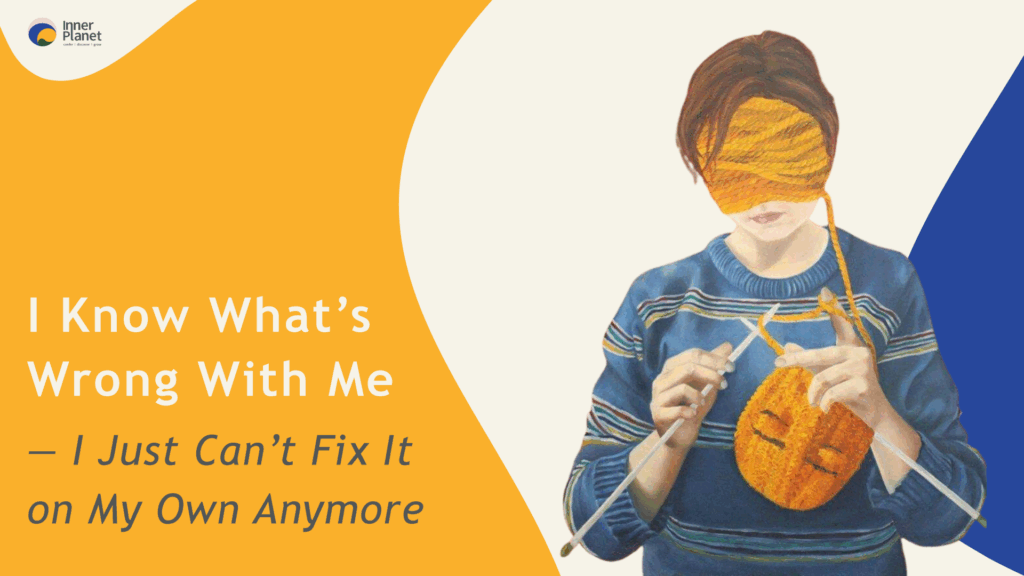
We know our patterns.
Where they come from.
We can trace the line from past to present with uncomfortable accuracy.
We know why we react the way we do, why certain situations unsettle us, why some relationships feel heavier than others.
We’ve spent time thinking about ourselves. We’ve reflected, journalled, talked things through in our heads. Some of us have read enough to even name what’s happening almost as it unfolds.
And yet, things haven’t improved.
There’s a quiet exhaustion that comes with being this self-aware. A sense that insight was supposed to do more than this. That once we understood ourselves, things would start loosening on their own.
Let’s explore this reflection on a very specific moment many of us reach: when we understand ourselves well — and still feel stuck. We’ll explore why that happens, what makes self-improvement hit a limit, and what changes when we stop trying to carry it all alone.
When Awareness Starts to Feel Heavy
At some point, awareness stops feeling empowering and starts feeling like a burden.
We notice everything. The emotional shift. The familiar thought spiral. The old reaction arriving right on schedule. We catch ourselves in real time — and somehow that makes it worse. Now there’s frustration layered on top of the original feeling.
“I know I’m doing it again.”
“I know this isn’t helpful.”
“I know where this comes from.”
Awareness turns into constant self-monitoring. We observe ourselves instead of inhabiting our lives. We correct, manage, and mentally annotate our reactions — but the emotional charge doesn’t always follow logic.
And quietly, shame creeps in. Because if we understand ourselves this well, shouldn’t we be doing better by now?
The Limit of Trying to Fix Ourselves
The uncomfortable truth is that understanding a pattern and changing it are not the same thing. Like the difference between understanding how an internal combustion engine works and actually driving a car.
Many of the patterns we struggle with aren’t cognitive puzzles.
They’re emotional responses wired through experience, shaped in relationship, and activated when we’re overwhelmed, threatened, or vulnerable.
They don’t arise when we’re calm and reflective — they show up when perspective narrows and old reflexes take over.
From inside that moment, clarity is hard to access. We’re in it, not observing it.
This isn’t a failure of intelligence or effort. It’s a limitation of doing emotional work in isolation. Some patterns simply can’t be shifted from inside the system they live in.
The Cost of Always Handling It Alone
Most of us learned, early on, to handle things ourselves.
We became good at thinking through pain, staying functional, keeping things together. We learned to rely on our own insight and competence because it was safer, more predictable, or simply what was available.
That self-reliance deserves respect. It has protected us; helped us survive.
But over time, it can also become a glass ceiling.
Carrying everything internally means we never get to put anything down. We hold the understanding and the emotion, the awareness and the weight.
There’s no shared space where something can be processed differently. Just more responsibility to manage ourselves well.
And that’s exhausting.
How Support Changes the Equation
There is a noticeable shift that happens when we stop trying to do all of this inside our own heads.
When a trusted friend hears us say something we’ve been circling internally for years. When a family member reflects something back that lands differently than our own thoughts ever did.
Human beings don’t make sense of themselves in isolation. We never have. Perspective, emotional regulation, and meaning-making are relational processes.
What felt fixed internally begins to move simply because it is no longer being carried alone.
This is not about advice. Or being told what to do. It’s about allowing another mind to hold a piece of the process with us — and noticing how that alters what’s possible.
Why Some Support is Different Than Others
Of course, not all support does the same kind of work.
Friends and loved ones offer warmth, reassurance, familiarity. They remind us who we are when we’re stuck inside a narrow version of ourselves. That kind of support matters deeply, and for many moments in life, it is enough.
But there are patterns that aren’t addressed in those spaces. Not because the people around us aren’t caring — but because they are inside our lives.
They have their own stakes, histories, and emotional investments. They can walk with us, but they can’t always slow the process down, hold it steady, or stay with the discomfort long enough for something new to emerge.
Some patterns require guidance from a professional in a space designed not just for comfort, but for clarity.
What Therapy Offers That Other Spaces Can’t
This is where therapy becomes a natural next step — not a last resort.
Therapy offers a relationship with clear boundaries, intention, and continuity. A space where the focus doesn’t drift. Where nothing needs to be protected or managed. Where emotions don’t have to be softened for someone else’s needs.
In that setting, patterns can be noticed as they unfold, not just discussed afterwards. Reactions can be slowed down instead of overridden. The things we habitually rush past — discomfort, contradiction, uncertainty — can be stayed with long enough to loosen.
This is about creating the ideal conditions in which change can occur naturally. Conditions that are difficult (if not impossible) to recreate elsewhere, no matter how loving the people around us are.
“I Should Be Able to Handle This” — Reconsidered
For many of us, the resistance to seeking help sounds reasonable.
We tell ourselves that if we’re self-aware, we should be able to work this out. That needing structured support means we’ve somehow failed to apply what we already know. That asking for help undermines our competence.
But that logic presumes that insight alone is the endpoint.
What if it isn’t?
What if insight is what brings us to the edge of what we can do alone — and no further? What if reaching for support isn’t a step backwards, but an organic step forward into a better way of working with ourselves?
Seen this way, seeking help isn’t a collapse of self-sufficiency. It’s its natural extension.
The Relief of Not Carrying the Weight Alone
There is a particular kind of relief that comes from sharing the weight of inner work.
Not having to steer the process.
Not having to constantly observe ourselves minutely.
Not having to keep translating feelings into something manageable.
In the presence of trusted, consistent, and attuned support, effort is shared. The work continues — but it no longer rests entirely on our shoulders. Over time, that shared holding creates space. And in that space, meaningful change flourishes.
That kind of movement doesn’t come from trying harder.
It comes from no longer doing it alone.
We do know what’s going on with us. That has never been in doubt.
But perhaps the way forward now isn’t to understand ourselves better.
Perhaps it’s to let ourselves be emotionally met where understanding has already taken us.
Not everything that matters can be changed alone. No man is an island
And if you need help on this journey we’re always just a call away!