

For many people, the idea of therapy is introduced casually—someone else mentioning it in passing. A partner says it during an argument. A friend brings it up with concern. A family member suggests it because they “just want you to have support.”
And while you listen, something doesn’t quite connect (cue internal eye roll). Not because they’re wrong, exactly, but because it doesn’t feel like your story.
Because you’re managing. You’re functioning. You’re not falling apart.
What often gets missed here is that therapy isn’t designed only for moments of collapse. It’s more like adjusting the temperature in a room you’ve lived in for years. You didn’t notice the chill until someone pointed it out—and once you do, you can’t quite ignore it.
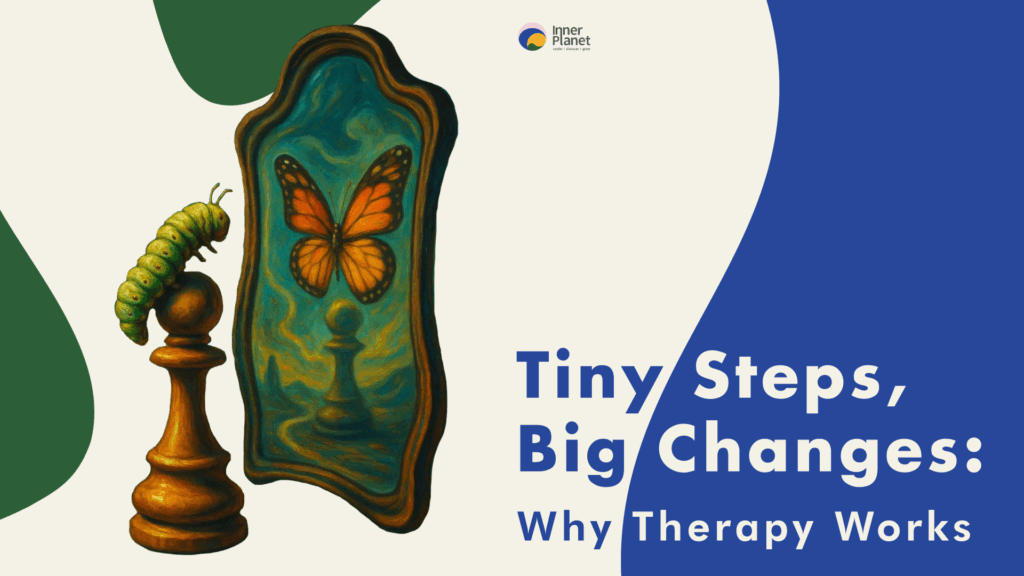
This is a piece about how therapy actually creates change. Not always through dramatic breakthroughs, but often through quiet shifts that eventually add up to big changes. It’s about why those changes often feel unimpressive at first—and why that’s precisely what makes them powerful.
Why We Expect Change to Look Obvious
We intuitively recognise change when it noticeably announces itself. Big emotions. Clear turning points. Before-and-after versions of a person.
So it’s no surprise that therapy is often imagined the same way: one intense session, one key insight, and suddenly everything makes sense. Like turning on a light in a dark room.
But real emotional change rarely works like that. It’s closer to dawn. At first, nothing seems different. The room looks the same. Then, gradually, edges soften. Shapes become clearer. You don’t notice the exact moment night becomes morning—but you know it has.
This expectation of obvious transformation is one of the reasons people dismiss therapy early. If nothing dramatic happens, it can feel like nothing is happening at all. In reality, it may just be happening quietly.
The Shifts You Almost Miss
Some of the most meaningful moments in therapy barely register at the time.
You leave a session thinking it was uneventful, only to realise later that you didn’t replay an old argument in your head on the drive home. Or you catch yourself halfway through a familiar reaction and pause—just long enough to choose something slightly different.
These are the small steps in therapy that are easy to overlook. They may not feel productive. They may not accompany emotional relief or momentous clarity. They’re more like noticing you’ve stopped clenching your jaw only after the tension headache fades.
This kind of small progress in therapy doesn’t feel like progress because it doesn’t ask for applause. It just quietly changes the way you move through a moment.
When “Nothing Happened” Is Actually Something
Almost everyone has sessions they describe as “fine” or “quiet” or “nothing much came up.”
But change doesn’t always feel like insight. Sometimes it feels flat. Sometimes confusing. Sometimes oddly neutral. That doesn’t mean the work isn’t working—it often means things are settling.
The little steps that help are often internal recalibrations:
- becoming aware of a pattern without immediately trying to fix it
- sitting with discomfort instead of rushing past it
- realising you’re allowed to take up space in the conversation
These moments don’t feel rewarding in the short term. They don’t resolve anything neatly or immediately. But they nourish the ground just enough for something new to grow later.
The Mathematics of Tiny Efforts
There’s a quiet logic to therapy that doesn’t rely on motivation or emotional intensity. It relies on honest consistency.
Think of it like adjusting your direction by a single degree. At first, it feels insignificant. But over time, that small change in course takes you somewhere entirely different.
This is where the invisible connection between consistent tiny efforts & big results become visible. In the way conversations feel less draining. In how quickly you recover after a difficult interaction. In the choices you make without needing to overthink them.
Often, other people notice these changes first. You seem calmer. More present. Less reactive. And you might not even agree with them—because from the inside, it didn’t feel like much happened at all.
Starting Without Certainty
Many people enter therapy without a clear reason of their own. They’re there because someone else suggested it, encouraged it, or worried enough to say something.
If that’s you, it doesn’t mean you’re doing therapy wrong. It means you’re starting where you are.
Therapy for beginners does not require belief, urgency, or a personal mission statement. It allows room for doubt. For observation. For showing up without knowing what you’re meant to get out of it yet.
You don’t have to be convinced. You don’t even have to be particularly hopeful. You just have to make an honest effort.
Why Therapy Works Even When You’re Not “Ready”
Readiness is often misunderstood as something you need before you begin. In reality, it’s something that develops along the way.
You don’t wait to fully understand a map before taking the first step—you understand it by walking. Therapy works in much the same way. The clarity people expect at the beginning usually arrives later, built slowly from small experiences that didn’t seem important at the time.
Ambivalence isn’t a barrier to therapy. It’s often the texture of the starting point.
Therapy doesn’t ask you to reinvent yourself. It asks you to notice yourself—gently, honestly, and consistently.
The changes it creates are rarely loud, but they’re lasting. And they don’t require certainty to begin—only a willingness to take one small step and see what happens next.
If you’re curious, uncertain, or simply wondering why people in your life think therapy might help, that curiosity alone is enough to start exploring further—at your own pace, and on your own terms.
When and if you choose to begin, we’re always just a call away!