

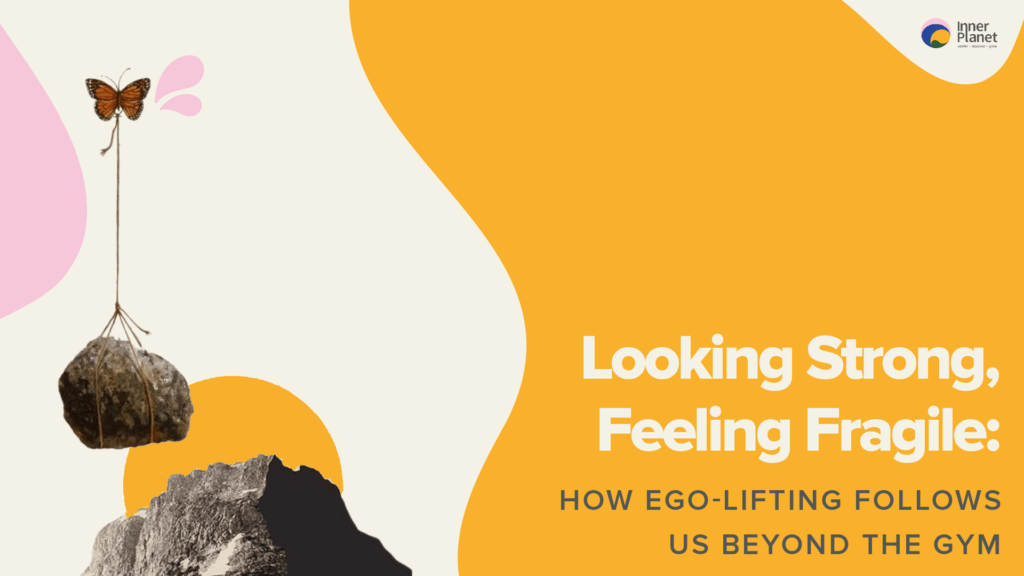
Ego lifting at the gym is when someone loads more weight than they can properly control because it helps them feel strong, look impressive, or prove something.
The bar is heavy, the form is questionable, and somewhere in the background, pride is doing quite a bit of the lifting.
It is easier to spot there because it is visible. Sometimes loud, too. Literally.
But ego lifting is also a deeply human tendency.
Essentially, the ego is the part of us that cares about identity, image, status, and how we are seen. It is the part that wants to feel important, respected, secure, and intact.
That is not automatically a bad thing. We all have an ego. The issue begins when protecting that image becomes more important than being honest, grounded, or open.
That is why ego lifting extends beyond the gym.
We are not here to mock people at the gym or shame anyone for having an ego. We are here to look at why we reach for performances of strength, how that same pattern shows up outside the gym, and why it can get in the way of real confidence.
What Ego Lifting Really Reveals
At first glance, ego lifting looks like a strength issue. More often, though, it is a self-image issue.
That is what makes the pattern useful beyond the gym.
Ego lifting is not really about the weight itself. It is about what the weight is being used to say.
Look at me.
I am strong enough.
I am not behind.
I am not weak.
I am not small.
The gym simply gives that impulse a barbell.
Outside the gym, the same pattern shows up in more acceptable, everyday forms, which is partly why it is easier to miss. A person may never attempt an absurdly heavy bench press in their life, but they may still spend years trying to look stronger than they feel.
And that is the deeper point. There is a difference between being steady and looking strong.
The ego does not always care about that difference. Real confidence usually does.
We Do It Outside The Gym Too
Once you start seeing ego lifting as a form of self-protection, you begin to notice it in all sorts of places.
You see it when someone cannot admit they were wrong, even when the evidence is right in front of them. You see it when a person turns every conversation into a subtle ranking system. You see it in people who seem determined to appear completely unaffected by everything, as though being visibly moved by life is some kind of weakness.
You also see ego lifting in quieter ways.
The need to sound more certain than you are.
The urge to mention your success before anyone asks.
The impulse to downplay someone else’s win because it stirred something uncomfortable in you.
The performance of having it all together when you very clearly do not.
Most of this does not come from some grand, cartoonish arrogance. That is what makes the concept of ego lifting more complicated, and more human, than it first appears.
A lot of ego-driven behaviour is not rooted in genuine superiority. It is rooted in discomfort. Pride is often just insecurity in a sharper outfit.
Why We Reach For It
People rarely reach for ego when they feel deeply settled within themselves.
Usually, they reach for it when something feels threatened.
Maybe they feel overlooked.
Maybe they feel behind.
Maybe they were criticised, and it landed harder than expected.
Maybe someone else’s confidence has exposed how fragile their own feels.
Maybe they are tired of feeling ordinary in a world that often rewards visibility, certainty, and performance.
If ego-based behaviour were only about vanity, it would be easier to dismiss. But a lot of it begins somewhere much more familiar: in the desire not to feel small.
And that desire is incredibly common.
Most people know what it is like to want to feel respected. To want to feel significant. To want reassurance that they matter. There is nothing strange about that. The problem starts when ego lifting becomes a habitual way of getting there.
Because ego lifting does not usually help us feel secure in the long run. More often, it helps us feel defended for a moment, without making us feel secure for long.
Why It Feels Like Strength
If ego lifting did not work at all, people would let go of it much faster. The tricky part is that it often does work, at least for brief moments.
Ego lifting can give you immediate relief. It can make you feel less exposed, less uncertain, less ordinary. It can create the impression of control at exactly the moment you feel least in control.
That is why it can be so convincing.
In the gym, ego lifting can feel powerful because the number on the bar gives you something visible to lean on. In life, the same thing happens in other forms. Being admired can feel like proof. Being right can feel like safety. Being above it all can feel like maturity. Being desired can feel like worth.
But relief is not the same as stability.
What feels like strength in the moment may actually be avoidance in a more flattering form.
It is the emotional equivalent of loading the bar for the audience instead of for the body.
And because some of these behaviours are socially rewarded, they can be hard to question.
Confidence is praised. Certainty is praised. Winning is praised. Looking untouched by doubt is often praised too.
But what often gets encouraged is not confidence. It is simply polished self-protection.
The Everyday Forms It Takes
Ego lifting is not always dramatic. More often, it slips into ordinary habits and starts making itself at home there. Following are a few common forms ego lifting can take:
Comparison as fuel
One of the most common forms of ego lifting is comparison.
Not simple noticing. Not honest reflection. Constant comparison.
Who is doing better. Who looks better. Who is further ahead. Who is getting more attention. Who seems more loved, more respected, more chosen, more impressive.
Comparison can give the ego a temporary ladder. If someone else seems lower, you feel taller.
But that kind of relief is unstable by design. It depends on scorekeeping. It depends on external measurements. It depends on never fully arriving, because there will always be someone else to compare yourself with.
So instead of feeling grounded, you end up mentally checking the scoreboard all day.
Being right as self-protection
Another common form of ego lifting is the need to be right.
Not because truth matters, although of course it does. But because being wrong feels too exposing.
For some people, correction does not feel like information. It feels like humiliation. Feedback feels like disrespect. A disagreement feels like a threat to identity rather than a normal part of being human.
This is where the ego becomes especially costly, because learning requires some tolerance for not already knowing. Relationships require some tolerance for not always winning. If every correction feels like an injury, growth starts to feel unbearable.
That is a hard way to move through life. Exhausting, too.
Showing off as reassurance
There is also the softer, more socially polished version of ego lifting: showing off as reassurance. Sharmaji comes to mind.
This is not always loud bragging. Sometimes it is subtle. Carefully casual. The kind of performance that wants to be noticed while pretending not to mind either way.
Achievements, busyness, emotional insight, discipline, status, taste, healing, even humility can all become props if the deeper goal is not expression but validation.
That is why people can sometimes turn even self-awareness into a performance. Suddenly everyone is not just growing, but apparently growing better than everyone else.
The issue is not sharing good things. It is needing those things to hold your sense of self together.
When admiration becomes regulation, silence can start to feel strangely unsettling.
Putting other people down to feel taller
This one is usually easier to recognise, though not always in ourselves.
Sarcasm that cuts a little too neatly. Dismissiveness disguised as honesty. Mockery framed as banter. Quiet contempt. The habit of reducing someone else so you can feel enlarged by comparison.
Sometimes this shows up as criticism. Sometimes as snobbery. Sometimes as behaving as though other people’s joy, pain, or effort is embarrassingly beneath you.
It is one of the clearest signs that ego is not expressing strength. It is compensating for a lack of it.
People who are genuinely secure do not usually need to build emotional height out of other people’s shortcomings.
Performative detachment
Ego lifting can also show up as the performance of being unbothered.
You know the kind of posture. Too cool to care. Too evolved to react. Too self-contained to need anything from anyone. Nothing touches them. Nothing hurts them. Nothing matters enough to move them, supposedly.
Sometimes that is composure. Sometimes it is well-disguised fear.
Detachment can become a way of avoiding embarrassment, rejection, need, tenderness, apology, grief, or dependence — in other words, all the messy human experiences the ego finds inconvenient.
But a person can spend years mastering the appearance of emotional control while becoming less and less honest about what is actually happening inside them.
That does not create strength. It creates distance.
Chasing attention
Attention can be another form of ego lifting.
Again, the issue is not enjoying praise or wanting to be seen. That is human. The issue is when visibility starts doing the work that self-worth can do more sustainably.
When attention becomes proof, its absence starts to feel like erasure.
That is how people begin confusing being noticed with being valued, or being desired with being secure. The feeling can be intense, but it does not last. It needs topping up, again and again.
That endless need for topping up is often a clue that the ego has mistaken reaction for nourishment.
Why It Becomes Dangerous
Calling this pattern dangerous may sound far-fetched at first. But the danger is not always immediately obvious. Usually, it is gradual.
Ego lifting becomes dangerous when it stops being an occasional defence and starts becoming the main way a person relates to themselves and other people.
Because then it begins to shape everything.
It shapes how you handle criticism.
How honest you can be in relationships.
How much vulnerability you can tolerate.
How threatened you feel by other people’s success.
How willing you are to admit fear, hurt, envy, uncertainty, or need.
How much of your life becomes image management.
That has consequences.
A person led too heavily by ego often becomes harder to know. They may be admired, but not close. Impressive, but not at ease. Surrounded, but not especially connected. They can spend so much energy protecting an image of strength that they never build the steadiness real strength requires.
That is one of the most painful losses in all this.
The ego promises protection, but often produces fragility. It tells you to avoid anything that could expose weakness, but that only makes ordinary human experiences harder to bear. Being wrong feels unbearable. Being overlooked feels crushing. Being criticised feels personal. Being vulnerable feels unsafe.
So the person keeps lifting with the ego, in one form or another, while becoming less able to tolerate life without it.
And the more settled that pattern becomes, the more reality itself can start to feel offensive. Other people become threatening mirrors. Feedback becomes disrespect. Honesty becomes uncomfortable. Intimacy becomes risky, because intimacy requires being seen without the performance.
That is why this matters.
The problem with ego lifting, in any form, is not that it makes people think highly of themselves. It is that it can make them less able to face themselves truthfully.
What Real Confidence Looks Like Instead
Real confidence does not need to announce itself every few minutes. It does not depend on being the most impressive person in the room. It does not collapse the second someone else shines. It does not need an audience in order to exist.
Real confidence can survive being wrong.
That alone separates it from a lot of ego-driven behaviour.
A grounded person can be corrected without turning it into a courtroom drama. They can apologise without feeling erased. They can admire someone else without feeling diminished. They can admit uncertainty without believing it lowers their value.
That does not mean they enjoy every uncomfortable emotion. It simply means they are not ruled by the need to defend themselves from all of them.
Real confidence is not perfect self-belief. It is a steadier relationship with imperfection.
It is the difference between needing to appear strong and being willing to become stronger.
How To Notice It In Yourself
This is the part where honesty helps, but harshness does not.
Everyone has an ego. Everyone has moments of defensiveness, comparison, performance, or pride. That alone is not a personal failure. It is part of being human.
The useful question is not, Do I have an ego?
Of course you do.
The better question is, When is my ego doing the lifting for me?
When do you feel the need to exaggerate, compete, or shut down?
Why does certain criticism feel so threatening?
Why do some situations make you desperate to appear above it all?
Are you trying to grow, or mostly trying to look strong?
Do you want respect, or do you want the safer feeling of being untouchable?
These are not comfortable questions, but they are clarifying ones.
And what they often reveal is not some dramatic character flaw. More often, it is a wound, a fear, or an old belief that has been covered over with performance for a long time.
That matters, because once you can see the pattern more clearly, you have more choice around it.
You do not have to keep handing your self-worth to comparison. You do not have to keep using pride as a shield every time life brushes against something tender. You do not have to keep loading the emotional barbell just to prove you can carry it.
Ego lifting is easy to recognise when someone is in a gym trying to move weight they cannot really control.
It is harder to recognise in its other forms. But the principle is often the same. Ego lifting is still an attempt to feel strong without facing what strength actually asks of us.
And real strength asks for more than appearance.
It asks for honesty.
For humility.
For the ability to be corrected without collapsing.
For the courage to be seen without always performing.
The goal is not to get rid of the ego completely. That is probably neither possible nor necessary. The goal is to notice when it is doing the lifting for you, and to ask what that may be costing.
If you need help developing sustainable confidence, we’re always just a call away!