

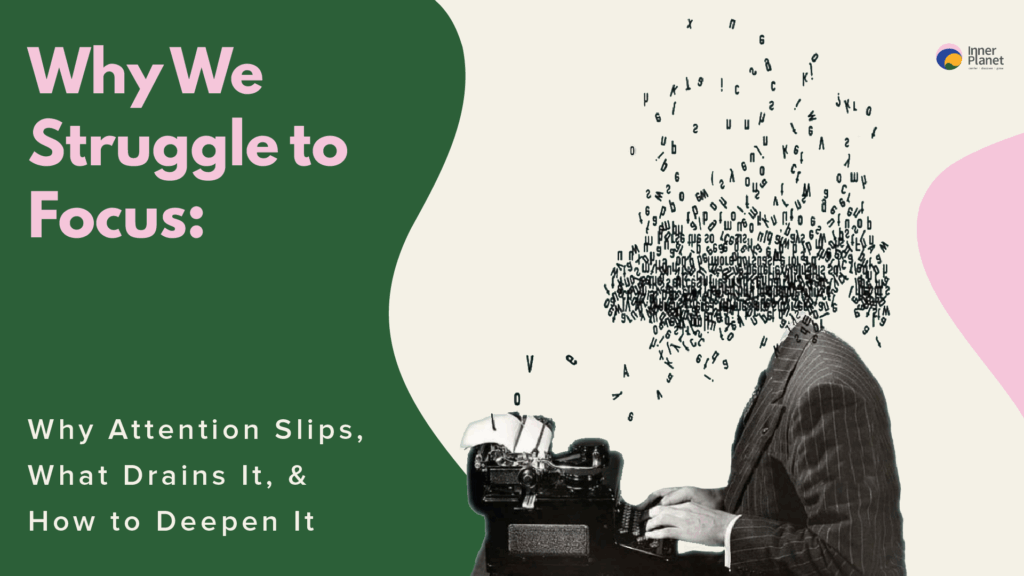
Wanting to do one thing properly and finding your mind already somewhere else?
You sit down to work, read, study, write, reply, think, and within minutes your attention has wandered into messages, tabs, errands, worries, memories, or that vague sense that there is probably something else you should be doing first.
For many of us, this has become so ordinary that we hardly stop to notice it.
But difficulty focusing is not always a sign of laziness or poor discipline. Sometimes it is simply what happens when a mind is asked to hold too much, for too long, without enough space to settle.
So let’s look at why focus feels so fragile today, what quietly wears it down, and how we can work with our attention more wisely and gently.
We Rarely Try To Focus In Peace
A lot of advice about focus quietly assumes that people are starting from a calm and tidy place. As though the only thing standing between us and concentration is a better attitude.
That is rarely how life actually works.
Most people are trying to focus while managing noise, messages, responsibilities, internal pressure, unfinished conversations, tiredness, and the strange modern habit of being mentally available to far too many things at once.
Even when the room is quiet, the mind may not be.
There may be emotional residue in the background. There may be decisions waiting to be made. There may be ten loose ends tugging at attention.
When that is the reality, losing focus is not surprising. In many cases, it is simply what we can expect.
Fragmentation Soon Feels Normal
One of the more unsettling things about scattered attention is how quickly it begins to feel normal.
We get used to half-reading, half-listening, half-working, half-resting. We skim. We switch. We interrupt ourselves. We reach for our phones in the middle of almost anything.
Slowly, sustained attention begins to feel unusually hard, almost old-fashioned.
The problem is not just that we get distracted. It is that distraction starts to feel like the natural setting of the mind.
That changes more than work. It affects how we read, how we listen, how we think, how we sit with discomfort, and even how long we can stay with our own thoughts before wanting an escape hatch. There is a quiet loss in that. Not dramatic, perhaps, but real.
Focus Is Not A Moral Virtue
We often talk about focus as though it were a character trait. Some people have it. Some do not. Some are disciplined. Others are careless, weak-willed, or simply not trying hard enough.
That way of thinking misses something important. Focus is not endless.
It can be depleted, strained, protected, or worn thin.
It is shaped by sleep, stress, clarity, mood, environment, physical energy, and the sheer number of things competing for your attention.
This matters because many people respond to difficulty focusing by becoming harsher with themselves. They assume the answer is more force, more guilt, more self-scolding. But attention does not always respond well to intimidation. More often, it responds to the right conditions.
That may sound less heroic than grit, but it is usually far more useful.
Vague Tasks Scatter The Mind
Sometimes what looks like distraction is actually fog.
A surprising number of us sit down intending to “get work done”, “be productive”, or “focus properly” without being clear about what the next task actually is. The mind does not settle easily around vagueness. It circles it. Resists it. Looks for somewhere easier to go.
There is a difference between saying, “I need to work on this,” and saying, “I need to write the first two paragraphs,” or, “I need to reply to these three emails before lunch.” The second gives attention somewhere to land.
This is one of the simplest ways to streamline focus. Not by demanding more concentration from yourself, but by reducing confusion. A clear task asks less of the mind at the point of entry. And very often, that is where the battle is won or lost.
Multitasking Flatters Us
Multitasking has a good reputation. It sounds efficient, capable, and quick. There is almost a little vanity to it. We like the idea that we can juggle many things at once and still do them well.
In reality, most multitasking is expensive.
When attention keeps switching between tasks, the mind has to keep stopping, reorienting, and beginning again. That may not feel dramatic moment to moment, but over time it leaves a person oddly drained without much satisfaction to show for it. You may be busy all day and still end up with the uncomfortable feeling that nothing really received your full mind.
Motion is not the same as progress. Busyness is not the same as depth. Sometimes what we call multitasking is simply repeated self-interruption dressed up as efficiency.
The Beginning Shapes The Rest
People often imagine focus as something you either have for the day or do not. In practice, it is usually more local than that. The first few minutes of a task matter enormously.
How we begin tends to shape what follows.
If you start while checking messages, clicking between tabs, half-reading something, and carrying three other tasks in your head, your attention is unlikely to deepen. It has not really arrived yet. Some part of you is still elsewhere.
This is why small entry rituals can help. Not because they are magical, but because they create a bridge. Shut the extra tabs. Put the phone away. Read the brief once. Write the first line. Reopen the document you have been avoiding. Make the beginning less chaotic.
A lot of people do not need a grand new system. They need a cleaner, steadier way to enter the work.
Not Every Hour Is Made For Depth
Many of us expect the same quality of concentration from ourselves regardless of the hour, the day, or the state we are in. Then we feel irritated when our minds do not cooperate.
But not every hour is built for the same kind of thinking.
Some hours are better for demanding tasks that need language, memory, or precision. Others are better for lighter admin, routine replies, or organising. Some days the mind feels sharp and available. On other days it is slower, fuller, more emotionally crowded.
Working efficiently does not always mean forcing depth into every available slot. Sometimes it means knowing your own rhythm well enough to match the task to the state you are in. That is not laziness. It is precision.
There is a particular kind of exhaustion that comes from treating yourself like a machine you keep finding defective.
Sometimes Focus Is Emotional
This is where many conversations about focus become too thin.
Not every difficulty with concentration can be solved by a better planner, fewer notifications, or a stricter routine. Sometimes attention is hard to steady because something inside you is unsettled. Anxiety can do that. So can dread, resentment, grief, loneliness, shame, self-pressure, or the exhaustion of having been “fine” for too long.
The mind is not always wandering at random. Sometimes it is circling something important.
That does not mean every distracted afternoon is a deep psychological event. It simply means we should be careful not to reduce all struggles with focus to poor habits. Sometimes the more useful question is not, “Why can’t I just get on with it?” but, “What is taking up so much room in me right now?”
That question changes the tone. It replaces contempt with curiosity. And that, in its own way, can make focus more possible.
Make Attention Easier To Hold
When people think about using focus efficiently, they often imagine getting stricter with themselves. More pressure. More rules. More force. But that approach can become yet another way of making attention feel like a battlefield.
Often, the kinder and more effective move is to make the task easier to stay with.
Make the first step small enough to begin without drama. Decide what matters for this hour and let the rest wait outside it. Keep only the relevant materials in front of you. Do not ask your mind to hold five priorities while trying to complete one. Let one thing be one thing.
This sounds simple, but it matters. Many of us create difficulty without meaning to. We begin tasks too late, after too much scrolling, in the middle of mental clutter, with vague expectations and too many competing demands. Then we blame ourselves for not focusing well.
But attention is easier to hold when it is not being constantly provoked, confused, or overburdened.
This is true outside formal work too. If you want to read more, keep the book within reach. If you want to think clearly, reduce the number of open loops you are carrying. If you want to write, stop waiting for a rare and sacred mood to descend. A simpler doorway is often enough.
A great deal of sustainable focus comes not from heroics, but from removing needless friction.
Better Focus Is Better Presence
At some point, any conversation about focus has to grow beyond productivity. Otherwise the whole thing becomes a little joyless.
Good focus is not just about getting more done. It is also about being more fully where you are. It is reading without the itch to check something else. Listening without rehearsing your next thought. Finishing a task without mentally fleeing it every few minutes. Letting your mind rest on one thing long enough for some depth to emerge.
That kind of attention changes the quality of experience. It may improve work, yes, but it also makes life feel less scattered and less accidentally lived.
Perhaps that is the deeper reason to care about focus at all. Not to become some impossibly optimised version of yourself, but to recover a steadier relationship with your own mind.
What Efficient Focus Really Means
Efficient focus does not mean being intensely concentrated every hour of the day. It does not mean becoming rigid, humourless, or relentlessly productive. It means using attention with more intention.
It means knowing what deserves depth and what does not. It means not leaking energy into ten directions at once. It means recognising when the issue is distraction, when it is vagueness, when it is overload, and when it is something emotional asking not to be ignored.
Most of all, it means letting go of the fantasy that better focus will come from bullying yourself into it.
A more useful approach is quieter than that. Clearer tasks. Fewer competing demands. More respect for your rhythm. A little less noise. A little more honesty. A little more care in how you begin.
Focus is not a gift reserved for a lucky few. It is shaped every day by how we live, what we carry, and what keeps tugging at our minds.
When we understand that, we can stop treating every lapse in concentration like a personal failure. The fact is that being human can often be a messy journey.
And if you need help on this journey we’re always just a call away!