

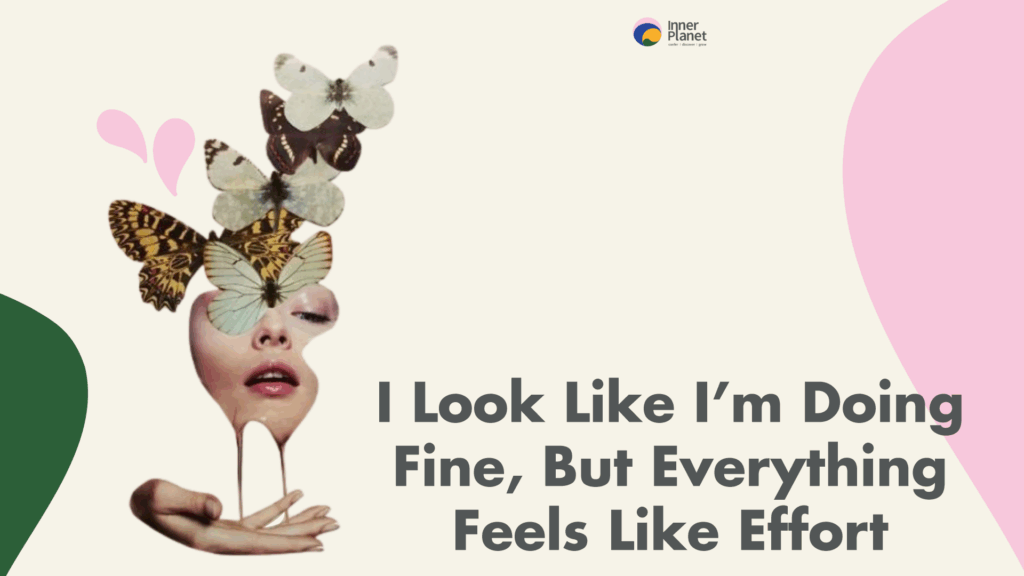
One day follows another, one week the next, month after month, endlessly.
But, on paper, life looks stable.
We are functioning. Showing up. Getting things done.
Nothing is visibly wrong.
And yet, almost everything feels effortful.
Not in a dramatically alarming manner that makes others concerned about us. But in a quieter, more persistent way—where even ordinary tasks seem to require intention, preparation, and a small internal push. There is no sense of being broken or lost. Just the feeling that life no longer runs on ease.
Let’s explore a subtler state that many high-functioning adults live in for years without realising. Here, we will see why life can feel effortful even when it is going well, why rest alone does not always fix it, and what can genuinely help reduce this invisible strain.
When Life Stops Running on Autopilot
There is a moment—often gradual—when life stops feeling automatic, easy, or convenient.
We still wake up, but getting out of bed takes a decision. Messages still get answered, but replies require thought. Days continue, but nothing quite carries us forward on momentum alone.
It is as if life has shifted into manual mode.
Tasks that once ran quietly in the background now demand conscious energy. It is not that they are difficult; it is that everything requires engagement. Even small things need a nudge. Like swimming upstream all of a sudden, or biking uphill. The problem is not malfunction—it is a constant effort to overcome friction.
Effort Without Obvious Exhaustion
What makes this state confusing is that it does not look like tiredness in the usual sense.
Sleep may be adequate. Motivation may still exist. Work may remain competent, even impressive. From the outside—and sometimes even from within—there is little evidence that anything is wrong.
But, each task costs more than it used to. Each interaction draws slightly more from the system. Output stays the same, but internal expenditure invisibly rises. This is why the experience often goes unnoticed—not only by others, but by ourselves.
There is rarely a single moment when depletion becomes obvious. Just a growing sense that life feels heavier than it should.
Why Proficient People Feel This First
This experience tends to show up more frequently in people who are proficient (and are expected to exercise that capability) and self-aware.
Those who know how to push through discomfort.
Those who manage themselves well.
Those who rarely fall apart.
Competence, however, comes with a hidden cost. When functioning reliably becomes the norm, effort becomes invisible. Life continues not because it is easy, but because there is a learned ability to carry oneself through difficulty without external disruption.
Being “low-maintenance” often means maintaining ourselves constantly.
Over time, sustained self-regulation accumulates strain. Nothing collapses. Productivity remains intact. But flow quietly disappears. And because nothing outwardly breaks, there is little reason to pause or reassess.
The Cost of Always Pushing Through
The impact of constant effort is subtle but cumulative.
Spontaneity fades. Responses become thoughtful but feel less free. Pleasure still exists, but it is filtered—experienced through effort rather than ease. Emotional range narrows, not because feeling disappears, but because everything is being managed.
Relationships begin to feel maintained rather than inhabited. Conversations require presence, but presence feels costly. Even joy starts to feel obligatory.
Life continues, but fewer moments feel genuinely light.
Why Rest Alone Doesn’t Fix It
At some point, rest becomes the obvious solution.
Time off. Fewer commitments. A break.
And yet, the effort often persists.
The body may pause, but internally the system does not fully downshift. Silence invites more awareness. Stillness does not necessarily bring relief. It can feel like taking the foot off the accelerator while the car is going downhill; the wheel’s still in spin.
This happens because what is tired is not just the body—it is the sustained requirement to hold oneself together. Ease does not return simply because the calendar clears. It returns when vigilance is no longer necessary.
Rest helps. But it does not always restore.
Effort Is Not a Personal Failing
When everything feels effortful, self-judgement often enters quietly.
There is the thought that this should be manageable. That others seem to handle more. That gratitude should override heaviness.
These interpretations deepen fatigue because they misread the signal. Effort is not evidence of inadequacy. It is information. It tells us that the system has been running without slack for too long.
Nothing is inherently wrong here. The issue is not weakness—it is sustained load without sufficient easing.
Even naming this accurately can be relieving.
What Actually Restores Ease
Ease does not return through optimisation.
It does not arrive by trying harder, managing better, or thinking more positively.
Ease emerges when effort drops—not because discipline improves, but because the load is shared.
For many, therapy becomes a space where effort is genuinely shared. There is no need to perform insight, regulate emotions perfectly, or stay composed. The responsibility of carrying the thread alone is lifted.
This is not about fixing ourselves. It is about creating conditions where self-holding becomes shared.
Support Without Collapse
Support is often imagined as something sought only when life falls apart.
But for many high-functioning adults, support is not about repair—it is about preservation. It prevents quiet exhaustion from becoming something louder and more disruptive.
Therapy, in this sense, is not a response to crisis. It is a place where effort can be reduced safely.
Seeking support does not contradict competence. It helps maintain it.
When everything feels effortful, the answer is rarely to push harder.
Sometimes ease returns not by doing more, but by doing less alone.
A breakdown is not required to justify support. Some tiredness comes from carrying too much for too long, too competently.
And sometimes, the most meaningful relief begins when life no longer requires constant effort just to be lived.
If you need help on this journey we’re always just a call away!