

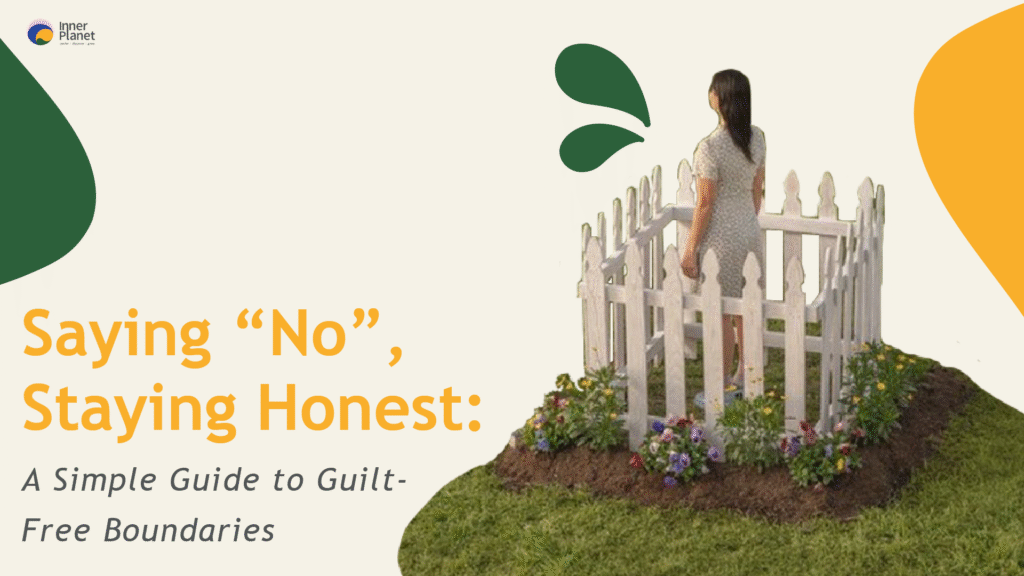
Saying no can feel strangely dramatic.
A simple request comes your way. A plan. A favour. An extra task. A call you do not have the energy for. Somewhere inside, you know your answer is no. But before you can say it, your mind begins preparing a full legal defence.
Will they feel bad?
Will I seem selfish?
Will this become awkward?
Should I just say yes and manage somehow?
Often, the hardest part of saying no is the story we attach to the word.
So let’s look at why saying no feels so difficult, the guilt and fear that often come with it, and how to respond with clarity, kindness, and self-respect.
Why Saying No Feels Personal
A no is rarely just a no in our minds.
It can begin to sound like a statement about who we are.
If I say no, I am rude.
If I say no, I am selfish.
If I say no, I am disappointing them.
If I say no, I am not a good friend, partner, child, colleague, or sibling.
No wonder we freeze.
For many people, saying no is difficult because they are trying to protect the relationship, protect the other person’s feelings, and protect their own image of being “good”.
That is not silly. It is human.
Most of us want to be loved, respected, included, and understood. We do not want to hurt people. We do not want to seem careless. We do not want someone we care about to feel dismissed.
But a no becomes painful when we treat it as evidence of our character, instead of seeing it as a response to one specific request.
Sometimes saying no means “not now”, “not this way”, “not at this cost”, or “not from me”.
It does not automatically mean, “You do not matter.”
The Belief Behind the Boundary
Before asking, “How do I say no politely?”, it may help to ask a deeper question:
What do I believe about saying no?
Because the sentence we say out loud is only one part of the process. The more powerful sentence is often the one running quietly in the background.
Maybe it sounds like:
“I must keep everyone happy.”
“If they are upset, I have done something wrong.”
“Good people are always available.”
“I should be able to manage.”
“If I set a boundary, they may pull away.”
“I cannot tolerate disappointing someone.”
These beliefs can make a normal “no” feel like an emotional emergency.
Try this before saying no: write down the sentence your fear is saying.
Not the polite message.
Not the socially acceptable version.
The fear sentence.
“They’ll think I don’t care.”
“They’ll be hurt.”
“I’ll seem selfish.”
“This will become awkward.”
“They won’t ask me again.”
That is the thought that wants to be addressed before you answer the person.
The aim is not to become cold or indifferent. The aim is to notice when your mind is perceiving a difficult moment as an absolute catastrophe.
A request can matter.
The person asking can matter.
And your capacity can matter too.
All three can be true at the same time.
No Is Not Rejection
One of the most common fears around saying no is this:
“If I say no, they will feel rejected.”
Sometimes they may feel disappointed. Sometimes they may need a moment. Sometimes they may wish your answer was different.
That does not automatically mean you have rejected them.
A “no” to a request is not always a “no” to the person.
You can value a friendship and still not want to go out.
You can love your family and still be unable to meet every expectation.
You can be committed to your work and still not take on another task.
This distinction is important.
Without it, saying “no” starts feeling like a betrayal. And when every “no” feels like a betrayal, we begin saying “yes” in places where we are tired, stretched, resentful, or quietly disappearing from ourselves.
Ask yourself:
Am I rejecting this person, or am I being honest about this request?
Those are not the same thing.
Sometimes, a clear “no” protects the relationship from a resentful “yes”.
Guilt Is Not Proof
Guilt is persuasive.
It arrives with such confidence that we often believe it without questioning it.
I feel guilty, so I must have done something wrong.
But guilt is not always proof of wrongdoing. Sometimes guilt simply means you have stepped out of an old role.
If you are used to being the available one, the understanding one, the one who adjusts, the one who says “it’s okay” even when it is not, then a healthy boundary may feel harsh at first.
Not because it is harsh. But because it is unfamiliar.
This does not mean guilt is useless. Guilt can be important. It can show us where we have been careless, unfair, or dismissive. It can help us attend and repair.
But guilt becomes unhelpful when it punishes us for having normal human limits.
A useful distinction is:
Helpful guilt says: “I may need to repair something.”
Fear-based guilt says: “I must prevent anyone from being unhappy with me.”
So before you let guilt make the decision, pause and ask:
Is this guilt coming from my values, or from my fear?
There is a difference between “I have genuinely acted against my values” and “I am uncomfortable because someone may not be pleased with me.”
The first needs repair.
The second needs tolerance.
Disappointment Is Bearable
Many people say “yes” to avoid what may happen after saying “no”.
The response may be “okay” instead of the usual warmth.
They may take longer to respond.
They may sound a little flat.
Your mind may immediately want to fix the mood.
Of course that feels uncomfortable, especially when the person matters to you.
But someone’s disappointment does not always mean you have done something wrong. It may simply mean they wanted something from you that you can’t give.
That can be painful without being unfair.
We can care about someone’s feelings without making ourselves responsible for preventing every difficult feeling they have.
You do not have to be dismissive of their disappointment. You can acknowledge it. You can be kind. You can understand why you saying no may be inconvenient or upsetting.
But you do not have to treat every disappointment as a danger signal.
Try telling yourself:
Their disappointment is uncomfortable, not unbearable.
A relationship that can survive honesty becomes safer over time.
Kindness Beyond Being Available
Many of us confuse kindness with complete availability.
We think being kind means picking up every call, replying immediately, saying yes to every request, adjusting endlessly, and being emotionally ready whenever someone needs us.
But kindness does not require unlimited access to your time, energy, attention, money, or emotional space.
You can be kind and still unavailable.
You can say:
“I care about you, but I can’t have this conversation tonight.”
“I want to support you, but I don’t have the room to take this on.”
“I’m not available this weekend, but I hope it goes well.”
“I can’t help with this, but I’m glad you told me.”
This matters because a forced “yes” often looks generous in the moment but sends the bill later.
It leaks into tone.
Into delay.
Into distance.
Into the feeling of, “Why do I always have to be the one?”
A clear “no” may feel uncomfortable at first, but it is often more respectful than a “yes” you cannot genuinely carry.
The goal is not to become unavailable to people.
The goal is to stop abandoning yourself to prove that you care.
Saying No Before You Explain
When we feel guilty, we often explain too much.
We begin with a long apology. Then a backstory. Then a justification. Then a reassurance. Then another apology.
By the time the sentence ends, we are not even sure whether we have said “no”.
This usually comes from a good place. We are trying to soften the impact. We do not want to sound rude. We want the other person to understand.
But too much explanation can make a boundary sound negotiable.
A clearer structure is:
Warmth + clearly saying no + brief reason (if needed).
For example:
“Thank you for thinking of me. I won’t be able to take this on right now.”
“I understand this matters to you, unfortunately I won’t be able to make it.”
“I wish I could help, but I don’t have the energy this week.”
“I care about this, but I cannot commit to it at the moment.”
These sentences are simple. They do not punish the other person for asking. They also do not abandon your answer.
Use Fewer Words
Sometimes the kindest no is also the simplest one.
When we overexplain, we may secretly be trying to earn permission to have a boundary.
We want the other person to see the full evidence and say, “Yes, okay, your no is acceptable.”
But you do not need to submit a thesis for having a limit.
Notice the difference between this:
“I’m so sorry, I would have loved to come, but this week has been very hectic and I’m not sure because I have had a lot going on, and maybe if things change I’ll let you know, but I feel really bad…”
And this:
“I’m sorry, I won’t be able to make it this week.”
The second one may feel abrupt if you are used to cushioning every refusal. But it is also cleaner. It gives the other person clarity.
Explanation is helpful when it offers context.
Overexplanation is often an attempt to reduce guilt.
You are allowed to be brief.
You are allowed to be respectful without being elaborate.
You are allowed to stop after the sentence has done its job.
Before You Say Yes, Pause
If you often say yes too quickly, build a pause before answering.
You do not need to respond immediately just because someone has asked. A pause is not rude. Sometimes, it is the small space where honesty returns.
Before you say yes, ask yourself:
- Do I actually want to do this?
- Do I have the capacity for this?
- Am I saying yes because I want to, or because I am afraid?
- Will I resent this later?
- What would I say if guilt was not driving the answer?
These questions won’t make you self-centered.
They are meant to help you embody honesty before you respond.
Sometimes, after asking these questions, your answer may still be yes. Beautiful. A mindful “yes” is very different from a fearful “yes”.
But if the answer is “no”, you now have a little more clarity. And clarity makes courage easier.
Practise Small Nos
If saying no feels terrifying, do not begin with the most emotionally loaded relationship in your life.
Begin small.
Say no to a plan when you are genuinely tired.
Say, “Let me think about it,” before agreeing.
Do not reply immediately if you need time.
Say, “I can’t commit to this right now.”
Ask for more time.
Decline a favour you do not have the room for.
Small “nos” matter because they teach your mind and body that discomfort is survivable.
The first few times, you may still feel guilty. You may replay the conversation. You may wonder if you sounded rude. You may feel tempted to send one more message to soften it.
That does not mean you did it wrong.
It may simply mean you are learning a new way of relating.
After the No
What happens after saying no can be rough.
The guilt.
The replaying.
The urge to fix.
The sudden fear that one boundary has damaged everything.
After saying no, your mind may offer you some very convincing thoughts. Try answering them gently, but firmly.
Instead of:
“I am selfish.”
Try:
“I am allowed to have limits.”
Instead of:
“They are upset, so I was wrong.”
Try:
“They are allowed to feel disappointed, and I am allowed to be honest.”
Instead of:
“I should have said yes.”
Try:
“A forced yes often leads to resentment.”
Instead of:
“I cannot handle this discomfort.”
Try:
“This is uncomfortable, not unbearable.”
This is not about forcing yourself to feel confident immediately. You may not.
It is about not letting guilt become the only voice in the room.
You can feel guilty and still make a healthy choice.
You can feel nervous and still be respectful.
You can feel uncomfortable and still survive the moment.
When “No” Is Not Safe
Most of this blog is about situations where saying no is uncomfortable but safe.
But sometimes, saying no does not only lead to disappointment. It may lead to prolonged punishment, intimidation, threats, financial control, fear of harm, or consequences that make you feel trapped.
In those situations, the question is not just, “How do I say no?”
It may be, “How do I protect myself?”
If a relationship punishes you for having limits, it may not be enough to find the perfect sentence. You may need support, planning, distance, or professional help.
In such cases, the aim is not to deliver a perfect boundary.
The aim is to protect your safety.
Saying no is not about becoming rude, selfish, or emotionally distant.
It is about learning to be honest without turning every refusal into a trial of your goodness.
You are allowed to care about people and still have limits. You are allowed to disappoint someone without becoming cruel. You are allowed to choose a clear no over a resentful yes.
And like most emotional skills, saying no becomes easier with practice.
If saying no brings up intense guilt, fear, or people-pleasing patterns, and you need professional help, we’re always just a call away!