

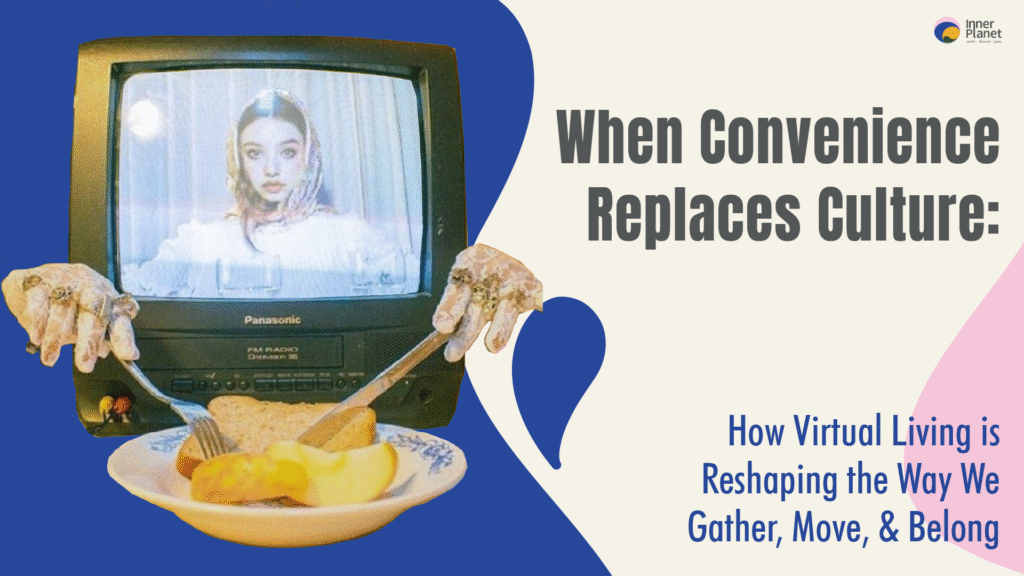
There are days when an entire life can happen from one chair.
Work begins on a laptop. Lunch arrives at the door. A friend sends a voice note. Groceries come through an app. By evening, a film, a workout, a prayer meeting, or a family call can all fit inside the same screen.
None of this is automatically bad, of course. For many people, virtual living is necessary, generous, even freeing.
But when convenience becomes the new normal, something quieter may begin to thin out: the physical habits that make culture feel shared.
So let’s explore how convenience culture may be reshaping physical culture, why that loss matters, and how we might recover presence without rejecting modern life.
Culture Needs A Body
Culture is often spoken about as if it lives in ideas. We think of language, beliefs, music, food, fashion, religion, art, or memory.
But culture also needs a body.
It lives in the way people gather at weddings. The way a family recipe is learnt by standing beside someone older. The way a city moves during a festival. The way people dress for a funeral, queue at a bakery, cheer in a stadium, dance in a crowded room, or sit together after a long day.
Culture is not only something we inherit. It is something we practise and share.
A song heard through headphones is still music, but a song sung together in a room does something different. A meal ordered alone can still be enjoyable, but a meal cooked with others carries another kind of memory.
Culture does not disappear only when people stop caring about it. It weakens when the daily reasons to practise it are quietly removed.
Friction Once Connected Us
Modern life has trained us to dislike friction. Waiting feels inefficient. Travelling feels avoidable. Small talk feels optional. Queues feel like a design failure.
Yet some friction once connected us.
Walking to the shop meant passing familiar faces. Commuting placed people in shared rhythms. Offices, markets, libraries, gyms, cafés, places of worship, and community halls created regular contact. Not always deep contact. Not always pleasant contact. But contact nevertheless.
These ordinary moments helped create a sense of local life. You did not need to be close friends with everyone around you to feel that you belonged somewhere. Sometimes belonging came from being recognised, from knowing the shape of a street, from seeing the same person at the same bus stop, from having a place where your presence was expected and accepted.
Some forms of inconvenience were also forms of belonging.
When Ease Removes Contact
The promise of convenience is simple: less effort.
Food comes to us. Shopping comes to us. Films come to us. Meetings come to us. Even friendship can arrive as a message, a voice note, or a reaction.
It would be unfair to treat convenience as a moral failure. For some, delivery is what makes a difficult week manageable. Remote work can protect people with chronic illness, caregiving duties, long commutes, or unsafe workplaces. Online communities can be a refuge for those who do not find safety nearby.
The concern is not that these options exist. The concern is what happens when they become the only way to participate.
When every errand becomes a delivery, streets lose some of their social purpose. When every meeting becomes a video call, work loses some of its informal human texture. When every celebration becomes content, the moment can start to feel artificial.
Convenience saves time, but it can also obstruct us from the encounters that make life feel shared.
The Optional Body
One of the clearest changes is physical.
Many parts of life no longer require the body in the same way. We can attend meetings without moving through a city. We can join events without standing in a crowd. We can order food without entering a restaurant. We can watch concerts, lectures, and celebrations from a screen.
The physical presence becomes optional.
Without the body, culture changes texture. It loses the sore feet after a festival, the smell of food in a crowded lane, the awkwardness of arriving early, the noise of children at a family function, the discipline of showing up even when it would be easier not to.
A neighbourhood is not just a location on a map. It is the repeated act of moving through it.
When physical participation declines, culture does not necessarily vanish. It may simply become less rooted. Less local. Less felt.
From Culture To Content
Another shift happens when culture becomes something we mainly consume or display.
A meal becomes a photo. A holiday becomes proof. A festival becomes a backdrop. A political opinion becomes a post. A personal belief becomes a brand.
There is nothing wrong with recording life. People have always wanted to remember, share, and be seen. The problem begins when the record of the moment becomes more important than the moment’s needs: staying, helping, listening, waiting, joining in, cleaning up afterwards.
Culture is not only made of beautiful scenes. It is also made of duties.
This is easy to forget online, where culture often appears as an image, a sound, a trend, or a statement. We may know the aesthetics of a tradition without taking part in its labour. We may admire community from a distance while rarely entering one. We may feel informed about the world while becoming physically absent from our own surroundings.
That is the strange bargain of digital life: more visibility, but sometimes less intimacy.
The Loneliness Of Ease
A convenient life can still feel lonely.
This is difficult to admit because convenience often looks like success. A comfortable home. Fast internet. Everything delivered. Entertainment on demand. Fewer obligations. Fewer awkward encounters. Fewer reasons to go out.
But a week can be full of tasks and still leave behind very little memory.
Human beings need more than comfort. We need rhythm, recognition, effort, and belonging. We need places where we are not just users, customers, profiles, or viewers. We need to be participants.
The loss is rarely dramatic. It is quieter than that. Fewer invitations. Fewer familiar faces. Fewer reasons to dress for the day. Fewer stories that begin with “I bumped into someone.” Fewer memories attached to streets, rooms, journeys, and local rituals.
Over time, ease can become a soft form of isolation.
Choosing Useful Friction
The answer is not to reject convenience. That would be unrealistic, and for many people, unfair.
The better question is: which forms of effort still give something back?
Useful friction is not pointless difficulty. It is not romantic suffering. It is not pretending the past was better than it was. It is the effort that restores contact with life.
Walking to a local shop when possible. Meeting a friend without needing a special occasion. Cooking with someone instead of only ordering in. Attending a local event. Joining a class. Sitting in a shared space. Celebrating offline. Allowing some parts of life to take longer because the slowness gives them meaning.
The screen is not the villain. The danger is not technology itself, but a life designed so smoothly that we no longer have to meet the world with our physical presence.
We do not have to abandon virtual living. We simply have to stop letting it replace every doorway into the world.
It is easy to turn this topic into a complaint about technology, but that would miss the point.
The past was not perfect. Many traditional spaces were exclusionary, tiring, inaccessible, or unfair. Many people were left out of the very cultures others now remember fondly. Virtual spaces have also helped people find community, safety, creativity, education, and support.
So the question is not whether convenience is good or bad. It is what we allow it to replace.
Virtual living can support culture, especially when it helps people access what they were once excluded from. But it should not quietly replace every meal, journey, ritual, queue, visit, and gathering. Convenience should give us more room to live, not fewer reasons to show up.
If culture is something we practise, then presence is not a luxury. It is part of how a shared life survives.
If you need help figuring out how to increase presence in your life, we’re always just a call away!