

Early relationships quietly shape the way we connect, trust, and communicate in adulthood. These invisible patterns, known as attachment styles, influence how we respond to closeness, handle distance, and interpret emotional cues.
Let’s explore the four main attachment styles — anxious, avoidant, secure, and disorganised — and understand how they develop, how they appear in everyday relationships, and what it means to move toward emotional security. The aim isn’t to label or diagnose, but to recognise patterns that we can nurture and evolve. What we can name, we can change — and awareness is the first step toward healing.
What Are Attachment Styles?
Attachment theory, first developed by psychologist John Bowlby and expanded by Mary Ainsworth, explains how early experiences with caregivers create mental “blueprints” for love and connection. When a caregiver responds reliably and warmly, a child learns that relationships are safe. When care is inconsistent, withdrawn, or frightening, the child adapts by finding other ways to manage closeness.
These early lessons don’t remain fixed in childhood. As adults, our attachment patterns continue to shape how we relate — how we seek reassurance, express needs, or protect ourselves. Importantly, they can differ across relationships (we may be secure with friends but anxious with partners), and they can evolve within the same relationship as we grow and build healthier experiences of trust.
Recognising our attachment styles is an opportunity at self-awareness that helps us understand why we respond the way we do, and empowers us to choose new ways of relating.
The Four Attachment Styles
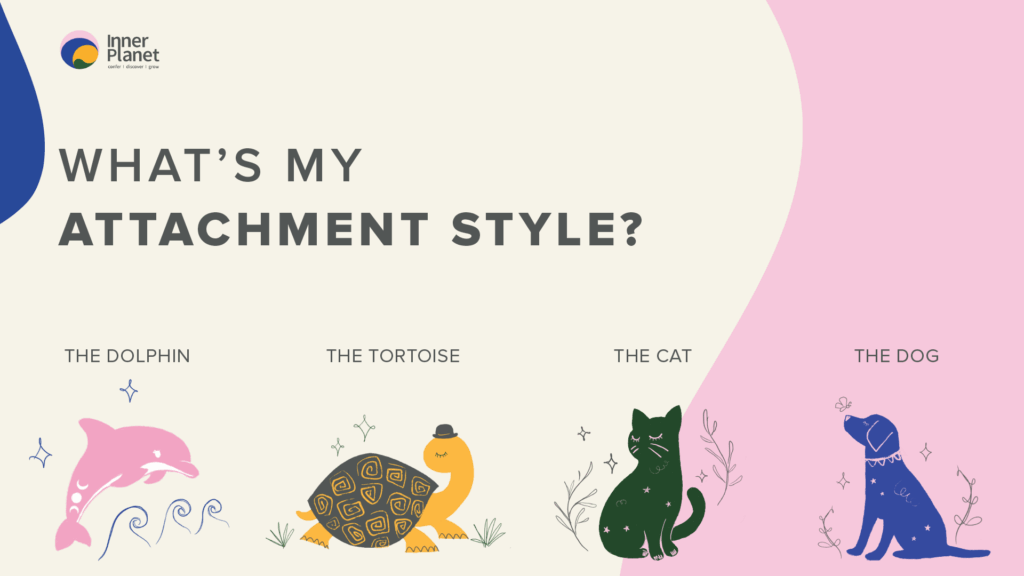
1. Anxious Attachment (The Dog)
Anxiously attached individuals crave closeness and fear its loss. They tend to sense even subtle changes in a loved one’s tone or behaviour and may worry about being forgotten, replaced, or not “enough.” Their relationships can feel like emotional rollercoasters — moments of deep connection followed by intense worry when reassurance fades.
Roots & Development:
This attachment often forms when caregivers were loving but inconsistent — attentive one moment, distracted or unavailable the next. The child learns to stay alert, reading every sign of approval or withdrawal, and grows into an adult who subconsciously equates love with vigilance.
Everyday Signs & Triggers:
- Feeling uneasy when communication slows down or changes
- Overthinking small disagreements or silences
- Sacrificing personal needs to maintain harmony
- Seeking frequent reassurance of commitment
Inner experience:
The anxious pattern isn’t “neediness” — it’s an emotional system working overtime to feel safe. Beneath the worry is a deep longing for reliability. Inside, it often sounds like: “If I love harder, maybe they won’t leave.”
Steps Toward Security:
Healing means turning some of that energy inward — learning to regulate and reassure oneself.
- Pause before reacting: Give the body time to calm before responding to perceived distance.
- Communicate needs clearly: “I value closeness, and I feel anxious when we don’t connect — can we talk about it?”
- Reframe assumptions: Absence doesn’t always mean abandonment.
- Affirm self-worth: “I can be loved even when I’m not perfect.”
In therapy, anxiously attached individuals often work on strengthening emotion regulation, updating inner beliefs (“I can’t lose everyone I love”), and learning that healthy attachment doesn’t require constant proof.
2. Avoidant Attachment (The Tortoise)
Avoidantly attached individuals often value independence so strongly that closeness feels uncomfortable. They may come across as self-contained or emotionally reserved. Under stress, they’re likely to withdraw — not because they don’t care, but because vulnerability feels unsafe.
Roots & Development:
This attachment usually forms when a child’s emotional needs were met with indifference or dismissal. When comfort wasn’t available, the child learned to suppress emotion and rely solely on themselves. As adults, they may subconsciously equate intimacy with loss of control.
Everyday Signs & Triggers:
- Feeling suffocated by emotional demands
- Keeping conversations factual rather than emotional
- Avoiding conflict or ghosting when overwhelmed
- Struggling to express needs or accept help
Inner Experience:
Though they appear calm, avoidantly attached individuals often carry an unspoken belief: “If I don’t depend on anyone, I can’t be hurt.” Beneath that self-sufficiency lies a fear that emotions make them weak — a myth that keeps connection just out of reach.
Steps Toward Security:
- Practice emotional naming: Try identifying what you feel in real time — even “I feel numb” counts.
- Allow small dependencies: Accepting help in safe contexts builds trust.
- Communicate honesty: “I need space to process, but I care and want to come back to this.”
- Affirm openness: “Relying on others doesn’t erase my independence.”
Therapeutic work often centres on tolerating closeness, rebuilding emotional vocabulary, and recognising that interdependence is a sign of maturity — not loss of self.
3. Secure Attachment (The Dolphin)
Securely attached people are comfortable with both closeness and independence. They find it natural to express needs, listen to others, and repair conflict without fear of rejection. Their relationships tend to feel stable and reciprocal.
Roots & Development:
This style develops when caregivers consistently meet a child’s physical and emotional needs — soothing distress, responding predictably, and encouraging exploration. The child grows up believing, “I am safe, and others are reliable.”
Everyday Signs & Triggers:
- Confidence in expressing needs and boundaries
- Trust that relationships can recover from conflict
- Discomfort only when trust is broken repeatedly
Inner Experience:
Security doesn’t mean constant calm or perfect relationships — it means having the resilience to face emotional storms without losing balance. The internal message is, “Even when things are difficult, we’ll find our way back.”
Steps Toward Growth:
- Reflect regularly: “What am I feeling, and how can I express it kindly?”
- Model empathy and repair: “I see how that hurt you — let’s talk about it.”
- Protect boundaries without guilt: Security thrives when both autonomy and connection are respected.
Even secure attachment requires ongoing mindfulness. Life transitions, stress, or trauma can temporarily shake stability — revisiting self-awareness ensures that emotional security remains flexible and grounded.
4. Disorganised Attachment (The Cat)
Disorganised attachment is marked by inner conflict — wanting closeness but fearing it. Relationships can feel intense and unpredictable, filled with alternating waves of pursuit and withdrawal.
Roots & Development:
This pattern typically arises from early trauma or environments where caregivers were both unpredictably comforting or frightening. The child experiences confusion: “The person who soothes me also scares me.” As adults, this can manifest as both a craving for connection and a fear of losing control within it.
Everyday Signs & Triggers:
- Oscillating between closeness and distance
- Feeling emotionally unsafe or “on edge” in relationships
- Difficulty trusting affection or calm periods
- Reliving old fears when conflict arises
Inner Experience:
Living with disorganised attachment can feel like driving with one foot on the brake and the other on the accelerator. There’s a yearning to connect, but also a reflex to protect — often leading to self-blame or guilt. The internal voice says, “I want love, but love feels dangerous.”
Steps Toward Security:
Healing involves stabilising the nervous system and rebuilding trust in predictability.
- Ground yourself before reacting: Deep breathing or brief pauses help bring safety into the body.
- Notice dual feelings: “Part of me wants to connect, part of me feels afraid.” Naming both brings coherence.
- Rebuild through safety and consistency: Small, repeated gestures of care — gratitude, calm conversations, daily routines — strengthen the sense of security.
Therapeutic work focuses on trauma processing, emotional regulation, and re-establishing trust in safe relationships. Over time, these steps transform fear-based patterns into foundations of stability.
Healing and Growth: Moving Toward Secure Connection
Understanding our attachment styles is about awareness. Each style developed for a reason: to protect us in the environments we once had. Healing means updating those strategies to match the safety and resources we have now.
Evidence-based areas of growth include:
- Emotional regulation: Learning to soothe yourself before responding reduces cycles of conflict and withdrawal.
- Updating internal models: Replace inherited beliefs — “I’m too much” or “I can’t rely on anyone” — with balanced truths like, “I am learning to connect safely.”
- Building secure relationships: Seek people who show consistency and empathy; repeated safe experiences gradually reshape our attachment wiring.
- Therapeutic support: A mental health therapist can help you explore old patterns and practise new emotional skills in a supportive setting.
Progress is not linear — it’s a practice. With patience and self-compassion, even long-held attachment patterns can shift. Healing is less about erasing the past and more about writing a new emotional story, one based on safety, clarity, and trust.
All attachment styles carry wisdom about how we’ve learned to survive. The goal isn’t to completely change who we are, but to understand ourselves well enough to connect differently — with steadiness, empathy, and care. Through awareness, practice, and compassion, we can move from reactive patterns to responsive connection, one honest moment at a time.
And if you need help on this journey of figuring out your attachment styles, we’re always just a call away!