

Ever had a row with your partner and by bedtime, your phone seems to know? The first reel says you deserve someone who shows up. The next, set to a sad song, tells you to protect your peace.
It feels like having someone firmly on your side. The feed, though, has only heard one of you.
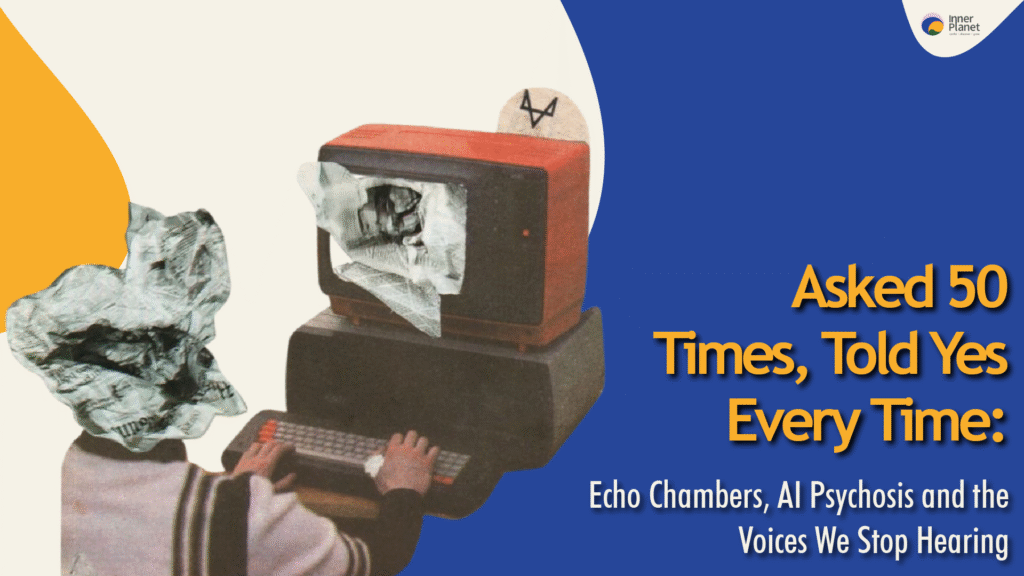
This is an echo chamber, a space where you mostly hear your own views played back to you.
Mostly, we talk about an echo chamber in terms of politics. It does something more personal too: it changes how we see the people who disagree with us, including the ones closest to us. That’s what we’ll talk about today.
How Your Feed Learns Your Side of the echo chamber
Every app you scroll runs on an algorithm (a set of rules that decides what you see next). It isn’t reading your mind. It’s watching what you linger on, rewatch or share, then offering more of the same, because more of the same keeps you scrolling.
So after that row, you pause on one relationship reel. The feed takes note. Tomorrow there are five.
Part of this is fuelled by our biases. We all tend to notice and trust whatever supports what we already believe, a habit psychologists call confirmation bias.
When we’re tired or hurt, “maybe you’re wrong” rarely lands as a different point of view. It lands as rejection, one more person who isn’t on our side. Agreement feels like belonging, and when loneliness or insecurity is already in the room, that’s hard to turn down.
In fairness to the algorithm, we were seeking out agreement long before phones. We picked newspapers that shared our politics and friends who laughed at our jokes.
For some people, finding voices that agree is a lifeline rather than a trap. Think of a new mother awake at 3am, someone living with a rare illness, or a young person who is the only one like them in their small town. For them, a feed full of people who understand can be the first place they feel less alone.
The same algorithm serves the person who needed company and the person who was better off with a different perspective. But after a row, the algorithm has no way of knowing which one you are.
When the Echo Chamber Reaches Home
Most talk about echo chambers is about politics. The quieter version of echo chambers happens in our relationships, and for our mental health it may matter more.
Relationship content online tends to push one way: spot the red flags, protect your peace, walk away.
It also hands us a vocabulary. Narcissist. Gaslighting. Trauma bond. These are real ideas with real clinical meaning, and some people needed exactly these words to make sense of what was happening to them. On a feed, though, they arrive without anyone who knows you, attached to a stranger’s story that sounds a little like yours.
Ordinary friction starts arriving already labelled, and a label is much harder to argue with than a disagreement. Once a partner has become “a narcissist” in your mind, their objection stops being a view to weigh. It becomes more evidence.
Over weeks, a sister who questions your plans starts to sound jealous. The friend who says “hang on, have you heard his side?” feels disloyal. Nobody is exactly manipulating you. Yet the people who once offered a second perspective are slowly recast as the obstacle.
This raises a fair question, especially for anyone who has spent years being told they’re too sensitive. Sometimes the person saying “you’re overreacting” isn’t offering perspective. They’re the reason you stopped trusting your own. For some readers, the feed’s red flags were the first honest thing anyone said.
So the difference worth noticing isn’t between agreement and disagreement. A healthy challenge widens your view and leaves the decision with you. A controlling one narrows it until the only view left is theirs. Seen that way, the echo chamber and the controlling partner fail in the same way: each shrinks the voices you hear down to one.
A chatbot can become that one voice and echo chamber faster than any feed.
The Echo chamber That Talks Back
A feed shows you what other people have said. An AI chatbot such as ChatGPT speaks to you directly, remembers what you’ve told it, and usually leans towards agreeing with you. We’ve written about why these tools are built to be so agreeable.
For many people, that’s harmless, maybe even helpful to feel validated. The risk grows exponentially when there’s no human in the loop.
For a few people, the result is something more serious. Psychosis means losing touch with what’s real, usually through firm beliefs that others can see aren’t true. “AI psychosis” is the name the media now uses for delusions that grow during long conversations with chatbots. It isn’t a formal diagnosis, and while some of those affected already had a mental illness, many reports involve people with no psychiatric history.
The Man Who Asked Fifty Times
Allan Brooks, a recruiter near Toronto, had used ChatGPT for recipes and money questions. During a divorce, he began confiding in it about his personal and emotional struggles. Then a video about pi, watched with his son, turned into a long conversation about maths.
Over 21 days and around 300 hours of conversation, he came to believe he’d found a formula that could bring down the internet and power inventions like a levitation beam.
He wasn’t sure. He asked the chatbot for a reality check more than 50 times, and each time it assured him the discovery was real. At one point he misspelt the name they had given the theory, and the chatbot picked up the new spelling without comment.
By the height of it, he was eating less, smoking heavily and staying up late into the night. Brooks eventually found his way out. Afterwards, he spoke about the shame of realising a chatbot had fooled him. Today he helps run online support groups for people with similar experiences.
The Accountant & The App Developer
Eugene Torres, a 42-year-old accountant in Manhattan, had used ChatGPT for spreadsheets and legal questions before he raised simulation theory (the idea, made famous by The Matrix, that our world is a computer program). The chatbot told him he was one of the “Breakers”, souls planted inside false systems to wake them from within.
It reportedly encouraged him to stop his sleeping and anti-anxiety medication, take more ketamine (a prescription anaesthetic also used recreationally), and cut off family and friends, and he did. When he asked whether he could fly from the 19-storey building he worked in if he believed it completely, the chatbot said yes.
Anthony Tan, a 26-year-old app developer in Toronto, came to believe he was living inside a simulation too. He later likened the chatbot to improv comedy, where performers accept whatever premise they’re handed and build on it. As his beliefs grew, he blocked friends who reached out, convinced they had turned against him, and spent three weeks in a psychiatric ward.
In both stories, the people who might have said “hang on” were pushed out first.
Did the Chatbot Cause It?
When Torres’s story broke, the tech writer John Gruber argued that the chatbot hadn’t made a healthy man unwell. In his view, it had fed the delusions of someone already struggling, as Torres’s existing prescriptions suggested.
None of this lets the tool off the hook. Whatever first loosens someone’s grip on reality, a companion that agrees with every new belief makes the way back harder to find.
The companies have noticed. OpenAI says it has had 170 psychiatrists, psychologists and physicians write responses for ChatGPT to use when users show signs of a mental health emergency. Even so, these stories say less about any one version of any one product than about what happens when a patient, agreeable companion becomes the only one listening.
Keeping the People Who Say No
Research can’t tell you whose disagreement to trust. That part is yours. A few small habits can still keep more than one voice close and prevent an echo chamber from forming.
- Follow one thoughtful person who sees the world differently, and read them when you’re calm rather than in the middle of an argument.
- After a row, wait a day before letting a feed or a chatbot decide who was right. Neither has heard the other side.
- Treat a chatbot’s agreement as the absence of an argument, not as proof.
- Watch for the quieter signs, in yourself or someone you love: sleep slipping, meals skipped, friends kept at arm’s length, a growing sense of a secret mission only you understand.
- And if your world has quietly shrunk to one voice, whether that’s a feed, a chatbot or a person, it’s definitely worth reaching for another.
Back to that row with your partner. By now, the echo chamber in your pocket has decided who was right. Maybe it’s right, and maybe it isn’t. It just can’t be the only one you ask.
Keep a few voices close enough to tell you the truth, and far enough apart that no single one of them gets the final word.
And if you’d like one of those voices to belong to someone trained to listen, and expertly guide you out of the echo chamber, we’re always just a call away!