

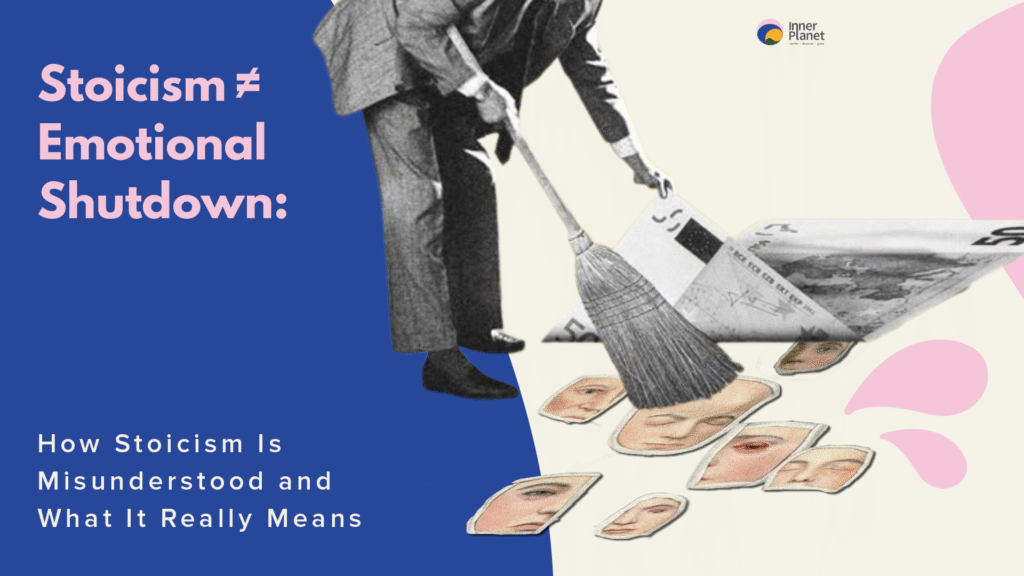
“Be stoic” is often the kind of advice people give when someone’s feelings start to show.
What they usually mean is: hold it together. Say less. Do not let it show. Do not make a scene.
Over time, Stoicism has come to mean emotional restraint in the narrowest possible sense.
In everyday life, it is often treated as a kind of emotional hardening, a refusal to be rattled, a way of staying untouched by what hurts. But that reading misses the heart of the philosophy.
Stoicism does not ask us to become numb. It asks something more challenging: to examine the judgments shaping our distress, distinguish what is within our control from what is not, and respond with steadiness rather than reflex.
So, let’s look at why Stoicism is so often mistaken for emotional suppression, what the philosophy actually teaches, and how psychology helps us see the difference between avoidance and genuine self-command.
Why “Be Stoic” Misleads
In modern language, “be stoic” often sounds less like wisdom and more like a warning against visible feeling.
It is what people say when tears are inconvenient. When grief is lingering too long. When anger is making things awkward. When anxiety is no longer easy to hide.
The message underneath is familiar: strong people stay composed. Mature people do not fall apart. The less affected you seem, the more admirable you are.
At first glance, that can sound sensible. Of course self-control matters. Of course it is not always helpful to react to every feeling the moment it arises.
But somewhere along the way, composure got confused with disconnection. Silence started to look like strength. Emotional distance began passing as wisdom.
That is the first misunderstanding. Stoicism is often reduced to a performance of being unaffected. And because that performance looks tidy from the outside, many people never stop to ask what it costs on the inside.
Why Numbness Feels Powerful
That misunderstanding persists for a reason. It offers something emotionally seductive.
When feelings are intense, shutting them down can feel like relief. If you do not fully let yourself feel the hurt, maybe it cannot fully overwhelm you. If you stay flat and controlled, maybe you can avoid the mess of being vulnerable, needy, angry, or undone.
Many people know this instinct well. You replay a conversation in your head, feel the sting of it rising, and immediately tell yourself to get over it. You feel grief starting to surface and distract yourself before it can take shape. You go quiet in an argument not because you feel calm, but because you do not trust what will happen if you speak from the middle of your hurt.
From the outside, that can look disciplined. Inside, it often feels more like retreat.
This is one of the reasons false Stoicism has such a strong grip on people. Emotional shutdown can feel clean. It can feel like adulting. It can feel safer than letting yourself be touched by what is true.
But what feels powerful is not always strength. Sometimes it is simply self-protection in a more flattering outfit.
Suppression Is Not Self-Control
This distinction matters, because suppression and self-control are not the same thing.
Suppression says: I should not be feeling this. It pushes emotion down before it has even been understood. It treats sadness, fear, anger, or shame as something embarrassing to get rid of as quickly as possible.
Self-control is something else entirely. It says: this feeling is here, but it does not have to run the whole show.
That is a quieter, steadier skill. It does not deny emotion. It makes room for it without surrendering to it. It allows a pause between what you feel and what you do next.
That pause is everything.
It is the difference between lashing out in anger and noticing the anger before you speak. The difference between feeling rejected and deciding that rejection doesn’t define your worth. The difference between being afraid and treating fear as proof that you cannot cope.
Stoicism belongs far more to this second category than the first. It is not a philosophy of repression. But neither is it only about managing emotion after it appears. More deeply, it asks us to examine the judgments that give certain emotions their force. Repression blocks awareness. Stoic restraint depends on it.
What Stoicism Actually Teaches
For the Stoics, the goal was not merely to feel better, but to live well: to become steadier, wiser, and more guided by virtue than by impulse.
At its core, Stoicism is deeply concerned with judgment.
It recognises that human beings react. We are affected by loss, conflict, disappointment, uncertainty, insult, change. Stoicism does not begin by pretending otherwise. What it asks us to look at more carefully is what happens after the first sting.
What are we telling ourselves about what has happened? What meaning have we attached to it? What are we assuming it says about us, our future, or our value?
This matters because our suffering is often shaped not only by events, but by the judgments wrapped around them. A setback can become a verdict on who we are. A disagreement can become proof that we are unloved. Uncertainty can become a story about impending collapse.
Stoicism asks us to slow that process down.
What is actually happening here? What is within my control, and what is not? Which part of this distress comes from the event itself, and which part comes from the interpretation I am feeding it?
That is why Stoicism is not a philosophy of emotional deadness. It is a philosophy of examined response. Its aim is not numbness, but clarity, self-command, and a way of living guided by reason. Not emotional emptiness, but the kind of steadiness that comes from seeing more truthfully and acting with character.
Feeling Without Being Ruled
In lived experience, this means Stoicism begins with honesty.
If you are struck by hurt, anger, or fear, Stoicism does not ask you to pretend otherwise. It asks you to examine the impression carefully before turning it into a settled judgment.
The aim is not to shame yourself for being affected. The aim is to pause long enough to examine what judgment has attached itself to the event.
That may sound simple, but it is not. Most people move away from their feelings almost immediately. They explain them away. They dramatise them. They drown them out. Or they let them take over without ever becoming curious about them.
Stoicism offers another path. It invites you to notice the disturbance, question the interpretation attached to it, and test whether that interpretation is actually true.
Take rejection. The pain may be real, but the suffering often grows when the mind turns it into something larger: I was not chosen, therefore I am not enough.
Or take conflict. The disagreement hurts, but what intensifies it may be the belief that tension means abandonment, humiliation, or danger. The feeling is real. The story attached to it may be less reliable.
This is where Stoicism becomes more challenging than its popular misunderstood version. It does not ask you to harden yourself into stone. It asks you not to hand total authority to the first interpretation your mind produces.
You may be deeply affected without surrendering your judgment completely. That is not denial. It is maturity.
Where Psychology Helps
Psychology helps illuminate why this matters.
A feeling that is not acknowledged does not simply disappear. More often, it changes shape. It comes out as irritability, withdrawal, cynicism, defensiveness, numbness, or a strange tiredness you cannot quite explain. You tell yourself you are fine, but you become harder to reach. You insist something did not matter, yet keep living as though it did.
What is buried does not vanish. It waits.
This is why emotional awareness matters so much. When you can name what you are actually feeling, you interrupt that burial process.
You create a little space between the feeling and the self. This is grief. This is envy. This is shame. This is fear. And once there is space, there can be choice.
That does not mean the feeling becomes easy. It means it becomes clearer. Less fused with your identity. Less likely to operate in secret.
This is one place where psychology and Stoicism can meet fruitfully, even if they are not identical. Both recognise that awareness changes what is possible. Both understand that reacting and reflecting are not the same thing. But Stoicism places special weight on examining judgment, accepting what is not in our control, and living with character.
Real resilience is not feeling nothing. It is staying present enough to choose your way through what you feel.
When Stoicism Becomes Avoidance
The misunderstanding becomes especially painful when Stoicism is used not only as a personal ideal, but as a way of managing other people’s emotions.
Someone is grieving, and the response is to tell them to be strong. Someone is anxious, and the message is to stop overthinking. Someone is wounded, confused, or overwhelmed, and they are praised most when they become quieter and easier to deal with.
In those moments, “Stoicism” stops being a philosophy of self-examination and becomes a tool for emotional dismissal.
It can happen in families where vulnerability is treated as weakness. In relationships where detachment is rewarded more than honesty. In workplaces where composure matters more than humanity. The person who shows least often gets read as the most stable, even when they are simply the most defended.
This is part of what makes the modern misuse of Stoicism so harmful. It gives emotional avoidance a noble vocabulary. It dresses withdrawal up as wisdom. It turns distance into a virtue and leaves people feeling ashamed for having ordinary human needs.
There is nothing especially strong about becoming unreachable.
Often, it is just a quieter form of fear.
A Healthier Stoic Practice
A healthier Stoic practice starts from a more generous idea of strength.
Strength is not the ability to feel nothing. It is the capacity to meet disturbance without surrendering judgment, character, or choice.
That begins with noticing when you have been disturbed without immediately treating the disturbance as truth. Not rushing to suppress it. Not turning it into proof that you are weak, dramatic, or failing. Instead, pausing long enough to ask what judgment is making it heavier.
Then comes the harder part: asking what is beneath it. What expectation has been bruised? What fear has been stirred? What judgment is making this feeling heavier than it needs to be?
From there, Stoic discipline becomes less about shutting down and more about examining carefully and choosing well. You separate discomfort from catastrophe. You allow the feeling to inform you without letting it command you. You ask what kind of response is worthy of the person you want to be.
That kind of self-command is not cold. In fact, it often belongs to people who are more observant of themselves, not less. They notice when hurt, anger, or fear has been stirred. But they have learned not to turn every disturbance into a final truth.
That is a more humane reading of Stoicism. It does not demand that we become less human. It asks us to become more responsible in the way we meet our humanity.
Stoicism is not a command to harden yourself against experience. It is a challenge to examine your judgments, accept what is not in your control, and respond with clarity, restraint, and character.
Misunderstood, it becomes another language for emotional shutdown. Understood properly, it asks something braver of us: not to silence what disturbs us, but to face it without surrendering ourselves to it.
Perhaps that is the real test of steadiness: not whether you can avoid your feelings, but whether you can stay with them long enough to respond wisely.
And if you need help learning this helpful skill, we’re always just a call away!