

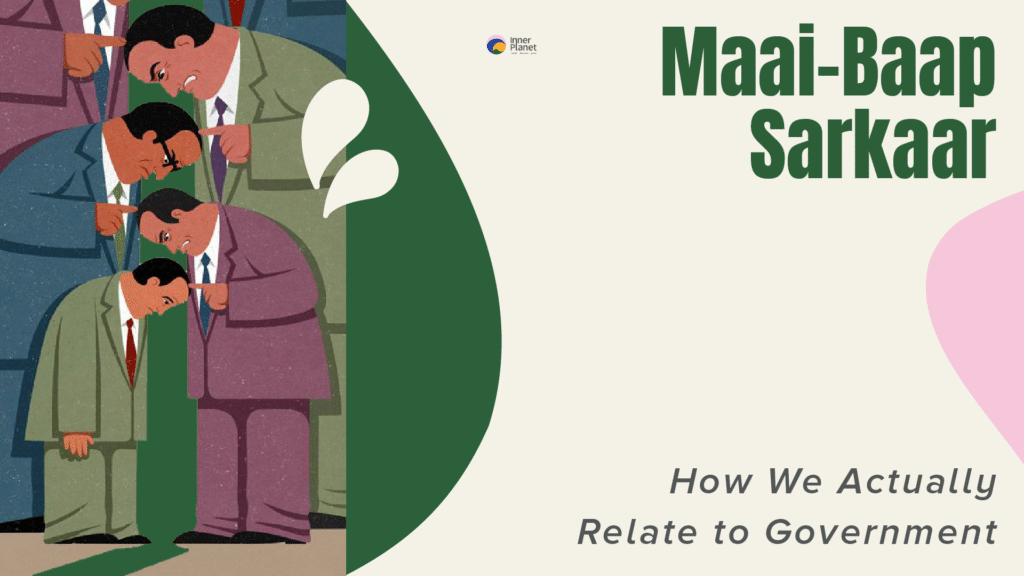
A man in the queue ahead of you has been sent back twice for a document nobody mentioned the first time. Behind you, somebody is saying that the family down the road gets a card they never earned.
Both of those are complaints about the government, and they point in opposite directions. One goes up, at the institution. The other goes sideways, at another citizen.
We tend to perceive the citizen-government relationship in the language of family. The state provides, or fails to. Maai-baap sarkaar. The government as the mother and father that provides.
What follows is what psychology can tell us about that dynamic.
The Relationship We Assume We Have
Governments set the rules, take your money and decide who gets helped. That is roughly the job description of a parent.
But the analogy hides a second relationship inside it. If you grew up with a sibling you’ll recognise this: the loudest arguments are rarely with the parent. They’re about the parent, conducted between the siblings, over who is getting more.
That second argument turns out to be the one we have most often.
The Feeling Runs Sideways First
Effort Decides Who Deserves Help
Before people work out what they think about the government’s welfare policy, they settle something simpler: is this person actually trying?
People sort recipients of welfare benefits by perceived effort before their political values get a say, and when the signal about effort is clear, values stop impacting welfare opinion altogether, equally among the least and the most politically informed (Petersen et al., 2011). Two sentences describing a recipient as lazy, or as unlucky, bring American and Danish opinion into line with each other, despite decades of very different welfare systems and public attitudes (Aarøe & Petersen, 2014).
Two sentences. Not two decades of policy.
That sounds concerning, because it inverts how most of us think our politics work.
You probably believe your view on welfare follows from your values — what you think people owe each other, what you think the state is for. What the effort cue does is arrive first and settle the question before the values are consulted. So the argument you have with your brother-in-law about the state of the country — the one with all the principles in it — was settled before either of you sat down.
Guarding the Step Just Below
The sideways reaction sharpens the closer you get to the bottom.
Near the bottom of any ladder you’re running two comparisons at once. Upward, at everyone doing better than you, which is where the sense of being short-changed comes from. Downward, at the one person you’re still ahead of, which is the only comparison that comes out in your favour.
The upward half has a name. Relative deprivation is the comparison with someone better off that leaves you feeling you’ve been handed less than you’re owed. Where researchers have looked for it, the effect is modest but consistently present (Smith et al., 2012).
Here’s the trouble with the upward comparison: it’s the one that stings and the one you can do nothing about. Nobody above you is going to hand anything down. The downward comparison is the one within reach. It’s the gap you can still defend.
Both findings point that way. In American lab studies, people placed just above last position often send money upward instead of down to the person below them, a reversal of what nearly everyone else in the experiment does. Among low-wage workers, those earning just above the minimum are the group least likely to support raising it (Kuziemko et al., 2014).
What’s being protected isn’t the money. It’s the distance.
To extend the analogy, this is like when siblings tussle for the same resources. We all know that toy we wanted or had to protect simply because the other wanted it.
What Parents Actually Pass Down
If the sideways reaction comes so readily, the parental feeling has to be learned somewhere, and home is the obvious place to look.
Party identification and vote choice pass from parent to child more reliably than almost any other political trait, strongly through the late teens and still detectably into adulthood. However, trust in government is the weakest trait measured in those same American families, thin in the teenage years and all but gone by the mid-twenties (Jennings et al., 2009).
Set those two beside each other. Which side you’re on arrives from your parents, largely intact, and stays. How you feel about being governed doesn’t arrive at all.
So the relationship you think you have with the state isn’t one you inherited.
Which party you back can pass down because it’s an idea, and ideas travel in conversation. They get argued at dinner, absorbed young, and are carried out of the house. A feeling about being governed doesn’t work like that. The state isn’t a person you grew up with. It’s a series of encounters — the queue, the form, the clerk who helped or the one who didn’t, the scheme that arrived or didn’t. Nobody can hand you those. You have to have them.
Family Ideals Shape Political Ones
The trust we have in government is self-discovered and doesn’t travel down the family line. Something else about family does, and it reaches politics by a different route.
Ask two parents what should happen when a child fails an exam. One says the child needs firmer boundaries and real consequences, or they’ll never learn to stand on their own feet. The other says the child needs to be understood before anything else, and met rather than punished. Neither answer mentions the government. Interestingly, both of them predict a fair amount about what the speaker thinks a government is for.
Those two answers have names in the research: the strict-father model, which treats authority, discipline and self-reliance as the point of raising a child, and the nurturant-parent model, which treats care, protection and responsiveness as the point.
Asking people to argue for their own strict or nurturing beliefs about raising children shifts their political attitudes (Feinberg & Wehling, 2018). The same two models are reported to predict political stances in different countries, with strict-father framing raising support for conservative positions and nurturant-parent framing raising support for liberal ones (Feinberg et al., 2020).
One comparison decides how far those models travel: the idea that a country runs like a household. Encourage people to treat that comparison as apt, and strict and nurturing types move further apart from each other rather than everyone going in the same direction (Feinberg & Wehling, 2018).
So what crosses from family to politics is a picture of how a household ought to be run and vice versa. Your view of a well-run home and your view of a well-run country are the same view, and moving one moves the other.
Which makes it a useful thing for somebody else to reach for.
Somebody Reaches for the Frame
Paternalistic leadership means authority, benevolence and moral example fused into one posture: the leader as father of the people. It has been identified directly in the public communication of Sri Lanka’s president through the first year of the pandemic, who presented himself as a fatherly protector while exercising authoritarian rather than authoritative control (Gunasekara et al., 2022).
What it shows is that the posture can be built on purpose.
A speech is one thing. Most of your relationship with the state isn’t built in speeches, though — it’s built out of what dealing with it actually feels like. Queueing since morning, proving you are who you say you are, coming back Thursday with the other document. That puts you in a particular position, and it isn’t the position of a citizen owed a service. It’s the position of someone asking to be looked after.
How much of that burden citizens carry, and how it’s split between them and the state, is frequently a deliberate political decision rather than accident or neglect, and it passes without much public argument because burdens are hard to see (Moynihan et al., 2015).
So the parental frame can also be supplied rather than spontaneously projected.
The State You Actually Meet
None of this makes the felt relationship an error, because after all, the government is built by officials that work for the public benefit.
Dealings with government carry three kinds of cost: learning what exists and whether you qualify, complying with the paperwork, and the psychological weight of the process itself, which includes stigma, loss of control and stress (Moynihan et al., 2015). Claimants describe those processes as leaving them frustrated, powerless and diminished (Dias & Maynard-Moody, 2007; Lipsky, 1980; Soss, 1999, as cited in Moynihan et al., 2015).
Someone whose pension is being reassessed isn’t running a childhood script. They’re dependent on a body that can alter their circumstances and can’t be argued with the way a person can. Dependency is not a projection when it is accurate.
And the shape of that encounter was decided by someone, somewhere nobody was looking.
It is Also Team Loyalty
The whole relational account can also be more complicated than a parent-child dynamic.
A measure of partisan identity predicts campaign involvement better than holding strong views on issues people themselves rate as important, and better than where they place themselves ideologically (Huddy et al., 2015). Strongly identified partisans are angrier when told their side is heading for defeat and more elated when told it will win, while people holding strong, consistent positions on the issues are no more stirred than anyone else (Huddy et al., 2015).
So, much of a citizen relating to their government can also be like a supporter watching a sports match.
The man at the front of the queue, sent back twice for a document nobody mentioned, doesn’t have an imagined relationship with the government.
The rest of us, a long way from any counter, are the ones doing the imagining — and most of what we imagine is aimed at whoever’s standing beside us in the line.
If the way you relate to authority, the government, or to what you believe you’re owed, is showing up closer to home than the ballot box, and you need help with that, we’re always just a call away!
References
- Aarøe, L., & Petersen, M. B. (2014). Crowding out culture: Scandinavians and Americans agree on social welfare in the face of deservingness cues. The Journal of Politics, 76(3), 684–697. https://doi.org/10.1017/S002238161400019X
- Andersen, S. M., & Chen, S. (2002). The relational self: An interpersonal social-cognitive theory. Psychological Review, 109(4), 619–645. https://psycnet.apa.org/doi/10.1037/0033-295X.109.4.619
- Cherniak, A. D., Mikulincer, M., Shaver, P. R., & Granqvist, P. (2021). Attachment theory and religion. Current Opinion in Psychology, 40, 126–130. https://doi.org/10.1016/j.copsyc.2020.08.020
- Cohen, J., & Holbert, R. L. (2021). Assessing the predictive value of parasocial relationship intensity in a political context. Communication Research, 48(4), 501–526. https://doi.org/10.1177/0093650218759446
- Feinberg, M., & Wehling, E. (2018). A moral house divided: How idealized family models impact political cognition. PLoS ONE, 13(4), Article e0193347. https://doi.org/10.1371/journal.pone.0193347
- Feinberg, M., Wehling, E., Chung, J. M., Saslow, L. R., & Melvær Paulin, I. (2020). Measuring moral politics: How strict and nurturant family values explain individual differences in conservatism, liberalism, and the political middle. Journal of Personality and Social Psychology, 118(4), 777–804. https://doi.org/10.1037/pspp0000255
- Ferenczi, N., & Marshall, T. C. (2013). Exploring attachment to the “homeland” and its association with heritage culture identification. PLoS ONE, 8(1), Article e53872. https://doi.org/10.1371/journal.pone.0053872
- Gruneau Brulin, J., Lindholm, T., & Granqvist, P. (2022). In the state we trust? Attachment-related avoidance is related to lower trust, both in other people and in welfare state institutions. Journal of Social and Political Psychology, 10(1), 158–172. https://doi.org/10.5964/jspp.8381
- Gunasekara, A., Dahanayake, P., Attanayake, C., & Bertone, S. (2022). Paternalistic leadership as a double-edged sword: Analysis of the Sri Lankan president’s response to the COVID-19 crisis. Leadership, 18(4), 498–519. https://doi.org/10.1177/17427150221083784
- Huddy, L., Mason, L., & Aarøe, L. (2015). Expressive partisanship: Campaign involvement, political emotion, and partisan identity. American Political Science Review, 109(1), 1–17. https://www.jstor.org/stable/43655021
- Jennings, M. K., Stoker, L., & Bowers, J. (2009). Politics across generations: Family transmission reexamined. The Journal of Politics, 71(3), 782–799. https://psycnet.apa.org/doi/10.1017/S0022381609090719
- Kuziemko, I., Buell, R. W., Reich, T., & Norton, M. I. (2014). “Last-place aversion”: Evidence and redistributive implications. The Quarterly Journal of Economics, 129(1), 105–149. https://www.hbs.edu/ris/Publication%20Files/The%20Quarterly%20Journal%20of%20Economics-2014-Kuziemko-105-49(2)_20215a4d-e73b-48e9-8de7-f6862054e552.pdf
- Moynihan, D., Herd, P., & Harvey, H. (2015). Administrative burden: Learning, psychological, and compliance costs in citizen–state interactions. Journal of Public Administration Research and Theory, 25(1), 43–69. https://doi.org/10.1093/jopart/muu009
- Petersen, M. B., Slothuus, R., Stubager, R., & Togeby, L. (2011). Deservingness versus values in public opinion on welfare: The automaticity of the deservingness heuristic. European Journal of Political Research, 50(1), 24–52. https://doi.org/10.1111/j.1475-6765.2010.01923.x
- Pronin, E., Lin, D. Y., & Ross, L. (2002). The bias blind spot: Perceptions of bias in self versus others. Personality and Social Psychology Bulletin, 28(3), 369–381. https://doi.org/10.1177/0146167202286008
- Smith, H. J., Pettigrew, T. F., Pippin, G. M., & Bialosiewicz, S. (2012). Relative deprivation: A theoretical and meta-analytic review. Personality and Social Psychology Review, 16(3), 203–232. https://doi.org/10.1177/1088868311430825
- van Oorschot, W. (2000). Who should get what, and why? On deservingness criteria and the conditionality of solidarity among the public. Policy & Politics, 28(1), 33–48. https://repository.tilburguniversity.edu/server/api/core/bitstreams/1f6531e8-cb9e-4444-ae34-08f4df6a990c/content