

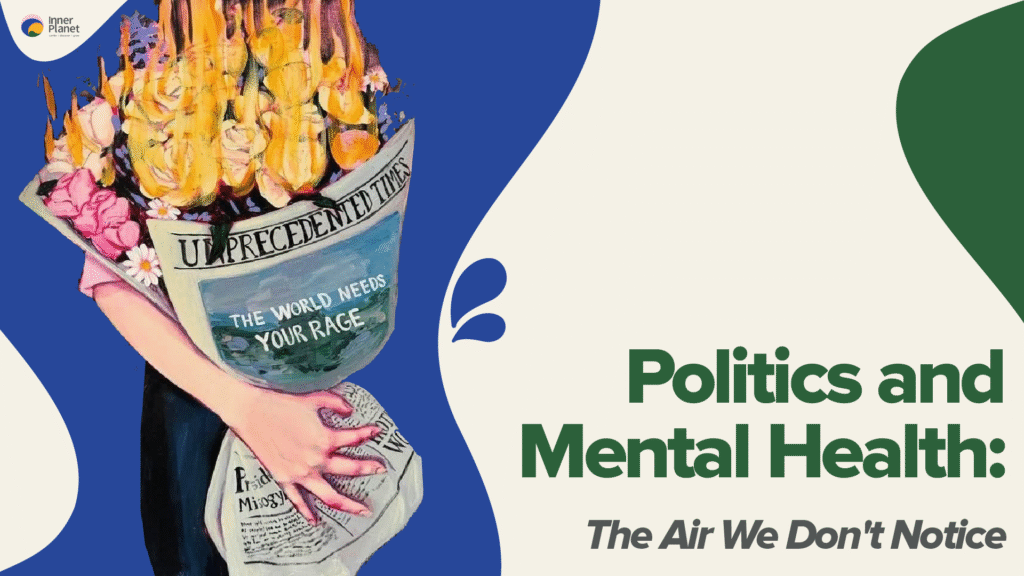
We can be tired in a way that sleep hasn’t touched, short with people we like, and not once will the word “politics” flash through our mind as the cause.
Politics is usually considered as background noise that really has nothing to do with us. As something boring that happens somewhere far removed from the reality of our lives.
But it’s not as remote as we tend to think.
The grimy tendrils of this sphere are bound to affect us in unpredictable and often unnoticed ways.
So let’s check out some ways that politics affect our mental health.
Politics and Sleep
Politics can impact our sleep. And it’s not limited to major events that include spontaneous and tragic violence.
On the night after the Brexit referendum result, British users of a sleep-tracking app slept measurably less than the rest of the region around them. The same thing happened in the United States on the night after the 2016 election (Anýž et al., 2019). In the US, the proportion of people sleeping between four and six hours rose from roughly a fifth to more than a third, while the proportion getting a full eight to ten hours nearly halved (Anýž et al., 2019).
That’s nearly one American in five who slept badly that night and wouldn’t have otherwise. The kind of night you’re still paying for two days later, at work, and with anyone who needs something from you.
Politics at the Family Table
Most families have an uncle who throws around their unsolicited opinions about the election before the starters arrive, and a set of cousins who have got very good at changing the subject to cricket.
Thanksgiving dinners in the US attended by people from opposing-party neighbourhoods ran thirty to fifty minutes shorter than dinners where everyone came from the same side. Across the country, the shortfall added up to an estimated 34 million hours of cross-party conversation that didn’t happen (Chen & Rohla, 2018).
And that’s fair, people that aren’t comfortable with their differences won’t go out of their way to communicate.
Both sides were protecting themselves. They just chose different exits.
A Country’s Mental Health, Measured
Around 40% of American adults consistently name politics as a significant source of stress, and that figure barely moved across four years and a change of administration. It behaves like a steady weight rather than a reaction to any single result (Smith, 2022).
The weight falls more heavily on the young, the politically interested, the politically involved and those on the political left (Smith, 2022).
After the Brexit referendum, psychological distress rose across a long-running survey of nearly 88,000 people in the UK, and there was no sign of it fading in the years that followed (Jeffery et al., 2026).
A country is its people, and politics is something that has the power to impact people collectively with long lasting effects.
When Politics Names You
Circumstances can change but some disadvantages are aimed directly at a certain section of society, usually minorities.
Across 31 American states, days of poor mental health tracked how exclusionary a state’s immigration policies were, and the link was significantly stronger for Latinos than for everyone else (Hatzenbuehler et al., 2017). What predicted the harm was policy aimed at a particular group (Hatzenbuehler et al., 2017).
The Indian evidence finds two different things at once. Across six large Indian states, both Muslims and Scheduled Castes reported worse mental health than higher-caste Hindus (Gupta & Coffey, 2020).
Two kinds of disadvantage, arriving at the same place by different roads. One travels through what a household has, and money can improve it, as was seen for Scheduled Castes. The other doesn’t travel that way, and money can’t improve it, as was seen for Muslims. Most policy debates about mental health assume everyone is on the first road.
Something other than poverty is acting on those numbers. Part of it is how secure belonging feels from the inside.
Where It Reaches the Body
In the nine months after the 2016 US election, preterm births to Latina women in the United States — babies born several weeks early — rose above what nearly eight years of prior trends predicted, and above what was happening to every other group in the same period. The rise was detectable from the late summer of 2016, months before anyone voted, and it didn’t fade (Gemmill et al., 2019).
The scale here is unusual. It covers nearly 33 million births, builds its expected figure from almost eight years of prior data, and every other woman in the country sits inside the same model, as the comparison. The excess among Latina women is already net of whatever was happening to everyone else (Gemmill et al., 2019).
Politics is like the scenery in which our lives play out. But just because it is in the background doesn’t mean we’re impervious to it.
Politics affects us all, and especially the targeted minorities. It impacts our sleep, our family interactions, even our emotions to some extent, and especially our mental health.
We don’t really think about the air we breathe, or its various components, until it’s taken away from us. Politics’ impact on mental health is like that.
If you need help discovering how politics has impacted your life, or are part of a minority that is politically targeted, talking with a professional can prove most helpful!
References
- Anýž, J., Bakštein, E., Dudysová, D., Veldová, K., Kliková, M., Fárková, E., Kopřivová, J., & Španiel, F. (2019). No wink of sleep: Population sleep characteristics in response to the Brexit poll and the 2016 U.S. presidential election. Social Science & Medicine, 222, 112–121. https://doi.org/10.1016/j.socscimed.2018.12.024
- Chen, M. K., & Rohla, R. (2018). The effect of partisanship and political advertising on close family ties. Science, 360(6392), 1020–1024. https://doi.org/10.1126/science.aaq1433
- Degerman, D. (2019). Brexit anxiety: A case study in the medicalization of dissent. Critical Review of International Social and Political Philosophy, 22(7), 823–840. https://doi.org/10.1080/13698230.2018.1438334
- Fenn, N., Sacco, A., Monahan, K., Robbins, M., & Pearson-Merkowitz, S. (2024). Examining the relationship between civic engagement and mental health in young adults: A systematic review of the literature. Journal of Youth Studies, 27(4), 558–587. https://doi.org/10.1080/13676261.2022.2156779
- Gemmill, A., Catalano, R., Casey, J. A., Karasek, D., Alcalá, H. E., Elser, H., & Torres, J. M. (2019). Association of preterm births among US Latina women with the 2016 presidential election. JAMA Network Open, 2(7), Article e197084. https://doi.org/10.1001/jamanetworkopen.2019.7084
- Gupta, A., & Coffey, D. (2020). Caste, religion, and mental health in India. Population Research and Policy Review, 39(6), 1119–1141. https://doi.org/10.1007/s11113-020-09585-9
- Hatzenbuehler, M. L., Prins, S. J., Flake, M., Philbin, M., Frazer, M. S., Hagen, D., & Hirsch, J. (2017). Immigration policies and mental health morbidity among Latinos: A state-level analysis. Social Science & Medicine, 174, 169–178. https://doi.org/10.1016/j.socscimed.2016.11.040
- Jeffery, A., Gascoigne, C., Rotous, I., Yu, X., Geneletti, S., Baio, G., Blangiardo, M., & Kirkbride, J. B. (2026). Impact of 15 years of social, political and economic shocks on population mental health in the UK: A longitudinal, Bayesian quasi-experimental analysis. BMJ Mental Health. https://www.scienceopen.com/document?vid=6ca4f6a7-93a9-40d6-8981-73284f5dd221
- Simchon, A., Guntuku, S. C., Simhon, R., Ungar, L. H., Hassin, R. R., & Gilead, M. (2020). Political depression? A big-data, multimethod investigation of Americans’ emotional response to the Trump presidency. Journal of Experimental Psychology: General, 149(11), 2154–2168. https://doi.org/10.1037/xge0000767
- Smith, K. B. (2022). Politics is making us sick: The negative impact of political engagement on public health during the Trump administration. PLOS ONE, 17(1), Article e0262022. https://doi.org/10.1371/journal.pone.0262022
- Wollburg, C., Steinert, J. I., Reeves, A., & Nye, E. (2023). Do cash transfers alleviate common mental disorders in low- and middle-income countries? A systematic review and meta-analysis. PLOS ONE, 18(2), Article e0281283. https://doi.org/10.1371/journal.pone.0281283