

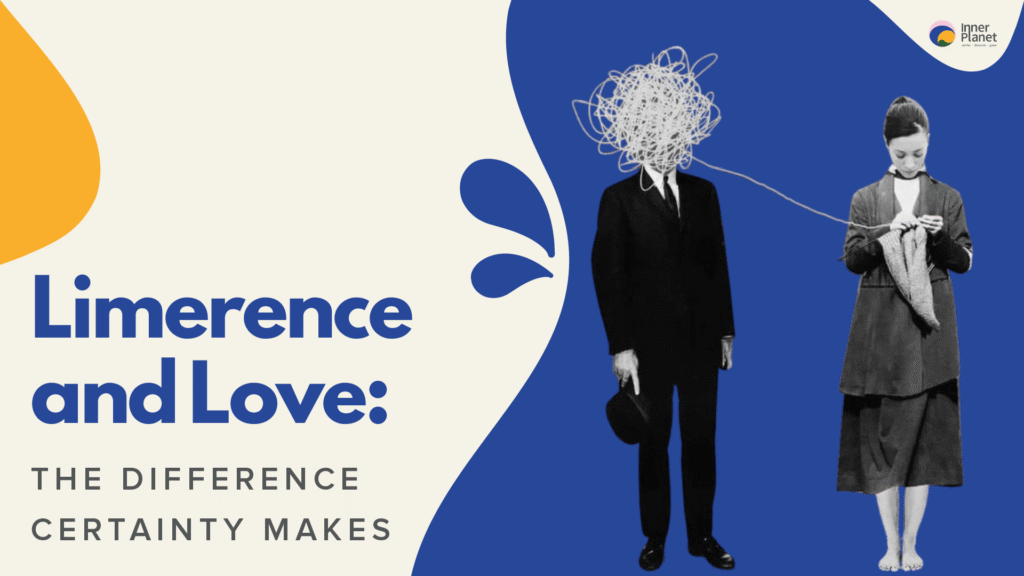
Ever seen a stranger walk by and instantly fallen in love with them?
If that feeling sticks around and increases in intensity there’s a name for the state. It isn’t quite love, though it borrows most of love’s vocabulary. It’s called limerence.
Let’s see what limerence is, why not knowing does so much of its work, and what love does with the same silence.
What Limerence Actually Means
Limerence is an involuntary attraction that organises itself around one person, and around one question: whether they feel it too.
It comes with intrusive thinking — thoughts that turn up without being invited and don’t leave when asked — and a habit of treating every small piece of evidence connected with them as some sort of verdict: maybe that smile means they love me, maybe the way they didn’t look up means they hate me.
The word comes from the psychologist Dorothy Tennov, who named and studied this particular kind of wanting in the 1970s.
It’s fair to say the word gets over-applied now. A good deal of what gets called limerence online is just an ordinary crush wearing a clinical-sounding coat. The version worth talking about is the one that outlasts its own usefulness — the attraction still running long after it has stopped being an innocent attraction.
Why Limerence Feels So Intense
The engine is the uncertainty.
The same three sentences from them can produce two entirely different afternoons depending on when the reply arrives. A swift reply, and you’re generous, unhurried, good company to everyone around you. A (perceived) delayed response, and you’ve rebuilt the whole message from memory looking for the exact place where you got it wrong.
Nothing about the other person changed in between. The only thing that moved was how long you had to sit without knowing.
Which is also why the question so often goes unasked. There’s a strange loyalty in it — we protect the uncertainty, because the uncertainty is where the possibility still lives.
Limerence doesn’t always stop with certainty. It can survive a clear yes and a clear no.
It can attach itself to somebody you know perfectly well and don’t particularly like, which is one of the more disorienting versions of it and one of the loneliest to be inside. Uncertainty is the usual fuel but it isn’t the only one.
There’s a second thing that works more quietly.
The Person Limerence Builds
You don’t know how they feel. You also don’t know who they are.
You know their laugh. You know the way they say your name, which songs they’ve had on repeat, and the three stories they tell well because they’ve told them before.
But, you don’t know how they are when they’re tired, or bored, or wrong about something and unwilling to say so. You don’t know what they’re like on the fourth day of something going badly.
Gaps in information like these don’t stay empty. They get filled in, generously, and largely by us — furnished beautifully, room by room, by somebody who has never been inside.
Nobody is lying to you here. This isn’t a story about a deceiver and somebody taken in. There’s simply very little to go on, and what you’re feeling so strongly is partly your own good work.
It can be a strange thing to be on the other end of, too. Being loved for a perfect version of yourself you didn’t write is flattering for about a week, and after that it starts to feel like being spoken to through a wall.
Limerence Is Not A Character Flaw
This is one of the more extraordinary things a nervous system does.
People write novels about limerence. They write songs about it, and letters they never send, and some of the best of what human beings have made came out of exactly this state.
Far fewer of them get written about an ordinary companionable Tuesday evening, and that lack underlines what the feeling of limerence is worth to the people who have it.
So a person who spends a few years of their life chasing that is making a choice any reasonable adult can make. Plenty of them, asked later, would take it again — not because they failed to learn anything, but because they weighed it up and decided that feeling that much was worth what it cost. That’s a fair position about how to spend a life, and it deserves to be treated as one.
Limerence often carries information too, about what you’re drawn to, what you’ve been going without, occasionally what you’re steering around. Some long and sturdy relationships began right here.
What Love Does With The Same Silence
Love gets the answer and stays anyway.
That’s the difference, and it’s less flattering than it sounds at first. Love has the information — the tiredness, the boredom, the wrongness not admitted to. It has seen the fourth day of something going badly. It knows how the person is about money, and about their mother, and about being interrupted.
And it stays, not because none of that registered, but because it registered and the person on the other side of it was still somebody you wanted.
Staying isn’t automatically the same thing as love. Some people stay because leaving feels unavailable to them, which is a different situation entirely.
What love offers in exchange is the thing limerence can’t: being known and not managed. Saying the wrong thing at dinner and not spending the drive home auditing it.
Which means love also survives being answered. Limerence needs a live question; she loves me? she loves me not?
Love works out what to do on an ordinary Wednesday when there’s no question at all, only logistics and somebody in the next room.
The other thing worth knowing is that limerence has a duration. It ends. Sometimes it’s answered and sometimes it simply wears out, and the ending is usually far less dramatic than the middle was — a slow noticing that you haven’t checked your phone in a while. If you’re in the thick of it now, that’s probably the least romantic and most useful bit of information.
When The Difference Starts To Matter
Where’s the line between interesting distinction and hurtful reality?
You cancel on a friend, because the reply hasn’t come and you can’t hold your face together for an evening. Once is nothing. It’s the third one that matters, and the friend on the other end who has stopped suggesting hangouts.
Then the wider erosion, which is harder to see from inside: sleep going, attention going, a whole day’s mood decided by a notification that may or may not arrive. It isn’t obviously a crisis, just a life quietly reorganising itself around one person’s availability.
And it doesn’t only happen to people who are free to feel it. Limerence turns up inside settled relationships, directed at somebody who isn’t the partner. It can also turn up as grief. Somebody notices they no longer feel it towards the person they chose, and has no idea what to do with that.
Neither of those automatically means the relationship is wrong, or that the feeling is. It means something is asking to be understood, and that’s hard to do alone. But you don’t have to.
It’s not a battle between limerence and love. They’re different experiences and they manifest differently as well. Limerence can settle into love, love can thin down into limerence, or they can be separate phenomena.
You aren’t crazy for feeling limerence, but it’s good to know the quality of one’s feelings to help make meaningful decisions.
If you need help discovering what sits underneath your limerence, we’re always just a call away!