

Tuesday, mid-morning. A blurry generic meeting, a random spreadsheet on the screen, somebody mumbling about next quarter. Under the table your hands have automatically become fists, and your jaw has been subconsciously clenched since you sat down.
Three weeks ago you accepted it. You said the sentence out loud to the people who needed to hear it, you cancelled what had to be cancelled, you made the calls. On paper it is done. The week has resumed and nobody is asking you about it any more.
The mind genuinely experienced acceptance, but the body has carried on as though the argument were still running.
These two distress tolerance skills are for that gap, once your mind has reached acceptance but your body lags behind. Let’s look at how your face and hands can smoothen your path to acceptance, what to do about the thoughts that keep coming back, and why watching a thought is not the same as agreeing with it.
1. Your Body Talks to Your Brain
Start by relaxing your face, working down from the top of your head to your chin and jaw. Forehead. Eyes and brows. Cheeks, mouth, tongue, teeth slightly apart. If a muscle will not loosen, tense it deliberately first and then let it go.
Then let both corners of your lips rise slightly, only far enough that you can feel them. Nobody else needs to see it. What you are aiming for is a neutral face rather than forcing a smile.
Your face communicates to your brain, and your body connects to your mind.
A lot of us have been told to “fix” our face for somebody else’s comfort, and this can sound like more of the same, but it isn’t. This skill manages an emotion and helps take the next step towards processing it and reaching acceptance.
Your hands can also help you do the same job.
Willing Hands, Palms Turned Up
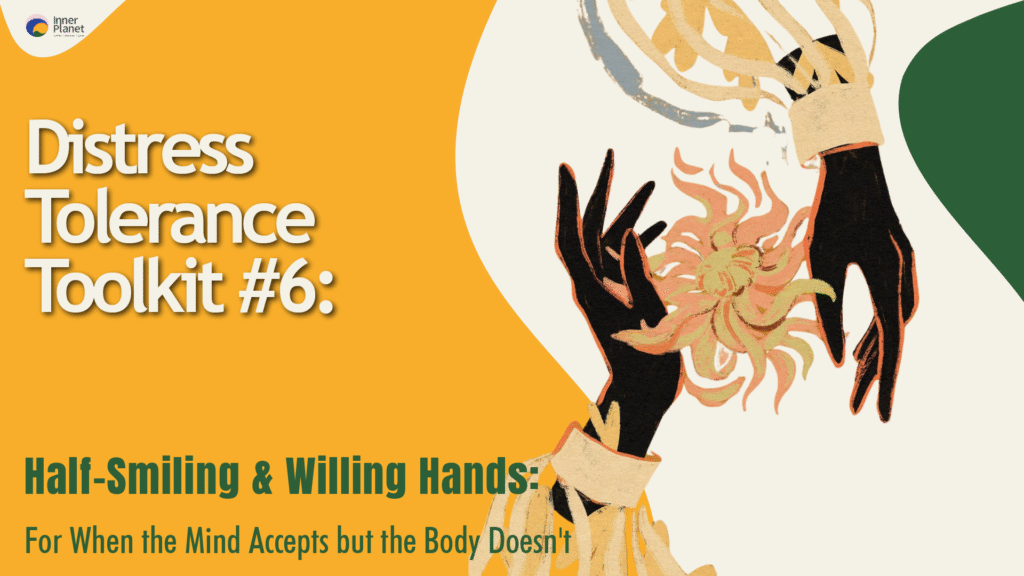
Unclench your hands and turn them outward, palms up, thumbs out to your sides, fingers relaxed. It works standing, with your arms dropped from your shoulders; sitting, with your hands on your lap or your thighs; or lying down, with your arms by your side.
The lying-down version is worth investing in at least once. Flat on the floor or on a bed without a pillow, legs slightly apart, letting go of every muscle as though it were sinking through the floor, or as soft and yielding as a piece of silk hanging in the breeze to dry. Think of a cat stretched out in front of a warm fire. Fifteen breaths, with your attention on each one.
Your hands communicate to your brain in the same direction your face does. A closed fist is the posture of refusal, and acceptance in the form of willingness has a shape you can take up even before you feel willing.
Practise It Before You Need It
Half-smile when you first wake up, before you get out of bed. Three gentle breaths, following each one. Maybe write the word “smile” somewhere you’ll be able to see when you wake up to help you remember.
Half-smile the moment you notice you are irritated. The instant the thought I am irritated turns up, half-smile or open your hands, and take three quiet breaths before you decide anything at all.
Bring to mind the thing you cannot even tolerate yet. Hold it there, deliberately, and half-smile with your hands open while you think about it. This makes the practice different from a simple relaxation technique and turns it into an acceptance skill: you are not calming yourself down instead of facing the fact, you are facing it in a body that is not braced against it.
Some days you may sit there with your palms up and your lips slightly turned and feel faintly ridiculous, and nothing will shift, you won’t feel any acceptance. But you’ll notice a difference if you practise it daily for a week, on the calm days as much as the difficult ones.
2. What the Thought Keeps You From
The second skill deals with thoughts, and it opens with a question about the body.
When a thought will not leave you alone, ask what sensations that thought is trying to avoid.
Then turn your mind to the sensation itself.
Then come back to the thought.
Repeat this movement several times. While you’re doing this, consciously relax your face and your body while reminding yourself that a thought is only a thought, a sensation of the brain.
From there, observe. Thoughts arrive and leave like waves. Acknowledge that a thought is present without suppressing it, judging it, analysing it, or keeping it around longer than it wants to stay. Or picture your thoughts as boats going down a river, and yourself sitting on the grass watching them pass. You don’t have to climb into the boat. Or jump between boats. Leave that part to Tom Cruise in his films.
State the thought neutrally, in a gentle voice: “the thought that I have ruined this arose in my mind”.
Then get curious about it. Ask where the thought came from and watch to see what turns up. Notice that every thought which comes also goes.
Watching Is Not the Same as Believing
Step back from your mind as though you were on top of a mountain and your mind were a boulder down below. Gaze at it. Watch which thoughts come up while you are watching. Then come back into your mind before you stop.
For some people this can be an instinctive trauma response. That’s why the coming back part of the skills is centrally important, not an afterthought.
You do not have to act on a thought. Remember the times you have held very different ones, and how you think when you are not in this much pain. Catastrophic thinking is the emotion mind — the state where feeling rather than judgement is making the decisions.
That is not the same as saying your thoughts are wrong. Not everything that circles at three in the morning is distortion. Some of it circles because it is true and has not been dealt with yet, and the loudness is doing its job. Watching a thought is a position you take towards it, not a verdict imposed on it.
Don’t Block a Thought, Play With It
Blocking is the one move this skill rules out.
What it offers instead is deliberate silliness. Say the thought out loud, over and over, as fast as you can, until the words stop making sense. Say it in a voice that is not yours, a cartoon character or a film star. Say it as a line of dialogue in a comedy: “you will never believe what went through my mind just now.” Sing it, wholeheartedly and badly.
This won’t work for some kinds of thoughts. This will be different for different people. Being asked to put the worst sentence in your life into a cartoon voice can feel like mockery of the one thing you cannot bear to have mocked. What is being played with is the sentence, not what the sentence is about, and those are genuinely two different objects. But if that distinction will not hold for you tonight, the skill instead asks that you say it very slowly — one word to a breath — or simply naming the thought as a thought and leaving it there.
Once you become comfortable with this, another helpful addition to the skill can be made. Imagine what you would do if you stopped believing everything you think, and then rehearse doing those things.
And the last instruction here: try loving your thoughts. Not just for their content or their quality, simply for the privilege of it.
The silliness works because it changes what the sentence has over you without requiring you to prove it false.
Acceptance can be elusive. It can be here and suddenly disappear for a while.
We can try our best to create space for acceptance in our life, in our minds and bodies.
Once the space is made, acceptance will appear there as if it was always there.
Next Tuesday, same room, same spreadsheet, somebody still talking about next quarter. At some point in the hour your hands open on your lap, and not one person at the table may notice. But you will!
The journey from distress tolerance towards acceptance can be long and confusing. If you need help on that journey, we’re always just a call away!