

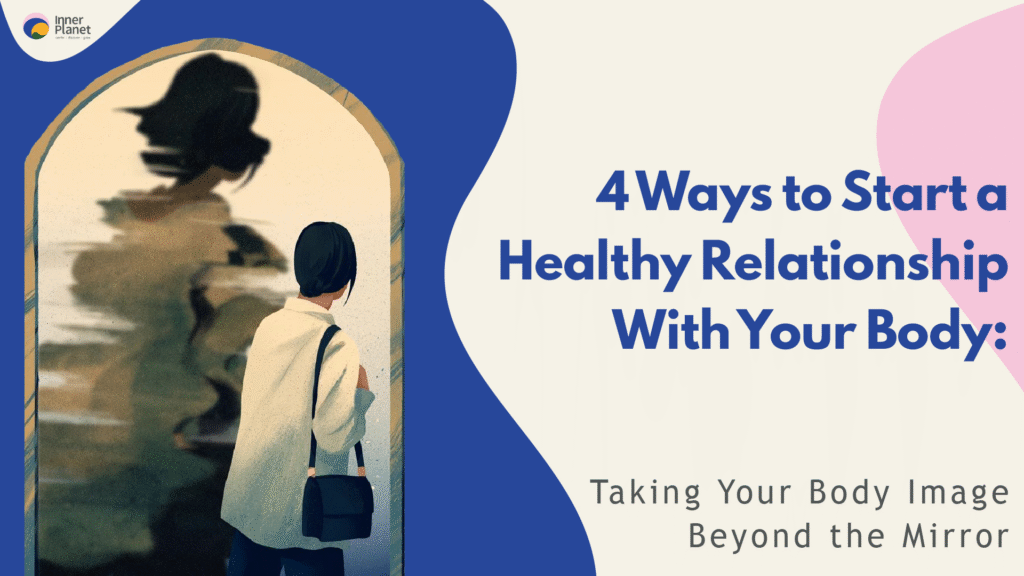
We all know that instinct after a group photo where we want to verify that none of our bad angles were captured. The bad angles at this point seem infinite, and always at the cusp of being captured.
Body image, the picture we carry of our own body and how we feel about it, is usually built from the outside in.
Below, we look at where that checking habit comes from, what your body is doing while you’re busy judging it, why appearance still counts, and how to build a healthier relationship with your body, including when it helps to get support.
How We Learnt to Judge Our Bodies
“You’ve put on a little, haan?” at a cousin’s wedding. A neighbour suggesting a remedy for your complexion. The boy told to eat more ghee because he’s too thin. The man quietly checking how much hairline he has left. A marriage biodata that asks for height and skin tone.
Add the selfie camera and an endless scroll of faces and bodies, and yours can start to feel like it’s lagging behind. For some, the pressure to look like they practically live at the gym tips all the way into looksmaxxing.
Over time, the comments move inside. You become your own relative at the wedding. That quiet insecurity follows you into photos, fitting rooms and family gatherings long after anyone has said a word.
The cost is easy to miss, because it’s paid in seemingly small moments. Sucking your stomach in for the family photo. Sitting out the pool party because of the swimsuit. Standing at the edge of the dance floor, half in the music and half watching yourself from across the room. Each appears small. But added up, it’s a lot of life spent as your own critic.
And all the while, your body is getting on with a great deal we rarely give it credit for.
What Your Body Does Without Asking
The Work You Never See
Right now, without a single instruction from you, your body is breathing, blinking and managing your temperature. If you nicked your finger chopping onions this morning, it has already started repairing the skin. It digested your lunch through an entire boring meeting.
It keeps this up through bad nights, rushed meals and weeks when you barely give it a thought.
The Life It Makes Possible
It also learns. Fingers that fumbled through their first guitar chords grow calluses and find the frets on their own. A cycle you haven’t ridden in fifteen years makes sense the moment you get on. Hands that have rolled rotis for decades know the dough without measuring a thing.
And it lets you live. It’s how you laugh until your stomach hurts, or taste the first sip of chai on a cold morning. For some, it’s the body that learns to swim at forty. For others, it’s the body that came through an illness and is still here.
None of that shows up in a photo, and it’s a far bigger part of the story.
That doesn’t mean looks stop mattering, though, and it would be dishonest to pretend otherwise.
Yes, Appearance Still Matters
How we look shapes how we’re treated. It plays a part in first impressions at interviews, in dating, and in the remarks families make long before anyone asks how you’re feeling. Telling people to simply stop caring ignores the world they actually live in.
Some of that pressure is plainly unfair, and it doesn’t disappear because you’ve made peace with your reflection. Colourism, weight bias at work and narrow ideas of who looks “presentable” are real.
There’s pleasure in it too. Choosing an outfit you love, finally getting a haircut that works, dressing up for Eid or Diwali. These are joys in their own right, and often a way of looking after yourself.
So caring how you look sits comfortably alongside a healthy body image. The trouble begins at a more specific point, when a preference turns into a demand.
“I’d like to look my best at my sister’s wedding” is a preference. It leaves room to be a little disappointed and still be okay. “I must look a certain way, or I’m not good enough” is a demand. It ties your worth to a mirror.
Wanting to change your body doesn’t mean you’ve failed at making peace with it. The same gym session can come from care or from contempt. What matters is whether you’re working with your body or punishing it for not being good enough yet.
You can’t always control how others judge you. What you can work on is how much their judgement gets to say about your worth.
And once worth stops hanging on looks, it’s tempting to hang it on performance instead.
Learning to Listen to Your Body
Swapping “How do I look?” for “What can I do?” helps, up to a point. Bodies get ill. They age, carry pain, change after pregnancy, live with disability, or simply have hard seasons. If your body’s value depends on what it can do, some days it will fail that test too.
Even the well-meant fix can become a test. “Love your body” sounds kind, but on a hard day it feels like one more exam you’re failing.
The way out is to stop grading altogether. That’s roughly what people mean by body neutrality: respecting and caring for your body without needing to love how it looks or be impressed by what it does. It’s less a feeling and more a working relationship.
Like any relationship, it runs on listening, and your body talks to you all day.
Hunger arrives. Tiredness gathers behind your eyes by late afternoon. Your shoulders creep towards your ears in the hour before a deadline. A knot forms in your stomach before a difficult conversation, sometimes before you’ve admitted to yourself that you’re dreading it.
Feelings often show up in the body before we’ve put words to them.
Many of us have learnt to override all of this. We skip lunch to finish one more task, push through exhaustion because resting feels lazy, and ignore hunger to “be good”. Over time, the signals get harder to hear.
Listening isn’t the same as obeying, though. Bodies sound false alarms. A racing heart during a panic attack feels like danger when there isn’t any. Pain can keep signalling long after an injury has healed. A craving at midnight might be about the day you’ve had. The skill is noticing the signal and getting curious about it, without ignoring it or taking every one at face value.
Finding that middle ground takes practice, especially after years of criticism.
Building a Healthy Relationship With Your Body
1. Mind the Mirror Talk
Notice the commentary that starts when you pass a mirror or open a photo. You don’t have to replace it with praise. You can start by simply refusing to add to it.
Try describing instead of judging: “my arms look soft in this” rather than “I look awful”.
When relatives offer their views, a light “I’m happy as I am. How’s the new house coming along?” usually moves things on. And if certain social media accounts leave you feeling worse every time you scroll, consider muting them.
2. Notice What It Did Today
Once a day, pick one specific thing your body did. It carried the groceries up three floors. It got you through a twelve-hour shift. It fought off a cold, or laughed at a terrible joke.
Keep it factual, like a record rather than a compliment.
3. Answer (Not Blindly Obey) Its Signals
When you’re hungry, eat. When you’re tired, rest, without first deciding whether you’ve earned it. When your shoulders are up near your ears, let them drop and ask yourself what’s worrying you.
On days when rest isn’t possible, with a newborn, a night shift or an exam week, simply noticing that you’re overriding a signal still counts. It keeps the line open.
Small responses, made often, are how trust gets rebuilt.
4. Move for the Joy of It
Choose movement you’d happily do even if it changed nothing about how you look. A walk with a friend, dancing in the kitchen, stretching while the chai brews, a swim.
For some bodies, joyful movement is slow and gentle, and that counts fully. Exercise used as punishment for a meal tends to strain the relationship, however fit it makes you feel initially.
For some people, though, the struggle runs deeper than habit, and small steps aren’t enough on their own.
When Body Image Affects Mental Health
Most of us have days when we don’t like what we see. It becomes something more when it starts shaping your entire life.
You might be avoiding photos, events or intimacy. You might check mirrors again and again, or avoid them entirely. Your eating might have changed because of how you feel about your body rather than because of hunger. For some, after psychological trauma, the body itself can start to feel unsafe or unfamiliar.
Sometimes this points to body dysmorphia, a preoccupation with flaws that others barely notice or can’t see at all. It can also sit alongside anxiety, low mood or other mental health concerns.
None of this is vanity. Speaking to a mental health professional is ordinary mental health care. If you recognise yourself here, it’s okay to need help, and to ask for it.
We’re bound to care about how we look. But we don’t have to stop at that basic good-bad distinction.
A healthy relationship with our body — a companion that is, after all, with us from birth till death — can prove most satisfying. Like always being around a trusted friend.
But just like any relationship with a trusted friend, it needs patience, compassion, and curiosity.
And if the mirror’s been doing most of the talking lately, we’re always just a call away!