

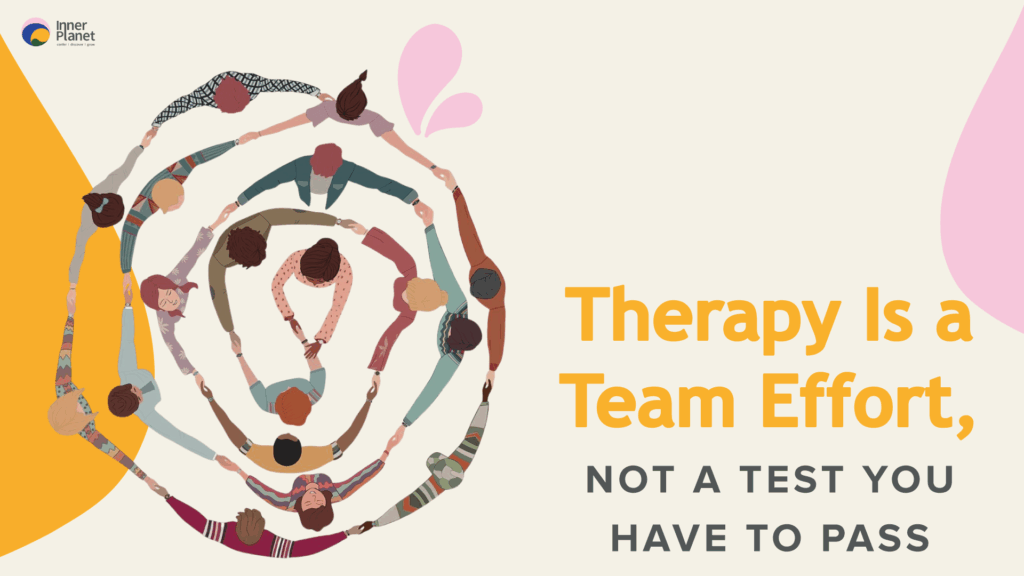
Walking into therapy for the first time can feel… strangely high-pressure.
Even if you’re hopeful.
Even if you know you need help.
Even if you’ve wanted to start for a long time.
A part of you might still be wondering:
What if I don’t say the right thing?
What if I cry too much?
What if I don’t know where to begin?
What if therapy is too much to handle?
If you’ve felt this way, you’re not alone.
Many first-time clients secretly approach therapy like it’s a test they need to pass — as though they have to perform their pain correctly or prove that they’re “doing it right.”
But therapy isn’t an exam.
It’s a team effort.
Let’s talk about why therapy can feel intimidating at first, why you don’t need to be the “perfect client,” what your therapist actually expects, and how you can begin gently without overwhelming yourself.
Why Therapy Feels Intimidating at First
Starting therapy is a little like walking into a new country without a map.
You don’t know the rules yet.
You don’t know what’s expected.
And you don’t know how it’s going to feel once you start speaking.
So it makes complete sense that you’re feeling scared of therapy.
The mind tries to cope by creating structure. It says:
I should be clear.
I should have a goal.
I should know what to talk about.
I should get better quickly.
That pressure is not a sign you’re unfit for therapy.
It’s often just the nervousness of doing something deeply new — and deeply vulnerable.
The Myth of the ‘Perfect Client’
A lot of people arrive at therapy believing they need to show up in a certain way.
They think they must:
- explain everything neatly
- have the “main issue” figured out
- speak confidently
- be emotionally contained
- make steady progress
But the truth is: there is no such thing as a perfect client.
Therapy is not a space where you are graded on clarity.
There is a safe space in therapy where you are allowed to be human.
Messy, unsure, overwhelmed, confused — all of that is welcome here.
You don’t have to arrive as a finished story.
You can arrive with many question marks.
Therapy Is More Like Physiotherapy
Here’s a metaphor that helps many nervous about therapy relax:
Therapy is much more like physiotherapy than an interview.
If you injured your knee, you wouldn’t be expected to describe the pain with perfect vocabulary.
You wouldn’t need to prove that you deserve support.
You’d simply go in, say, “Something hurts,” and the professional would help you understand what’s going on.
Step by step.
Therapy works in a similar way.
You bring what you can.
Your therapist helps you find the next step.
You’re not doing it alone.
Your Therapist Isn’t Judging You
One of the quietest fears first-timers carry is this:
What if my therapist thinks I’m overreacting?
What if they think my problems aren’t serious?
What if they judge me for feeling this way?
But therapy is not a courtroom.
It’s not a performance review.
A professional therapist is not listening to evaluate you — they are listening to understand you.
Their job is not to decide whether your pain is valid.
Their job is to support and guide as you unfold your pain.
Many people come into therapy carrying shame, self-doubt, and years of self-criticism.
Therapy is often the first space where you don’t have to defend your emotions.
You Don’t Need the Right Words
Some people worry they won’t be able to “express themselves properly.”
They’ll say things like:
- “I don’t even know what I’m feeling.”
- “I don’t know where to start.”
- “I’m scared I’ll just ramble.”
You can take a breath because you don’t need the right words.
That’s part of what the therapist helps with.
Silence is allowed.
Tears are allowed.
Confusion is allowed.
Sometimes the most honest sentence in therapy is:
“I don’t know how to talk about this.”
That is a beginning.
Progress Isn’t Always a Breakthrough
Another common fear is:
What if I don’t improve fast enough?
In movies, therapy looks like dramatic realisations.
In real life, progress is often more subtle.
Sometimes therapy looks like:
- noticing a pattern for the first time
- feeling slightly less alone
- understanding why you react the way you do
- learning how to pause instead of spiral
- building emotional steadiness slowly
Healing is rarely linear.
Therapy is not about quick fixes.
It’s about lasting shifts.
What You Bring Is Already Enough
You don’t need to feel ready.
You don’t need to feel confident.
You don’t need a perfectly articulated life problem.
You only need a small willingness to begin. The courage to start.
Even if all you can say is:
“I feel overwhelmed.”
“I don’t know what’s wrong.”
“I just don’t want to feel this way anymore.”
That is enough.
Therapy meets you where you are, not where you think you should be.
How to Start Without Overwhelm
If therapy feels like a lot, here are a few gentle truths:
You don’t have to tell your whole life story in the first session.
You can start with one thread.
One moment.
One feeling.
You can also ask questions like:
- “How does this process usually work?”
- “What happens in a first session?”
- “Can we go slowly?”
Therapeutic spaces are not meant to pressure you.
Professional therapy is paced according to your needs.
It’s collaborative and respectful.
And you are allowed to take your time.
The most important thing to remember is this:
Therapy is not something you have to pass.
It is something you get to participate in.
A team effort between you and a professional therapist.
You bring your experiences.
Your therapist brings training, perspective, and emotional skill.
And together, you build something steadier than what you could build alone.
If you are someone seeking mental health care for the first time — feeling hopeful but overwhelmed — therapy is not too much.
You do not have to do it perfectly.
You only have to begin.
And if you need help taking that first step, we’re always just a call away!