

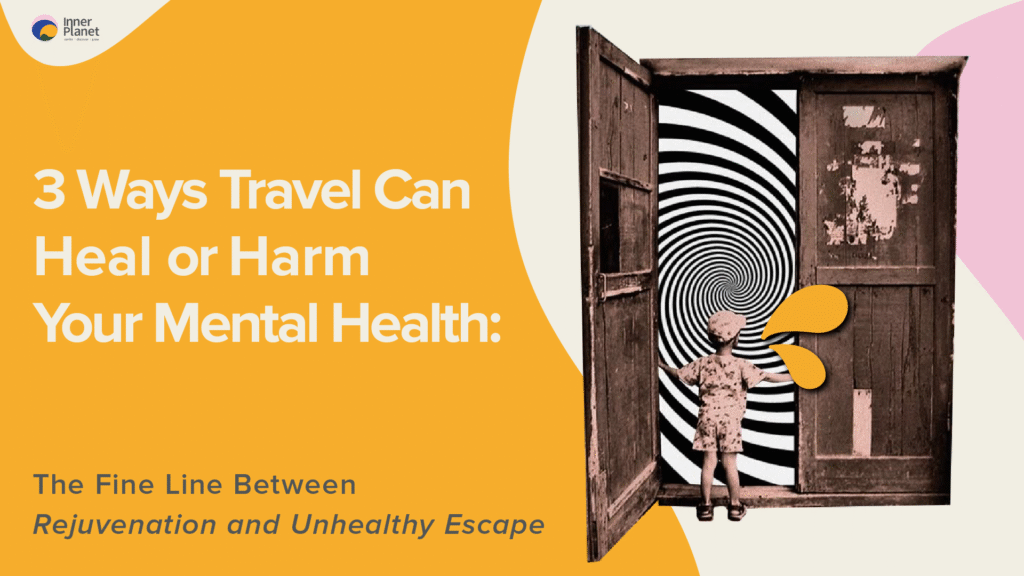
“Maybe I just need to get away.”
It is a thought many of us have when our own life starts to feel suffocating. Work is spilling over. Relationships feel tense. The same rooms, routines and responsibilities begin to feel heavier than usual. At such times, travel can feel like relief before the trip has even begun.
And sometimes, getting away really does help. A change of place can give the mind space to breathe. But travel is not automatically healing. Sometimes it becomes rest. Sometimes it becomes the scenic route to postponing what needs attention.
So let’s look at three ways travel can support mental health, and three ways it can quietly work against it: space versus disappearance, newness versus pressure, and connection versus loneliness.
Travel Is Not One Thing
Travel does not always mean an international holiday or a perfectly planned break. It may be a train ride to another city, a weekend with family, a pilgrimage, a work trip, or simply a day spent outside your usual environment.
It also does not affect everyone in the same way.
A beach holiday may feel peaceful to one person and overstimulating to another. A solo trip may feel freeing for someone and lonely for someone else. A family trip may offer warmth, or it may bring old tensions closer to the surface. All of these feelings and situations can exist simultaneously as well!
So the question is not simply, “Is travel good for mental health?” A better question is: what emotional role is this trip playing in your life?
1. Space or Disappearance?
One of the biggest gifts of travel is space.
When we are stuck in the same environment for too long, we can start thinking in circles. The same desk, commute, arguments and phone habits can make life feel smaller than it is. Travel interrupts that loop.
A different place can help you step out of your usual roles for a while. You are not only an employee, partner, parent, caregiver, problem-solver or responsible adult. You are also a person who can walk without rushing, eat without multitasking, look out of a window, and hear your own thoughts again.
Sometimes travel helps not only because the place is magical, but because it finally gives us permission to stop.
That kind of distance can be healthy. It may not solve the issue, but it can reduce the panic around it. Sometimes a different place helps you realise that the problem is not your whole life. It is one part of your life that has started taking up too much room.
But distance can also become disappearance.
Travel becomes less helpful when we are not resting, but running. If the only time you feel steady is when you are away from your actual life, the trip may be offering escape rather than recovery.
This does not mean you are doing something wrong. Sometimes we reach for distance because we genuinely do not know what else to do with what we are carrying. It is human to want relief. It is human to want a pause.
The concern begins when the pause becomes the only plan.
The clearest clue often appears after the trip ends. It may show up in ordinary moments: the first work email, the first argument, the first evening back in your room. Do you return with more capacity, or do you immediately need to leave again?
2. Newness or Pressure?
Travel can interrupt the dull loop of daily life.
When life becomes too repetitive, we can start moving through it on autopilot. Wake up. Work. Reply. Scroll. Sleep. Repeat. Even pleasure can become scheduled. Even rest can become another thing to manage.
Newness can revitalize that pattern.
While travelling, you may find yourself looking around instead of looking down, eating without rushing, sleeping at a different hour, or having a conversation that is not about work. A different street, unfamiliar food, or a slower morning can bring back curiosity.
A person who has been living on deadlines and errands may suddenly remember that they also like wandering, tasting, asking questions and being surprised.
For someone who has felt emotionally flat or burnt out, this can matter. Travel can offer small moments of liveliness. Not dramatic transformation. Not a complete reinvention. Just a reminder that there are still things to notice, enjoy and feel.
But newness can also become pressure.
Travel is not automatically restful simply because it is called a holiday. Planning, packing, budgets, delays, crowds, heat, unfamiliar food, poor sleep and constant decision-making can all add stress. For someone already anxious or exhausted, being away from familiar routines can feel less like freedom and more like instability.
Then there is the pressure to make the trip “worth it”.
We may feel we must see everything, eat at the right places, take good pictures, look happy, make memories, justify the money, and return with stories. Social media can quietly turn rest into performance. The trip has to look beautiful. It has to feel meaningful. It has to prove that we are living well.
Even rest can become work when we feel we have to make the trip look perfect, feel perfect and prove that we enjoyed it.
So it helps to ask: is this trip giving your mind room, or giving it more tasks? Is it helping you feel steadier, or asking you to keep adjusting, deciding and performing?
A holiday does not have to be impressive to be restorative. Sometimes the most supportive trip is the one with fewer plans, fewer expectations and more permission to simply be.
3. Connection or Loneliness?
Travel can give relationships a different room to exist in.
Partners may step out of the daily script of bills, chores and logistics. Friends may finally have time that is not squeezed between deadlines. Families may remember each other outside minor irritations and expected obligations.
Sometimes travel lets people meet each other without the usual scripts.
Solo travel can also be meaningful. For some people, it builds self-trust. You make decisions, navigate a place, eat alone, rest when you want to, change your mind, and discover that your own company can be enough.
But a different room does not always create a different relationship.
A couple may realise that the conflict has followed them. Friends may discover that they want very different kinds of rest. A family trip may bring old patterns into sharper focus. A solo trip may feel empowering for one person and painfully lonely for another.
A beautiful place does not automatically remove grief, anxiety, insecurity or emotional distance. In fact, sometimes it makes these feelings harder to ignore. When the usual distractions reduce, what is unresolved may become louder.
This does not mean the trip has failed. Sometimes travel hurts because it shows us something true.
It may show us that a relationship needs care. That we are lonelier than we admitted. That we are tired of being the planner, fixer or peacemaker. That we have been surrounded by people, but not felt truly known.
When travel reveals loneliness or conflict, the answer is not always “never travel again”. Sometimes the answer is to pay attention to what becomes visible.
What Are You Travelling From?
Not all escape is unhealthy.
Sometimes the mind does need distance before it can deal with reality. A break, a film, a day out, a weekend away, or a change of place can help us return with more steadiness. A healthy pause gives us enough relief to come back to life with more capacity.
The difficulty begins when escape becomes the only way to feel okay.
Before planning the next escape, it may help to pause for a moment. Are you looking for rest, or are you trying to disappear? Will the trip reduce your stress, or quietly add new pressure? What are you hoping will feel different when you return? And what will still need your attention after you come back?
These questions are not meant to turn every holiday into self-analysis. You are allowed to enjoy travel without making it a therapy exercise.
The point is simply to notice whether travel is helping you return to your life, or helping you avoid it.
Travel Is Not Therapy
Travel can support mental health. It can offer rest, beauty, perspective and moments of insight. It can help us feel more like ourselves, especially when daily life has made us feel cramped or numb.
But travel cannot carry the whole burden of healing.
It cannot have the difficult conversation for us. It cannot grieve what we have not grieved. It cannot repair a relationship we are afraid to look at. It cannot make an unsustainable daily life sustainable on its own.
If the urge to run away keeps returning, it may be worth listening to it more carefully. Not with shame, but with curiosity. What are you trying to get away from? What feels too heavy to return to?
Travel may give you distance from your life for a while. Therapy can help you understand why coming back feels so hard.
Travel can be beautiful for mental health when it gives us rest, perspective and a little more room inside ourselves.
But when leaving becomes the only way to feel okay, it may be worth asking what has become so hard to return to.
The goal is not to stop travelling or analyse every holiday. It is to travel with awareness.
If you need help understanding what you need — not just for a break, but for the life you come back to, we’re always just a call away!